Executive Overview
A high-stakes international cultural dispute has erupted over the planned commercial sale of the Magdala Gospel—an exquisite, highly illustrated 18th-century Ethiopian manuscript currently caught in the crosshairs of the global heritage restitution debate. Listed for sale by the Vienna-based antiquarian firm Antiquariat Inlibris and heavily promoted for display at the Abu Dhabi International Book Fair, the sacred artifact carries a guide price of €250,000 (£214,480)—a sum vastly exceeding standard market values for Ethiopic manuscripts.
The public surfacing of the manuscript has triggered swift and unequivocal pushback. The Ethiopian Heritage Authority formally dispatched a demand letter to the bookseller, insisting on the artifact’s unconditional withdrawal and repatriation. However, the dealership has defended its position, citing legal title continuity and offering the text back at a "preferential price"—a compromise routinely rejected by African restitution advocates.
This controversy is far from an isolated transaction. It unfolds against an accelerating global movement demanding the return of colonial-era African antiquities. As institutions worldwide grapple with the legal, ethical, and historical realities of imperial looting, the fate of the Magdala Gospel serves as a compelling case study of the friction between contemporary commercial art markets, colonial plunder, and national cultural sovereignty.
Detailed Chronology: From Gondar to the Abu Dhabi International Book Fair
Creation and Royal Patronage in Late 18th-Century Ethiopia
Dating to the second half of the 18th century, the Magdala Gospel is a monumental codex measuring approximately 360 x 290 x 100mm. Written entirely in Ge‘ez (ancient Ethiopic), the sacred liturgical language of the Ethiopian Orthodox Church, the manuscript originally formed the second half of a two-volume set containing the four New Testament Gospels. Its counterpart—likely containing the Gospels of Matthew and Mark—now resides in the Bavarian State Library in Germany.
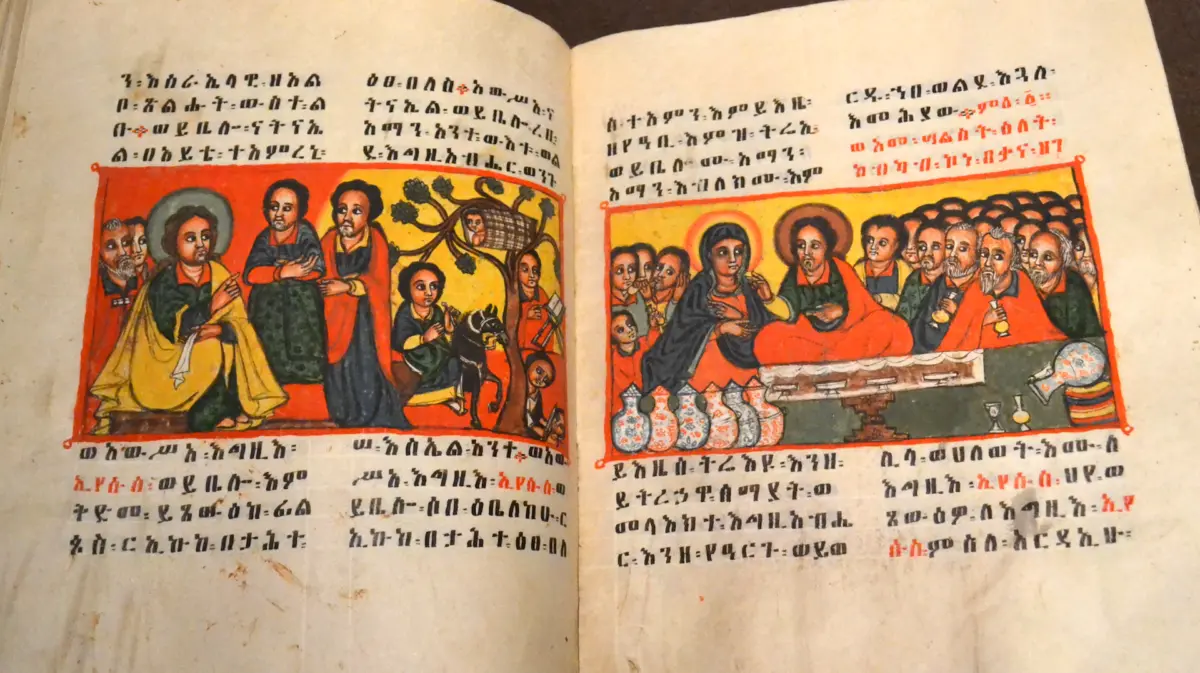
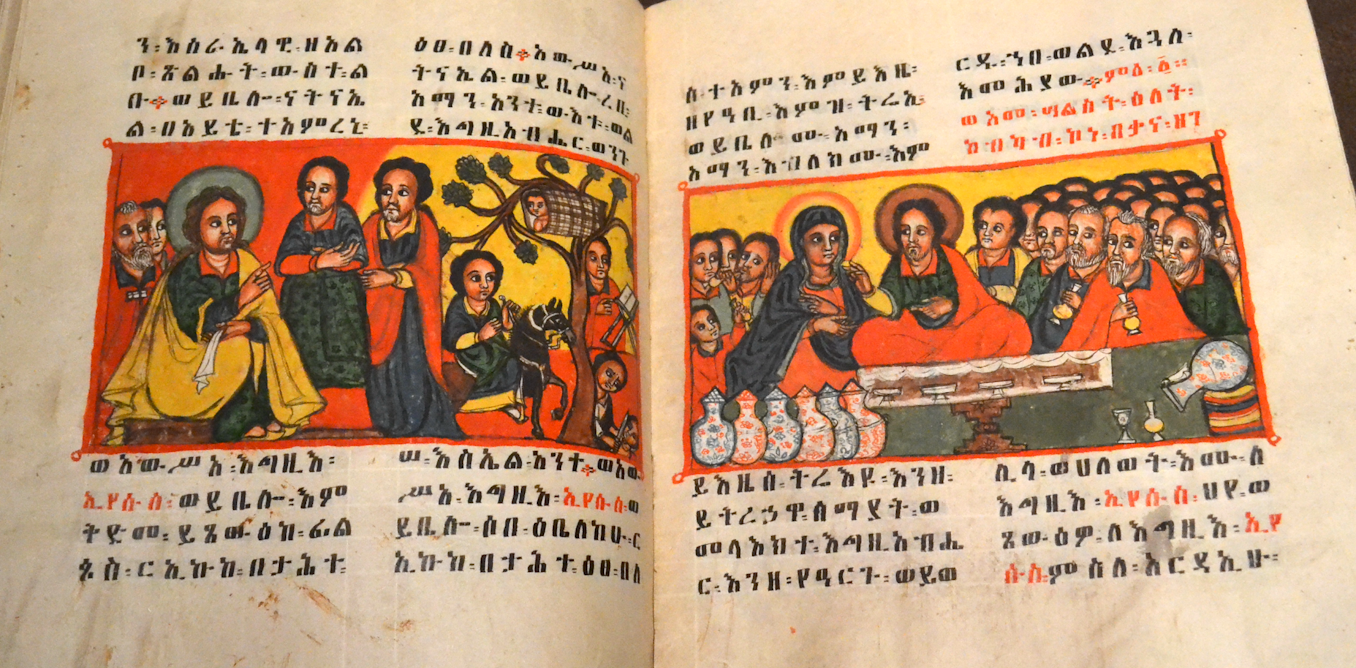
The codex is sumptuously adorned with 235 illuminations depicting scenes from the life, passion, and resurrection of Christ. These illustrations are celebrated by historians for blending traditional iconography with granular, everyday details of the period. Notably, a depiction of the wedding at Cana features a cluster of Qing porcelain vases in the lower-left corner, offering rare visual documentation of global trade networks intersecting with traditional Ethiopian art.
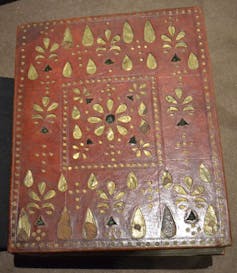
The manuscript’s physical binding is equally exceptional. Both front and back boards are wrapped in openwork red leather, intricately lined with gold foil and velvet. While such opulence points to elite backing, current dealer claims that the text was a direct imperial commission lack concrete archival support. Instead, internal evidence tells a more nuanced story: beneath an illustration of the Trinity, two uncolored, prostrate figures are sketched in a posture of humble supplication. Art historians believe these figures represent the manuscript’s intended donors. The lack of color and unfinished state of these portraits suggest that the patrons may have faced sudden financial or personal distress, leaving the commission permanently incomplete.
The 1868 British Expedition and Imperial Plunder
The manuscript’s journey from a devotional African text to a dislocated European commodity began during the tumultuous reign of Ethiopian Emperor Tewodros II. Between 1864 and 1866, Tewodros centralized power by stripping churches in the historic city of Gondar of their most prized treasures. Among these acquisitions was the Magdala Gospel.
The turning point in the manuscript’s modern provenance occurred in 1868, when a British military expedition led by Sir Robert Napier stormed Tewodros’s mountain stronghold at Magdala (Maqdala) to rescue British hostages. Facing inevitable defeat, Emperor Tewodros died by suicide rather than surrender. In the bloody aftermath, British forces systematically pillaged the royal treasury and local churches, stripping the fortress of countless sacred relics, processional crosses, and manuscripts.
While a small fraction of these items was left behind or later returned, the vast majority were dispersed across public and private collections throughout Europe. Inserted typewritten notes at the front of the Magdala Gospel—attributed to the Reverend John Medows Rodwell—reveal that Commander Robert Napier presented the manuscript to William Robert Seymour Vesey-Fitzgerald, Governor of Bombay from 1867 to 1872, during the Abyssinian campaign. Vesey-Fitzgerald subsequently sold the volume in 1887, initiating a succession of private hands that ultimately led to the modern antiquarian market.
The Modern Marketplace and the Abu Dhabi Flashpoint
In mid-August, Antiquariat Inlibris advertised the Magdala Gospel on its website, setting the stage for its high-profile presentation. When international heritage watchdogs realized the codex was slated for promotion at the Abu Dhabi International Book Fair with a €250,000 price tag, alarm bells rang across the cultural heritage sector. The unprecedented valuation caught the eye of the Ethiopian Heritage Authority, which immediately intervened to halt the sale.

Supporting Context & Metrics: The Scale of Restitution
The standoff over the Magdala Gospel illuminates a much broader structural crisis within the international art and antiquities market. For decades, Western galleries and auction houses have traded in looted African heritage, shielded by legal frameworks that prioritize continuous possession over historical justice.
| Metric / Event | Detail / Context |
|---|---|
| Magdala Gospel Guide Price | €250,000 (£214,480) — significantly higher than typical Ethiopic manuscript valuations. |
| Illuminations Count | 235 detailed scenes from the life of Christ, featuring unique historical artifacts like Qing porcelain. |
| Key Repatriation Precedent (2019) | Britain repatriated a lock of Emperor Tewodros II’s hair, which had been looted from Magdala in 1868. |
| Recent U.S. Repatriation | 17 ancient Ethiopic manuscripts privately repatriated from the United States to Ethiopia. |
| Toledo Museum of Art Partnership | A groundbreaking arrangement involving the transfer of approximately 380 Christian Ethiopian artifacts. |
As museums and collectors face mounting ethical scrutiny regarding provenance records, traditional loopholes are rapidly closing. Leading cultural institutions are beginning to forge direct partnerships with source nations to bypass the ethical dilemmas of holding disputed property.
Official Statements and Institutional Perspectives
The ideological clash between holders of colonial antiquities and source nations is underscored by sharply contrasting public positions.
The Ethiopian Heritage Authority
In its formal demand letter to Antiquariat Inlibris, the Ethiopian Heritage Authority insisted upon the immediate, unconditional cancellation of the sale and the prompt repatriation of the manuscript to its homeland. Ethiopian officials maintain that cultural property forcibly extracted through military violence, such as the 1868 sack of Magdala, remains stolen property regardless of how many private hands it has passed through over the centuries. Consequently, Addis Ababa routinely rejects "buyback" or "preferential pricing" proposals, arguing that purchasing one’s own stolen heritage normalizes and monetizes colonial theft.
Antiquariat Inlibris and the Antiquarian Trade
Defending the dealership’s position, Hugo Wertscherk, head of Antiquariat Inlibris, has acknowledged the historical reality of the 1868 British looting. However, Wertscherk argues that current international legal frameworks lack retroactive mechanisms that would invalidate the title of the present legal owner. In an effort to bridge the impasse, the dealership offered to facilitate the manuscript’s return to Ethiopian institutions at a reduced "preferential price"—a gesture framed by the bookseller as corporate goodwill, but dismissed by critics as an attempt to profit from plunder.
Western Museums and Evolving Provenance Standards
The debate also exposes shifting institutional behavior. Adam M. Levine, director of the Toledo Museum of Art, recently spearheaded a collaborative framework with the Ethiopian Heritage Authority to rehome approximately 380 Christian Ethiopian artifacts acquired from private collector Robert McCarthy Jr. This novel arrangement—mixing sales and donations—seeks to break the deadlock caused by strict museum policies that prohibit the acquisition of unprovenanced items, proving that creative institutional frameworks are possible when there is a political will to do so.
Future Outlook: Heritage at a Crossroads
The controversy surrounding the Magdala Gospel arrives at a perilous moment for Ethiopia. Domestically, the nation faces severe political instability, with active armed skirmishes reported across various regions and recent alliances forming among opposition groups seeking to challenge Prime Minister Abiy Ahmed’s government. Should Ethiopia slide further into widespread civil conflict, the logistical capacity of national heritage authorities to secure, store, and manage repatriated antiquities will face unprecedented stress.
Yet, despite these domestic vulnerabilities, the broader international momentum surrounding colonial-era restitution has reached an irreversible turning point. High-profile returns—ranging from the 2019 repatriation of Emperor Tewodros’s hair by the United Kingdom to private repatriations from the United States—signal that the global appetite for ethical stewardship is permanently altering the art market.
Whether the Magdala Gospel is successfully repatriated or remains sequestered in private European markets, its public exposure has irrevocably damaged the viability of "business as usual" for antiquities dealers handling colonial loot. The international community, heritage advocates, and source nations have made it abundantly clear: the ghosts of Magdala can no longer be quietly bought, sold, or ignored.