Executive Overview
For five decades, veteran photographer Alan Lodge—universally known by his moniker "Tash"—has stood on the frontline of Britain’s countercultural movements, documenting the raw energy, communal resilience, and radical autonomy of the UK’s free festival, New Age traveller, and illegal rave subcultures. From his initial brush with state authoritarianism at the 1974 Windsor Free Festival to the seismic underground gatherings of the 1990s, Lodge’s lens has captured an essential, unfiltered chapter of modern British social history.
Now, his lifelong body of work is the subject of a major retrospective exhibition, Common Grounds: Counterculture & Confrontation since 1976, running at Nottingham’s Bonington Gallery. Featuring over 100 historical images, the exhibition serves as a profound visual archive addressing critical socio-political themes: collective identity, civil liberty, environmental responsibility, dissent, public space, and the enduring friction between civilian self-determination and state authority. This comprehensive retrospective not only honors Lodge’s enduring legacy as a photojournalist but also offers a timely interrogation of how British youth culture has continually reinvented itself in the face of escalating legislative restrictions.
Detailed Chronology: From Windsor to the Peak District
The Genesis of Resistance: The 1970s and the New Age Traveller Ethos
Alan Lodge’s trajectory as a chronicler of dissent was forged through direct physical experience. On August 29, 1974, Lodge was sitting peacefully on a log at the Windsor Free Festival, drinking a cup of tea, when police violently stormed the site. Over an eight-hour crackdown in what he describes as "the Queen’s back garden," authorities arrested more than 200 people and injured upwards of 30. Lodge sustained a head injury that left a permanent dent in his skull—a literal scar marking the intersection of his life and the British state’s intolerance for autonomous gatherings.
Rather than deterring him, the incident galvanized Lodge. Utilizing his background in the ambulance services to help establish welfare and medical stations at subsequent gatherings, he embedded himself within the UK’s burgeoning free festival and New Age traveller communities throughout the late 1970s. These groups sought an alternative, self-sustaining mode of existence on the road, operating entirely outside the orthodox legal, economic, and social structures of industrial Britain. Armed with his camera, Lodge set out to record the music, lifestyle, and defiant anti-establishment ethos sustaining these migratory communities.
The Turning Point: The Battle of Beanfield and the Collapse of Utopian Ideals
As the 1980s progressed under successive Conservative administrations, public gatherings became targets of intensifying tabloid hysteria and aggressive legislative crackdowns. Lodge’s photography naturally assumed a sharper political edge, reflecting the profound disenfranchisement of working-class and alternative youth across Great Britain.
The breaking point arrived on June 1, 1985, during the infamous Battle of Beanfield. Approximately 1,300 Wiltshire police officers launched a brutal, coordinated assault on a convoy of New Age travellers traveling to the annual Stonehenge Free Festival. The raid resulted in dozens of injuries—including women and children—and culminated in one of the largest mass arrests of civilians in modern British history.
For Lodge and his contemporaries, the event shattered the hippy utopian ideal that had sustained the movement for a decade. Reflecting on the aftermath, Lodge notes:
"After the Battle of the Beanfield, the proud institution of the free festival and travellers’ movement ran into the sand. It became a bit like a refugee column. Heroin and special brew took over and it was not the proud alternative that we were trying to build."
Rebirth in the 1990s: The DiY Sound System and the Free Party Explosion
Disillusioned by the decay of the traditional traveller scene, Lodge relocated to Nottingham in 1990 to formally study photography. However, the underground cultural landscape was already shifting beneath his feet. Unbeknownst to him, his new home put him directly in the path of pioneering countercultural collectives.
"What I didn’t know at that point was that I’d moved straight into the DiY and Smokescreen nest," Lodge explains, referencing the radical sound system crews who spearheaded the 1990s UK free party movement. Fuelled by a younger generation sharing the anti-authoritarian ethos of their predecessors—yet energized by electronic music, acid house, and sound system culture—Lodge returned to the road.
He documented historic moments of spontaneous civil disobedience, including the legendary, week-long illegal gathering at Castlemorton Common in May 1992, which drew upwards of 20,000 revellers and ultimately forced the British government’s hand in passing the draconian Criminal Justice and Public Order Act 1994. Despite the chaotic nature of these events, Lodge found a renewed sense of hope: "There was an optimism that I found in this new way of doing things. It was a more positive vibe."
Supporting Context & Metrics: The Anatomy of the Archive
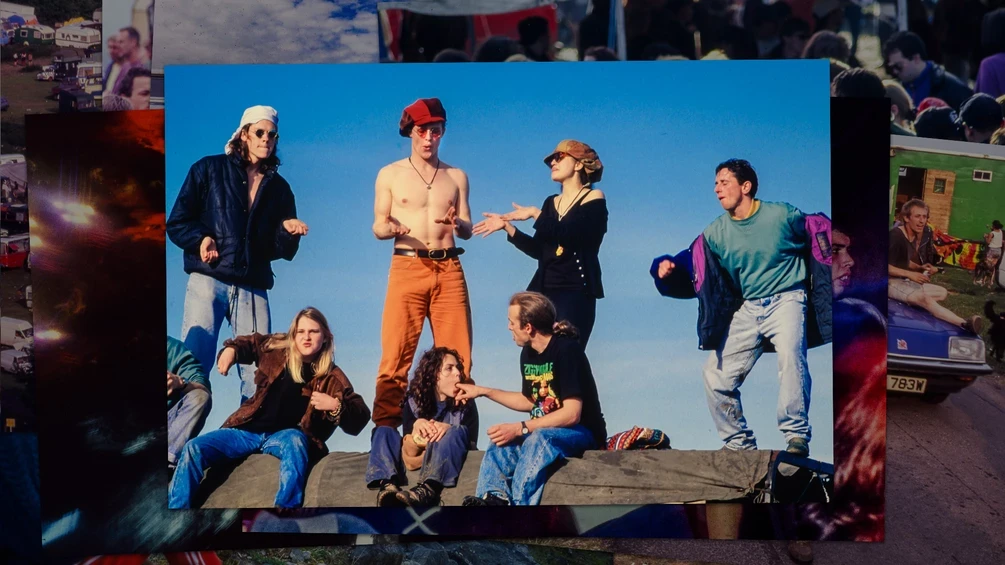
The Common Grounds exhibition features over 100 meticulously curated photographs, capturing defining moments across five decades of underground organizing. Lodge’s lens preserves both the sweeping scale of historic events and the intimate, transient human moments within them:
- The Lechlade Rave (Gloucestershire, 1992): Captured in early morning light, Lodge’s photographs of makeshift truck-and-bus auditoriums immortalize the hybridization of traditional traveller aesthetics and early 1990s rave culture—blending fashion, dance, and communal euphoria.
- Castlemorton Common (Worcestershire, 1992): Triggered when police redirected convoys intended for the Avon Free Festival, Castlemorton represented the apex of the 90s free party movement. Operating without urban planning or municipal infrastructure, up to eight multi-million-watt sound systems converged on the site, creating an anarchic acoustic cacophony that Lodge navigated on foot to capture the sheer scale of the crowd.
- DiY and Smokescreen Quarry Parties (Leicester and Derbyshire, 1993–1995): As the state pushed ravers out of open fields and into traditional urban nightclubs, crews like DiY sought out remote, geographically isolated locations—such as Eyam Quarry in the Peak District—where heavy basslines would cause minimal disruption to the general public, proving that the outdoor party ethos could adapt strategically to hostile legislation.
Official Perspectives & Retrospective Insights
Speaking on the evolution of his photographic technique and the philosophy behind his documentation, Lodge highlights the technical challenges of capturing the kinetic energy of underground raves without resorting to intrusive flash photography, which often left subjects looking distorted or alienated.
By utilizing slow shutter speeds and multiple exposures over extended time frames, Lodge was able to capture ambient washes of color, light trails, and fluid dance movements. "A photograph is a slice of time," Lodge notes, "but this is much more painterly." This empathetic approach transforms raw documentation into fine art, emphasizing community harmony over the sensationalist narratives frequently pushed by contemporary media outlets.
Curators at the Bonington Gallery emphasize that Lodge’s archive transcends mere nostalgia. The exhibition places historical snapshots of marginalized communities into direct conversation with contemporary debates surrounding civil liberties, the right to roam, public assembly, and environmental stewardship.
Future Outlook: Legacy and the Ongoing Battle for Public Space
As Common Grounds: Counterculture & Confrontation since 1976 opens to the public at the Bonington Gallery in Nottingham—running from September 25 to December 12, 2026—its relevance extends far beyond historical preservation.
In an era characterized by increasing restrictions on public protest, heightened surveillance, and the continuous commodification of public spaces across the United Kingdom, Alan Lodge’s work serves as a vital historical manual. It reminds contemporary society that alternative spaces of freedom, solidarity, and self-expression do not simply materialize; they are carved out through collective resilience, fierce independence, and direct action.
Through Tash’s lens, the ghosts of Windsor, Beanfield, and Castlemorton continue to challenge the orthodoxy of the state, ensuring that the voices and visions of Britain’s permanent outsiders remain indelibly etched into the historical record.