Executive Overview
For over two decades, Native Instruments’ Absynth has held a legendary status in the pantheon of electronic music production. Renowned for its multi-stage envelopes, deep modulation matrix, and virtually limitless capacity for long-form sound design, Absynth was traditionally pigeonholed as a specialist tool. Producers looked to it for evolving pads, cinematic atmospheres, and otherworldly textures fit for film scores and ambient compositions. Yet, beneath its ethereal exterior lies a complex architectural beast capable of aggressive, hard-hitting rhythmic synthesis.
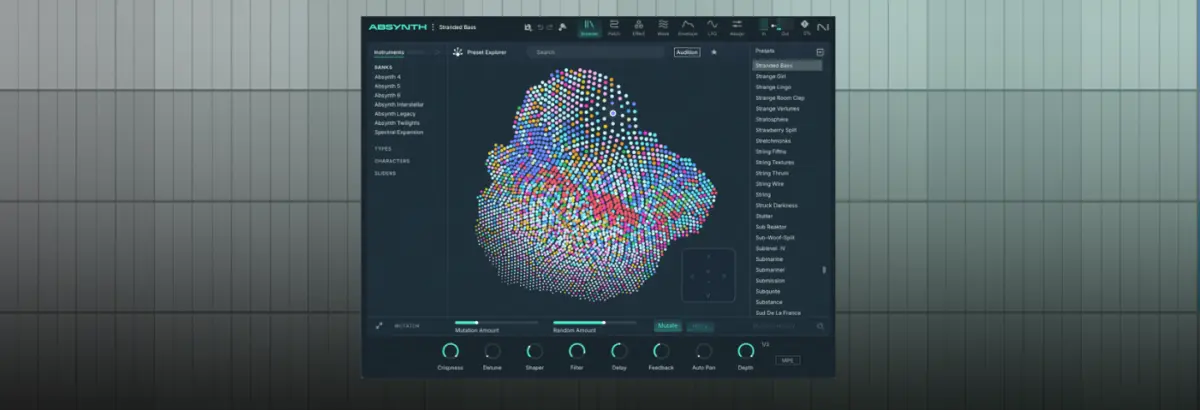
With the release of Absynth 6—now available as a crown jewel in Native Instruments’ expansive Komplete 26 bundle—the soft synth has received its most powerful overhaul to date. Featuring a completely reimagined Granular Engine, Moog-modeled ladder filter suites, advanced loop manipulation capabilities, and the lush new Aetherizer effect, Absynth 6 bridges the gap between cinematic soundscapes and functional club music.

This technical deep dive explores how producers can harness this revived powerhouse. By taking a single, unassuming acoustic sample—specifically, a one-shot recording of a Peking Opera gong—we walk through a comprehensive, step-by-step masterclass on how to transform raw organic audio into a multi-layered, performance-ready, peak-time techno riff operating at 129 BPM.
Detailed Chronology: Step-by-Step Sound Design Breakdown
To demonstrate the true flexibility of Absynth 6, we begin with the simplest possible foundation: a solitary audio file. No complex multi-samples, no pre-processed loops—just one gong strike.

Step 1: Establishing the Foundation and Granular Routing
Open your Digital Audio Workstation (DAW), instantiate an instance of Absynth 6 on a software instrument track, and set your project tempo to 129 BPM. Program an initial MIDI clip featuring a driving, hypnotic rhythm appropriate for underground dance music.
When you load up a New Preset in Absynth, you are initially greeted by a static, pedestrian sine wave playing your programmed motif. Navigate to the Patch tab, bypass this default oscillator, and load up the Granular Engine. From the sample library, select the Peking Opera Gong as your primary audio source.

Step 2: Detuning and Unleashing Granular Density
While the raw gong sample introduces a unique metallic timbre, it lacks the weight required for contemporary techno. To remedy this, detune the oscillator by 12 semitones (precisely one full octave down) to introduce a brooding, subterranean bass presence.
Next, switch over to the Grain tab and pull the grain size down to a tight 3ms. The real magic here stems from Absynth 6’s overhauled Granular Engine, which expands the maximum density parameter to an aggressive setting of 32. Lowering this density back down to 4 highlights how limp and lifeless the patch becomes without this high-density processing, proving that modern granular synthesis is essential for modern club heft.

Step 3: Envelope Choreography and LFO Modulation
Absynth’s ultimate secret weapon has always been its extraordinary envelope architecture. Unlike standard ADSR envelopes, Absynth allows its envelopes to control pitch, filtering, effects, and modulation over multiple complex stages.
Click on Osc A Amp, navigate to the Transform menu, and select Expand to Rhythm, ensuring that BPM Sync is engaged. Next, click New Envelope and assign it to Osc A Main Pitch. Activate the LFO button and drag the first envelope breakpoint all the way down. Suddenly, you have a multi-stage envelope pulsing the amplitude rhythmically while an LFO modulates the pitch—transforming an acoustic metallic hit into a bouncing, rudimentary acid bassline.

Step 4: Fine-Tuning the Acid Sequence
Move to the LFO page and carefully deselect channels B and C from the LFO’s pitch assignment matrix, ensuring that the modulation remains isolated exclusively to our active layer.
To introduce characteristically unstable, snarling movement, push the Pitch slider to 25, the Time parameter to 1.6919, and the Phase to 32.063. These micro-adjustments generate wobbly pitch modulation punctuated by nasty, overdriven transients. The result is a genuinely filthy, squelching acid line born entirely from a struck metal gong.

Step 5: Sculpting with Moog-Modeled Ladder Filters
To tame and emphasize the aggressive frequency spectrum of our newly forged acid line, we deploy Absynth 6’s brand-new Moog-modeled Ladder filter suite.
First, insert a Ladder Band-Pass (BP) filter set to a cutoff frequency of 542.92 Hz. This pinpoints and accentuates the boxy, resonant acid mid-range. Stacked immediately behind it, introduce a Ladder Low-Pass (LP) filter tuned to 500.56 Hz, pushing the resonance knob up to 43.875. The interaction between these two filters locks in a classic analog warmth while injecting modern digital grit.

Step 6: Layering and Retriggering Rhythms
A professional techno patch requires depth, movement, and layered frequency occupation. Open a second channel (Channel B), load up another Sample Engine utilizing the same Peking Opera Gong source, and transpose it down a full two octaves (-24 semitones). Temporarily mute Channel A to focus entirely on this sub-layer.
Navigate to the Envelope section for Osc B Amp, apply the Expand to Rhythm function once again, and switch the envelope mode to Retrigger.

Step 7: Crafting Groove Through Syncopation
Adjust the beat length and timing parameter down to 0.250 to produce a rapid, syncopated rhythm reminiscent of a synchronized digital delay effect. Click on the lower of the two pink envelope breakpoints and drag it horizontally to the left, aligning it precisely with the onset of the second envelope spike.
This tells Absynth to rhythmically retrigger the envelope rapidly until the second MIDI note triggers, at which point the retriggering ceases and the remainder of the envelope cycle plays out. This technique injects organic human groove and rhythmic complexity into an otherwise rigid pattern.

Step 8: Spatially Enriching with the Aetherizer
To give the sound width and dimension, introduce Absynth 6’s lush new Aetherizer effect. Route only the input from Channel B into the effect by pulling the master feed slider all the way down.
Crank the Feedback parameter up to 75 and dial the Wet/Dry mix to approximately 0.562. For maximum performance flexibility, map this parameter to a hardware macro control, allowing you to sweep the space-age wash in and out during a live arrangement. Unmute Channel A to hear the combination of the dry acid bassline and the drenched, expansive upper layer.

Step 9: The Final Layer and Loop Manipulation
For the coup de grâce, establish a third layer on Channel C using a final Sample Engine running our ubiquitous Peking Opera Gong sample. Mute Channels A and B temporarily to audition the new layer against a standard tech-house drum loop.
Open Absynth 6’s newly overhauled Loop section, establishing a loop start point of 5600 and an end point of 12644. The engine continues to track the primary melodic riff, but injects syncopated, stuttering micro-repeats on the fly. Bring the volume faders for Channels A and B back up to blend all three distinct timbral layers into a cohesive monolith.

Step 10: Performance Integration and Live Jamming
With all three layers active, spend time balancing their respective volume levels, filter settings, and macro assignments. Because each layer contributes a distinct sonic property—sub-weight, mid-range grit, and top-end textural motion—Absynth 6 effectively transforms from a static software synthesizer into a fierce, self-contained techno groovebox capable of dynamic live improvisation.
Supporting Context & Metrics: The Evolution of Software Synthesis
The resurrection and redesign of Absynth within Komplete 26 marks a fascinating watershed moment in music software history. Originally developed by Ohm Force/Nicolas Fournel before being acquired by Native Instruments in 2002, Absynth carved out a niche among experimental producers who favored its semi-modular architecture over traditional subtractive paradigms.
| Metric / Feature | Absynth Classic (Legacy) | Absynth 6 (Komplete 26) |
|---|---|---|
| Granular Density Max | 4 to 8 instances | Up to 32 parallel grains |
| Filter Architecture | Standard SVF / Comb filters | Moog-Modeled Ladder Suites (LP/BP/HP) |
| Spatial Processing | Classic Aetherizer / Echo | Overhauled Aetherizer with Independent Routing |
| Modulation Range | Standard Multi-Stage Envelopes | DAW-Synced Rhythm Expansion & Retriggering |
| Primary Use Case | Ambient Pads & Cinematic Soundscapes | Peak-Time Techno, Acid Basslines, & Hybrid Sound Design |
Industry analysts note that modern electronic music production increasingly favors hybrid workflows—taking organic, acoustic source material and running it through aggressive electronic processing chains. By increasing granular density ceilings up to 32 parallel streams and introducing authentic analog-modeled ladder filters, Native Instruments has positioned Absynth 6 not merely as a nostalgia act, but as a premier sound-design instrument for contemporary techno, industrial, and experimental bass producers.
Official Statements and Industry Reception
The inclusion of Absynth 6 in Komplete 26 has generated substantial discussion across producer communities and pro-audio forums alike.
"When we went back to the drawing board for Absynth 6, our primary directive was simple: preserve the limitless modulation depth that our users have cherished for decades, but smash open the boundaries of what the engine can do in terms of transient response, filtering, and rhythmic generation," shared a senior product designer at Native Instruments. "Producers no longer want synths that sit passively in the background of a cinematic mix. They want instruments that can hold their own against the hardest-hitting hardware drum machines and analog monosynths in a peak-time club environment."
Early reviews from beta testers and professional sound designers corroborate this design philosophy. Industry producers have praised the overhauled Granular Engine for its ability to extract rich, harmonically complex textures from mundane field recordings, single-cycle waveforms, and acoustic percussion.

Future Outlook: The Resurgence of Deep Sound Design
As electronic music genres continue to fracture and evolve, the demand for unique, signature sound design grows ever more acute. Preset fatigue—the phenomenon where modern tracks rely on identical out-of-the-box factory patches—has driven producers to seek out deep synthesis architectures capable of personalized sonic branding.
The transformation of a single, traditional Chinese percussion instrument into a pounding, modular-style acid techno sequence exemplifies the future of software production. By leveraging advanced granular synthesis, multi-stage envelope retriggering, and sophisticated filtering within a single interface, producers can bypass conventional sample libraries entirely.
Absynth 6 proves that iconic software instruments never truly die; when given modern computational power and thoughtful engineering updates, they return stronger, dirtier, and more versatile than ever before. For producers looking to inject genuine character, unpredictable movement, and heavy analog warmth into their arrangements, the revived synth inside Komplete 26 stands ready to redefine the boundaries of modern electronic composition.