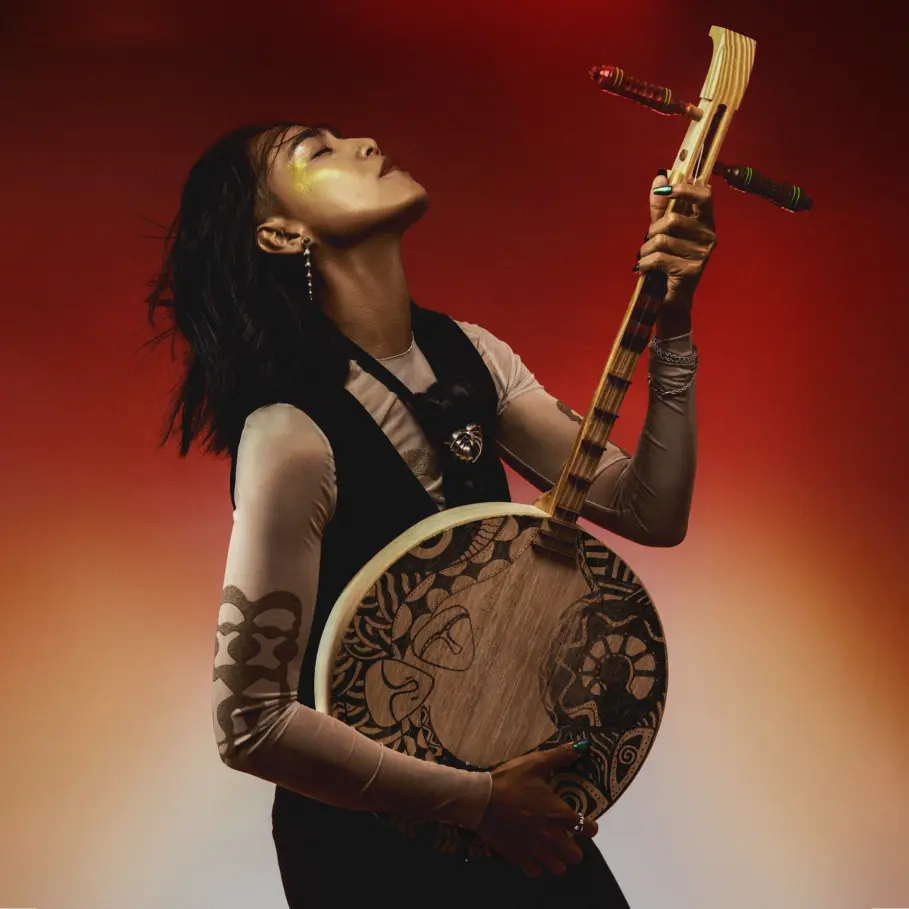
In the rugged, sun-warmed Hengchun Peninsula at Taiwan’s southernmost tip, a quiet cultural renaissance is taking place—one catalyzed by the unexpected collision of contemporary heavy metal and ancestral Indigenous storytelling. This transformation is embodied by Sauljaljui, a pioneering singer-songwriter, multi-instrumentalist, and cultural messenger from the Paiwan village of Kapanan.
For the fourth installment of the Musical Road to WOMEX series, Sauljaljui prepares to take her distinctive sound to the global stage at WOMEX (World Music Expo) in Las Palmas de Gran Canaria. Her journey has been anything but conventional. Once a frustrated nu-metal drummer facing repeated rejections from Taiwan’s premier underground music festivals, Sauljaljui found her true artistic north not in Western rock subcultures, but in a humble village community room. There, surrounded by Paiwan elders strumming the yueqin—a traditional two-stringed Chinese moon lute—she unlocked a profound idiom of ancestral preservation, transnational solidarity, and sonic innovation.
Her self-produced 2025 critically acclaimed album, VAIVAIK (meaning both "searching" and "embarking" in the Paiwan language), swept Taiwan’s prestigious Golden Melody Awards, taking home Best Indigenous Language Album, while its standout lead single, “Dipin Kari Tang,” secured Best Arrangement. This project, born from a month-long creative residency with local musicians in Mauritius, showcases her cross-cultural dexterity. Furthermore, her long-standing collaboration with the trans-oceanic collective Small Island Big Song underscores a broader artistic mission: uniting disparate Indo-Pacific island cultures through a shared maritime heritage.
As Sauljaljui steps onto the international showcase in the Atlantic, she carries more than just an eclectic repertoire of folk-fusion, jazz, and rock elements. She carries the weight, resilience, and vitality of the Paiwan language—spoken by fewer than 200,000 people and historically suppressed under colonial rule. This comprehensive profile explores her extraordinary trajectory, the philosophies driving her sonic evolution, and her upcoming initiatives to empower the next generation of Indigenous artists.
Detailed Chronology: From Heavy Metal Rejections to Ancestral Awakening
The Rust and Rhythm of the City
Long before she was hailed as a visionary of modern Indigenous folk music, Sauljaljui was navigating the hyper-competitive underground music scene of Taiwan’s metropolitan centers. As a university student, her creative outlet was visceral and heavy: she played drums in a nu-metal band. Like countless young musicians of her generation, her aspirations were pinned on breaking into Spring Scream, Taiwan’s legendary alternative music festival.
Yet, despite persistent applications, her band repeatedly faced rejections. Frustrated by the metropolitan music industry’s gatekeeping and feeling creatively untethered, she made the pivotal decision to return home to Kapanan on the Hengchun peninsula.
Opening the Village Room Door
Back in her home village, Sauljaljui mentioned to an auntie that she still harbored a deep desire to make music. The auntie, recognizing this creative hunger, led her down a village lane and opened the door to a community room.
Inside sat a dozen elderly villagers, their laps holding yueqin lutes, quietly weaving traditional Paiwan melodies. Initially, Sauljaljui confessed she was skeptical, mentally dismissing the session as uninspiring "old people’s music." However, looking for a way to contribute, she dragged a cajón box drum into the circle and began laying down a steady rhythmic foundation.
The impact was immediate. Bolstered by her percussion, the elders sang with newfound steadiness and syncopation. What began as a polite guest appearance rapidly evolved into a regular ritual. She performed with them weekly, and the elders gradually embraced her as one of their own grandchildren. This intergenerational immersion softened her demeanor and recalibrated her artistic sensibilities.
The Flowering Memory
The turning point in her artistic awakening occurred when she finally inquired about the narrative substance behind the Paiwan lyrics. One elder recounted a vivid childhood memory: while playing hide-and-seek, she had spotted a wild flower blooming high upon a sheer cliff face. Unable to reach it, she simply stood below, gazing upward, until a passing spring wind carried the flower’s intoxicating fragrance down to her.
For Sauljaljui, this revelation brought a complex wave of shame and warmth. She realized that authentic folk music was never merely about technical performance; it was a profound medium for singing the very land into existence. Sitting in that room, she had been surrounded by a living archive of environmental memory without fully hearing it. She promptly laid down her cajón, set aside her metropolitan rock ambitions, and began learning the yueqin from scratch alongside the village children.
Full Circle at Spring Scream
Applying her background in global Austronesian rhythms to the restricted two-string constraints of the yueqin, Sauljaljui re-imagined the instrument not as a melodic voice, but as a driving rhythm section.
In a poetic twist of fate, it was not her old nu-metal band that finally breached the walls of Spring Scream, but the Paiwan elders. Invited to perform at the festival, they brought Sauljaljui onto the iconic stage alongside them. Standing backstage, she attempted to coach one of the grandfathers on how to flash the universal "rocker" hand sign during the performance. Swept up in the moment, the elder raised his hands and instead shouted, "Local!"—prompting an ecstatic eruption from the festival crowd.
Supporting Context & Metrics: The Architecture of VAIVAIK
Sauljaljui’s trajectory culminated in the release of her 2025 self-produced album, VAIVAIK, a project that cemented her status as a heavy hitter in contemporary global roots music.
Key Artistic & Operational Metrics:
- The Linguistic Landscape: The album is primarily sung in Paiwan, an Austronesian language currently spoken by fewer than 200,000 individuals and previously marginalized under decades of colonial assimilation policies.
- Award-Winning Resonance: VAIVAIK was named Best Indigenous Language Album at Taiwan’s prestigious Golden Melody Awards, often considered the "Grammys of the Mandopop and Taiwanese music world."
- Transnational Arrangement: The opening track, "Dipin Kari Tang," earned the award for Best Arrangement. The song was forged during a month-long immersion residency in Mauritius, where Sauljaljui lived, ate, and jammed daily with local musicians, later recording the final version with the Taiwu Ballads Troupe back in Taiwan.
- Global Collaborations: Her ongoing work with Small Island Big Song has connected her network with master tradition-bearers across the Indian and Pacific Oceans, using the ocean as a connective cultural tissue.
| Album Track / Project | Origin & Influences | Accolades / Recognition |
|---|---|---|
| VAIVAIK (Album) | Hengchun Peninsula, Taiwan | Best Indigenous Language Album (Golden Melody Awards) |
| "Dipin Kari Tang" | Mauritius residency & Paiwan roots | Best Arrangement (Golden Melody Awards) |
| Small Island Big Song | Indo-Pacific maritime communities | International touring & cultural preservation network |
Official Statements & Direct Perspectives
Reflecting on her philosophy of music, culture, and her upcoming showcase at WOMEX in Las Palmas de Gran Canaria, Sauljaljui shared profound insights into her creative ethos:
On the Illusion of Language Barriers
"Creating music in my native language naturally comes with its own challenges, especially because we have experienced colonization and the loss of our culture and language. But those difficulties don’t make me feel defeated. Instead, they give me strength. It’s okay if the audience doesn’t understand my language. When I stand on stage, I believe they can still feel the conviction and energy that I carry. Sometimes I think about what the world would be like if there were no language barriers. I believe what would remain is energy."
On Inventing Tradition and Creative Freedom
"My culture has given me confidence. It taught me to truly believe that ‘tradition can be invented.’ When I became brave enough to respond to my culture with my own ideas, rather than simply following what already existed, I finally felt a sense of openness within myself. It made my soul want to see the world. And now, I want to share that energy with the world without holding anything back."
On Cross-Cultural Kinship
"In the past, when I created music that involved cultural fusion, it was mostly about combining different musical styles. But ‘Dipin Kari Tang’ was different. I lived there for a month, spending every day with local people… This song wasn’t something I imagined from a distance. It came from a real experience and became part of me. In my culture, recognition and belonging can sometimes be more important than blood relations. If we recognize one another, then we are brothers and sisters."
Future Outlook: The Van Tour and Beyond WOMEX
While the global music industry gathers in Las Palmas de Gran Canaria this October to witness her showcase, Sauljaljui’s vision remains deeply anchored in grassroots community empowerment.
Rather than resting on her Golden Melody accolades or treating WOMEX as a mere stepping stone to commercial western markets, she views international exposure as fuel for local revitalization. Having recently purchased a dedicated tour van, she is launching an ambitious community outreach initiative starting this September.
The Community Van Initiative:
- Immersive Residencies: Traveling across Indigenous communities in Taiwan, she plans to spend approximately one month living within each village.
- Mentorship & Courage: Her goal is to demystify international touring and show young Indigenous people that their ancestral culture is not a rigid cage or a barrier to modernity, but rather a profound source of strength that can propel them onto the global stage.
- A Message to Las Palmas: True to her boundary-breaking spirit, her message to the residents of Gran Canaria ahead of her showcase is disarmingly intimate: "I’m Sauljaljui. Your long-lost half-sibling from another mother and another father. Come and listen to what I have to say."
As she bridges the gap between the intimate village rooms of the Hengchun peninsula and the sprawling arenas of the global music market, Sauljaljui proves that the most forward-looking music is often that which remembers best.