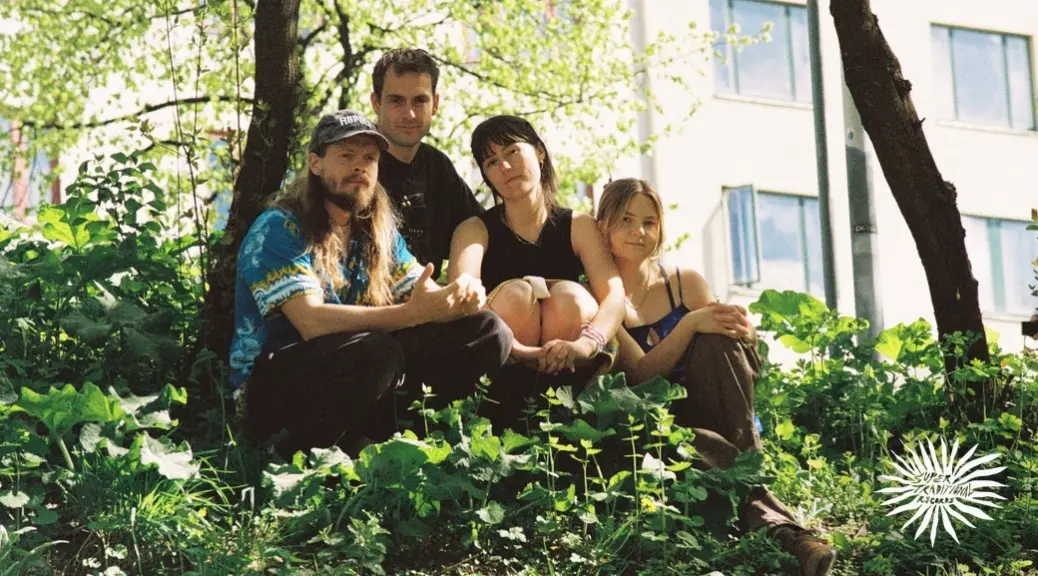
In the sprawling, often insular landscape of contemporary Nordic roots music, few releases manage to capture the melancholic poetry of daily survival with the piercing clarity of DIKET I SOLEN I DIKET. This debut full-length album by Oslo-based quartet Diket serves as a sweeping sonic exploration of the Nordic calendar. Moving seamlessly through freezing January slush, blinding April sunlight, fleeting early-summer barbecues, and the quiet dread of returning calendars in September, the record acts as both a topographical and emotional map of life in contemporary Scandinavia.
The band’s name—Diket, translating directly from the Swedish and Norwegian as "the ditch," specifically the roadside variety—is playfully doubled in the album’s title, looping back on itself like a rhyme missing its final cadence: the ditch in the sun in the ditch in the sun. It is a fitting metaphor for an ensemble that effortlessly navigates the paradoxes of modern youth: the crushing weight of metropolitan rent in an increasingly unaffordable Oslo, set against the enduring, rustic comfort of traditional instrumentation.
Comprising Levina Storåkern (vocals, kantele, fiddle), Jonathan Kleven (guitar, vocals), Hanna Skjerdal (bass, vocals), and Oddbjørn Sponås (drums, vocals)—with producer Martin Langlie augmenting the sonic palette on banjo, percussion, and vocals—Diket represents a formidable cross-pollination of the Norwegian and Swedish folk scenes. Individually, the members are stalwarts of celebrated underground acts such as Ävestaden, Benedikt, and Hey Gloria. Following the critical success of their 2024 12-inch EP Och sen kom vintern (“And then came winter”), which earned a Swedish Grammis nomination for folk music, Diket has crafted a full-length statement that balances deep-rooted tradition with avant-garde jazz sensibilities, sharp lyricism, and modern socio-economic realities.
Detailed Chronology: A Journey Through the Nordic Year
Side A: Spring, Slush, and Domestic Realities
DIKET I SOLEN I DIKET unfolds less as a traditional collection of songs and more as a series of intimate vignettes capturing the passage of time in the sub-Arctic north.
The record opens with "Aprilvisa," a composition stripped down to its barest essentials. Harmonising voices intertwine over delicate, understated instrumentation, setting an atmospheric tone that immediately grounds the listener in the seasonal transition. This minimalism shifts slightly on "Och jag sa dam di da di," where Storåkern’s plucked kantele—the traditional Finnish zither—and Hanna Skjerdal’s pulsing bass lock together in an enchanting, symbiotic groove.
The mood lifts temporarily with "Karolin," a joyful, skipping pastoral frolic that pushes the kantele to the fore and highlights the collective vocal blend of the quartet. Yet, the emotional high point of Side A arrives with "Marken rodnar" (“The ground blushes”). Here, the ensemble delivers the record’s richest-sounding folk arrangement, underpinned by the rolling, organic percussion of Oddbjørn Sponås.
Despite these pastoral highs, the lyrics consistently anchor the music in the gritty particulars of modern urban life. Storåkern’s writing shines on tracks like "Favoritserie" (“Favourite series”), where the instrumental palette shrinks to near-silence. It mirrors the quiet desolation of realizing that a comforting television series—once a ritualistic escape from the grind of working-class life—has quietly stopped meaning anything at all.
Side B: The Jolt of "Koskenkorva" and the Long Winter
Flipping the physical LP delivers a deliberate, disorienting tonal shift. Side B opens with "Koskenkorva," named after the notorious Finnish vodka. Unlike the rest of the album’s lyrics, penned exclusively by Storåkern, this track features shared writing credits across all four band members. Each takes a turn at the microphone, recounting tales of rigged games, systemic power struggles, and the quiet desperation of taking matters into one’s own hands.
The track begins innocently enough, unfurling a traditional-sounding melody over a sparse, hypnotic drum groove. Suddenly, Sponås steps forward to deliver the first verse in the broad, idiosyncratic dialect of Surnadal in Nordmære. The song hardens instantly: the rhythm section locks into driving, relentless eighth notes beneath Kleven’s electric guitar, culminating in a blistering, free-jazz synthesizer solo by guest artist Håvard Aufles. Placing "Koskenkorva" at the gateway of Side B is an act of masterclass sequencing, jolting the listener awake just as the needle enters the second half of the record.
Following this kinetic outburst, "Droppar" (“Drops”) introduces a cascading, plucked figure that mimics the resonance of an African kalimba, though realized through the deft fingers of Storåkern on the kantele. The emotional and sonic anchor of Side B, however, is "Januari, februari." Bolstered by Aufles’s return on keys, the track is deep, warm, and full-bodied, capturing the bleak beauty of the darkest months of the year.

The album closes with "Oslogangar," a piece that borrows its rhythmic DNA from the traditional Norwegian gangar walking dance. Passed down through historical archival recordings by figures like Torjus Odden and interpreted through the lens of Setesdal Jew’s harp master Sigurd Brokke, the track is propelled by a driving, circular pattern that evokes polyrhythmic African dance traditions. Storåkern’s lead vocals ride triumphantly over a guest choir comprising Vera Sonne, Astrid Garmo, Johan Lindvall, and Eir Vatn Strøm (her bandmate in Ävestaden). The fiddle, largely absent throughout the rest of the record, finally steps forward here to lead the procession.
Supporting Context & Metrics: Pedigree, Production, and Production Lineage
The exceptional pedigree behind DIKET I SOLEN I DIKET extends far beyond the four core members. The album’s distinctive sonic clarity and textural depth are the result of meticulous production and mastering choices that bridge folk purity with avant-garde experimentalism.
The Production Team
- Martin Langlie (Producer): Beyond steering the core arrangements, Langlie contributes vital textural layers via banjo and auxiliary percussion, ensuring the acoustic instruments retain their raw, tactile qualities without ever sounding clinical.
- Helge Sten (Mastering): Operating under his legendary moniker Deathprod—as a founding member of the seminal ambient-jazz outfit Supersilent—Sten brings a distinct mastering touch. His influence ensures that the dynamic shifts between the delicate acoustic passages of Side A and the volatile, synth-driven outbursts of Side B are preserved with uncompromising sonic integrity.
Critical Acclaim and Awards
Diket enters the critical sphere with an impressive accumulation of prior accolades:
- EDVARD Award (2023): Levina Storåkern shared the prestigious TONO lyric-writing prize alongside her collaborators in Ävestaden and Benedikt.
- Swedish Grammis (2025): The band’s debut 12-inch EP, Och sen kom vintern, secured a coveted nomination in the folk music category.
- Jazz Circuit Recognition: An upcoming billing at the prestigious Trondheim Jazzfest highlights the crossover appeal of their improvisational structures, drawing the attention of contemporary jazz critics and curators alike.
Official Statements & Artistic Vision
Speaking on the conceptual framework of Diket, the collaborative writing process reflects a deliberate embrace of everyday mundanity. Rather than retreating into romanticized, agrarian myths of historical Scandinavia, the group’s lyricism is fiercely contemporary.
Rent payments scraped together for cramped, substandard student flats; shrinking rear bicycle lights disappearing into the endless Nordic night; and the bleak visual of a brown-grey winter landscape likened unromantically to meatballs with brown sauce and mashed swede—these are the lyrical building blocks of Storåkern’s universe.
In interviews and liner notes, the band has emphasized that these heavy thematic elements—loneliness, economic precarity, and the suffocating darkness of urban winters—are never delivered with heavy-handed solemnity. Instead, they are met with a distinctly Nordic blend of dry humour and sincere resilience. The spirit of the record echoes the late-1960s crossover movements where folk and pop collided, driven by a philosophy that sincerity and a carefree attitude can coexist.
Future Outlook
As DIKET I SOLEN I DIKET hits shelves via Superstandard on both LP and CD, the trajectory for the quartet points firmly upward. While digital streaming formats will undoubtedly capture their share of listeners, physical media purists—particularly those advocating for the vinyl format—will find that the structural integrity of the record relies heavily on the physical act of flipping the disc. The transition from the delicate, spring-oriented folk of Side A to the volatile, vodka-fuelled grit of Side B’s "Koskenkorva" is an artistic statement best experienced in the analog domain.
Looking ahead, Diket is poised to bridge disparate musical communities. By captivating both the traditional folk establishment—exemplified by their Swedish Grammis recognition—and the progressive jazz elite, signaled by their Trondheim Jazzfest appearance, the quartet has carved out a unique lane for themselves.
For listeners willing to brave the dark, snow-drifted landscapes they evoke, DIKET I SOLEN I DIKET is more than just an album; it is an essential seasonal companion. Whether soundtracking a freezing January trek across the Muonio River in Swedish Lapland or soundtracking the late-night walk home through the overpriced streets of Oslo, Diket has crafted an enduring testament to the beauty found in life’s roadside ditches.