Executive Overview
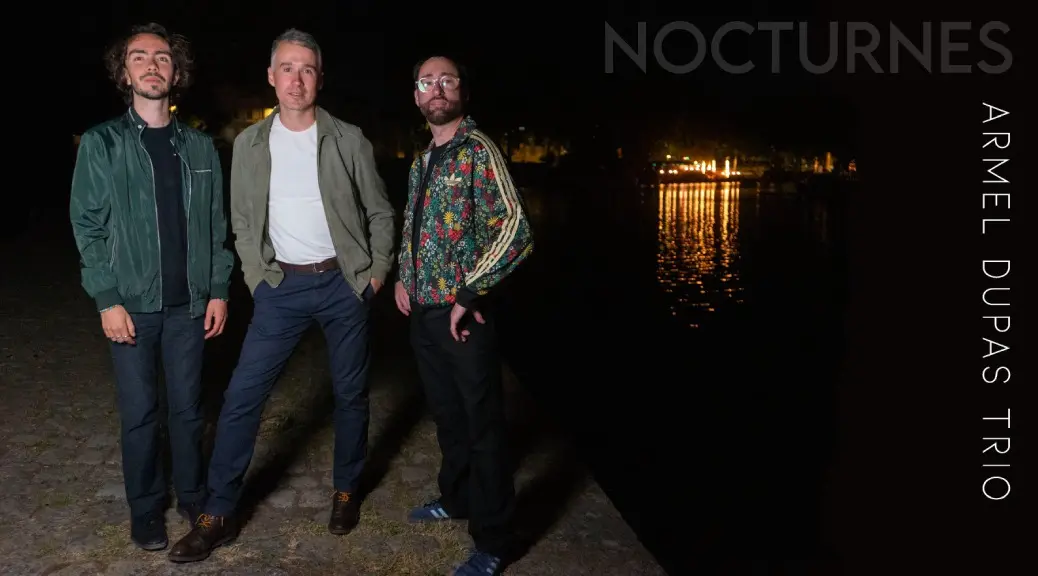
In an era dominated by high-density digital production, compressed dynamics, and hyper-caffeinated tempo maps, the Armel Dupas Trio has carved out a profoundly radical counter-narrative. With their sixth studio album, Nocturnes, the Paris Conservatoire-trained pianist Armel Dupas, alongside bassist Jules Billé and drummer Christophe Piot, has delivered a masterclass in acoustic restraint. Recorded intimately within the rustic confines of Dupas’s timber home studio nestled in the French countryside near Nantes, this seven-track collection reinterprets the classical nocturne format for the contemporary jazz landscape.
At the heart of this sonic journey is a daring physical and aesthetic constraint: the utilization of a felt piano. By interposing a strip of muted felt between the piano hammers and the strings, Dupas strips away the percussive glare and brilliant upper-register sheen typically associated with modern grand pianos. The result is a velvety, rounded timbre that feels deeply personal, as though the listener is sitting directly inside the instrument’s soundboard.
Seamlessly blending five striking original compositions with inspired instrumental translations of classic folk and indie singer-songwriter cuts—specifically Joni Mitchell and Emilíana Torrini—Nocturnes is not merely an album of songs. It is a unified, continuous meditation on quietude, space, and the delicate equilibrium of trio interplay. This critical review explores the genesis, execution, and cultural resonance of a record that defines the pinnacle of contemporary French jazz sophistication.
Detailed Chronology: From Countryside Sessions to Stage
To understand the singular cohesion of Nocturnes, one must trace the evolutionary timeline of the Armel Dupas Trio, a project whose methodology deliberately inverted standard industry practices.
July 2021: The Genesis in the Countryside
The trio’s story began not in a high-priced commercial facility in Paris or New York, but in the serene expanse of Dupas’s timber-framed home studio near Nantes. In July 2021, Dupas convened with bassist Jules Billé and drummer Christophe Piot with a distinct mandate: build a recording entity first, and let the stage follow organically. This inversion of the traditional jazz paradigm—where bands tour endlessly before capturing their material on tape—allowed the trio to forge an ineffable telepathic rapport away from the pressures of live audiences and commercial expectations.
Over subsequent years, this rural sanctuary became a crucible for creative exploration. Following the release of their acclaimed 2025 album, Everyday Superheroes, the trio immediately began conceptualizing their next statement. Where Everyday Superheroes explored broader, more vibrant harmonic palettes, the mood for the subsequent sessions swung definitively toward the twilight hours.
The Conception of Nocturnes
Dupas drew conceptual inspiration from the historical lineage of the nocturne—pioneered as a solo piano form by John Field and immortalized by Frédéric Chopin. These "night pieces" traditionally featured a singing right-hand melody drifting over a gentle, rocking left-hand accompaniment. Dupas expanded this intimate framework to accommodate a three-piece acoustic ensemble, challenging Billé and Piot to match the quiet vulnerability of a solo pianist.
Rather than treating the rhythm section as a separate engine room, the trio functioned as a single, multi-limbed acoustic organism. The decision to employ a felt-prepared piano elevated the stakes, demanding absolute precision and dynamic restraint from every member.
Late 2026: Album Release and Live Debut Circuit
Following the completion of recording, Nocturnes was self-released as a compact disc—continuing a frustratingly familiar distribution trend for boutique French jazz projects that often bypass vinyl pressings. The live translation of these delicate studio recordings commenced with a highly anticipated, sold-out album launch event on November 13, 2026, at Desevedavy Pianos in Orvault.
The momentum continued through the late autumn, with the trio taking their hushed aesthetic to regional French cultural spaces, including performances at Théâtre Le Millandy in Luçon on November 27 and Le Balcon in Cholet on December 9, proving that whisper-quiet jazz can command rapt attention in live performance settings just as effectively as high-decibel modal workouts.
Supporting Context & Metrics: Anatomy of a Masterpiece
To fully appreciate the weight of Nocturnes, one must examine the specific mechanics, track sequencing, and sonic architecture that define the album. Across its runtime, the record functions as a singular, unbroken thought, anchored by precise engineering and a profound understanding of negative space.
The Opening Statement: "Le Rescapé"
The album’s opening track, "Le Rescapé" (The Survivor), immediately establishes the rules of engagement. Christophe Piot initiates the texture using wire brushes on snare and cymbals, creating a whispered, rustling cushion of sound. Jules Billé enters with a resonant, beautifully rounded acoustic bass line that anchors the harmonic foundation without crowding the sonic field.

Dupas’s felt piano enters like morning fog rolling over a quiet valley. The absence of harsh transients allows the notes to bloom and decay organically. This track serves as a textbook example of the quintessential contemporary French jazz aesthetic—one characterized by harmonic sophistication, impressionistic coloring, and an absolute rejection of gratuitous pyrotechnics.
Deconstructing the Canon: Mitchell and Torrini
One of the most daring compositional choices on Nocturnes is the inclusion of two vocal-centric songs translated entirely into instrumental jazz vehicles:
- "Marcie" (Joni Mitchell): Originally appearing on Mitchell’s celebrated 1968 debut album, Song to a Seagull, "Marcie" tells a gentle, evocative story of a woman waiting across the seasons for a letter that never arrives, underpinned by an airy acoustic guitar figure. Dupas boldly strips away the lyric entirely, handing the vocal melody over to the piano. Without the narrative safety net of Mitchell’s words, the trio tightens its performance, navigating the song’s emotional architecture through pure melodic phrasing and subtle dynamic shifts. Remarkably, despite the radical reinvention, the song remains instantly recognizable within the opening seconds.
- "Serenade" (Emilíana Torrini): Pulled from Torrini’s haunting 2005 release, Fisherman’s Woman, this piece repeats the transfigurative trick. Operating under the same conceptual framework—taking a composition originally built on voice and guitar and transforming it into an instrumental trio piece—Dupas demonstrates an uncanny ability to isolate the DNA of a melody. Even for listeners unfamiliar with Torrini’s original recording, the tune carries a haunting, deeply familiar resonance, proving that great melodies transcend their original genre boundaries.
The Original Compositions: Weight and Space
The remaining tracks on Nocturnes carry evocative French titles that hint at psychological depth and environmental awareness:
- "Les Signes" (The Signs): A masterclass in spatial mixing, this track features an astonishing amount of "air" around the trio. The crispness of the recording makes the silence between notes feel as important as the notes themselves.
- "Leaving The City" & "Quand tout s’effondre" (When Everything Collapses): These tracks showcase Piot’s subtle textural shifts behind the drum kit. He returns to wire brushes for "Leaving The City," before deliberately swapping them for traditional drumsticks on "Quand tout s’effondre" as the apocalyptic title demands. The transition adds just enough kinetic weight to capture the emotional upheaval implied by the title, before returning to brushes for the album’s closing movement.
Official Statements & Critical Perspectives
While the Armel Dupas Trio has chosen to let their music speak primarily for itself, the critical discourse surrounding Nocturnes has positioned the release as a pivotal milestone in European contemporary jazz.
Industry critics reviewing the record have universally praised the group’s ability to maintain a unified identity across disparate material. Jazz writer Steve Williams noted in his foundational review for UK Vibe:
"All seven pieces carry the same trio identity, which is why the album plays as a single thought. It’s wonderful from start to finish, everything I would want from a contemporary trio release."
Furthermore, the intentionality behind the felt piano has drawn considerable praise from acoustic purists. Sound engineers and musicologists have lauded Dupas for challenging the hegemony of the bright, aggressive modern concert grand. By embracing the muted intimacy of the felt preparation, the trio has re-established a direct historical line connecting the romantic salon nocturnes of the 19th century with the introspective, minimalist jazz chambers of the 21st century.
The sole notable critique from contemporary reviewers centers on the commercial distribution model. The decision to release Nocturnes exclusively on compact disc—a persistent trend within niche European jazz markets—has left vinyl enthusiasts longing for an analog pressing that could fully capture the warmth and physical resonance of the home-studio sessions.
Future Outlook: The Path Ahead for the Armel Dupas Trio
As the Armel Dupas Trio concludes their late-2026 regional touring cycle in support of Nocturnes, the ensemble stands at an exciting creative crossroads. By proving that an acoustic trio can command absolute silence and profound emotional engagement in live venues—ranging from Orvault to Luçon and Cholet—they have broken new ground for intimate chamber jazz.
Looking forward to 2027 and beyond, the success of Nocturnes poses intriguing questions for the ensemble’s trajectory:
- Acoustic Exploration: Will Dupas continue to push the boundaries of prepared and felt piano mechanics, or will the trio explore further collaborations with string arrangements or vocalists to expand their minimalist palette?
- International Touring: Given the positive critical reception across European jazz portals, demand is building for the trio to expand their touring footprint beyond regional French cultural centers into major international jazz festivals across the UK, Scandinavia, and North America.
- Format Advocacy: Driven by vocal fan demand regarding the exclusive CD release of Nocturnes, conversations regarding a delayed, limited-edition vinyl pressing may gain momentum, satisfying audiophiles who crave the physical warmth of wax for such an organically recorded project.
Ultimately, the Armel Dupas Trio has demonstrated that in a noisy, overcrowded modern musical landscape, the softest voice is often the one that resonates the longest. Nocturnes stands as a testament to the power of patience, craftsmanship, and the beauty of shared acoustic breath.