Executive Overview
For a UK-based listener, the linguistic barrier of Swedish lyrics can initially present a hurdle when approaching the fourth solo album by acclaimed folk artist Sara Parkman. However, this barrier dissolves once the listener uncovers the rich, multidisciplinary tapestry of source material underpinning the project. Across its ten tracks, Aster, atlas—released this past May on gatefold black vinyl and CD via Supertraditional—operates as a modern-pagan liturgy. It weaves together the Agnus Dei, Christ’s final words from the cross, the seventh chapter of the Wisdom of Solomon, a 19th-century poem by historian Erik Gustaf Geijer, a children’s story by Astrid Lindgren, a traditional Swedish polska, and the foundational Benedictine motto that gives the closing track its name.
Parkman, alongside her long-standing co-writer and collaborator Hampus Norén, built the sonic architecture of the album around these historical and literary texts, supplementing them with deeply personal lyricism. Hailing from a distinguished lineage of Swedish clergy, Parkman treats church Latin and sacred texts not as academic exercises, but as the familiar vernacular of her upbringing.
Following a string of major accolades—including winning the folk category at the 2023 Grammis (Sweden’s equivalent of the Grammys) for her previous solo album, Eros Agape Philia—Parkman is now bringing the ambitious scope of Aster, atlas to the stage. With a four-date UK tour booked for January 2027, the album demands a thorough critical re-examination. It is a work of profound emotional weight, cultural synthesis, and avant-garde folk experimentation.
Detailed Chronology
Musical Lineage and Institutional Roots
Sara Parkman’s trajectory is deeply rooted in both traditional preservation and contemporary reinvention. As a fiddler, singer, and composer steeped in her family’s clerical background, she naturally bridges the gap between the sacred and the secular. After completing formal studies in folk music at the prestigious Royal College of Music in Stockholm, she announced her arrival with her 2016 solo debut, Sara Parkmans Skog.
Her career gathered international momentum in November 2019 when she co-founded the independent Stockholm-based label Supertraditional, releasing her critically lauded album Vesper on the imprint. The label has quickly become a vital hub for boundary-pushing Nordic folk; it claimed Sweden’s Grammis folk award a year prior to Parkman’s win, taking home the prize for Ebo Krdum’s Diversity. Parkman’s restless collaborative spirit has also yielded cross-genre explorations, such as the haunting Funeral Folk project crafted alongside Maria W Horn, and enduring creative partnerships with luminaries like Lena Willemark.
The Collaborative Cast and Sonic Architecture
Aster, atlas is a massive collaborative undertaking. The cast shifts dynamically from track to track, ultimately involving fifteen distinct musicians and a full choir. Among the luminaries is Lena Willemark, a figure instantly familiar to ECM Records listeners from her landmark work on Nordan with Ale Möller. The project also incorporates prominent voices from Stockholm’s vanguard jazz scene, notably drummer Konrad Agnas and pianist Alexander Zethson (of Angles and Je Suis!). Notably, Willemark and Möller’s recent release, NORDANKVÄDEN, shares a spiritual and institutional home on the Supertraditional roster.
The album opens with “Bära mörker” (“To carry darkness”), featuring a verse inspired by the 12th-century mystic Hildegard von Bingen married to a chorus melody derived from the classic Georgian folk song “Tsintskaro.” A deep, bellowing atmosphere rumbles beneath a delicate vocal delivery, culminating in folk-rooted choral swells that immediately captivate the listener.

This is followed by “Svarta tråden” (“The black thread”), which sets off at a measured walking pace over a plucked string figure before aggressively climbing. Grief is rendered here as a physical object—a black thread handed down through generations that pricks the singer and stitches her into mourning crêpe before the choir arrives to intone the Agnus Dei.
“Paradiset,” a striking duet with Tuva Syvertsen of the Norwegian avant-folk band Valkyrien Allstars, is conceptualised as a garden party channeled through the feminist ethos of Judy Chicago’s The Dinner Party, complete with Niki de Saint Phalle and Tove Jansson imagined on the guest list. The track opens as tense spoken word laden with frustration and anger, before breaking into a serene bridge underpinned by lush, modern synthesizers. The voice returns, driving the tempo forward before unexpectedly swerving into an all-out Ibiza-club climax.
Supporting Context & Metrics
Lyrical Deep Dives and Philosophical Frameworks
The sequencing of Aster, atlas reveals a meticulous intellectual design. “In manus tuas pater,” written on a park bench in Tbilisi, takes Christ’s poignant words from Luke 23:46—“Into your hands, Father”—as its central refrain. Field recordings, delicate instrumentation, and spacious vocal delivery frame a lyric exploring a secret garden of wild vines, marigolds, and the titular aster flower.
Closing the first vinyl side is “Salomos vishet,” a dramatic setting of the seventh chapter of the Wisdom of Solomon, originally penned in Greek some two thousand years ago. In the text, a king reflects on his shared mortality—noting he entered the world with the same first breath and cry as any other human—before choosing wisdom over sceptre and throne. Here, Wisdom is personified as a woman, a reflection of eternal light. Parkman delivers the text in a rhythmic, near-spoken cadence against a climbing organ and a wall of echoing choral voices that evoke a stone cathedral. It stands as the album’s most radiant and goosebump-inducing centerpiece.
The second side opens with “Odlaren” (“The grower”), transporting the listener from the cloister to the open agricultural field. Set to Erik Gustaf Geijer’s 19th-century poem “Höstsådet,” the song follows a farmer casting seeds into dark earth, trusting in the eventual spring harvest despite impending autumn rains and winter snows. Parkman maps her own creative and emotional anxieties onto this imagery, burying her hopes while trusting in the cyclical renewal of the seasons.
Folk Traditions and Personal Tragedies
“Salikons rosor” draws directly upon Astrid Lindgren’s poignant 1949 short story Allrakäraste syster, in which a lonely girl visits her secret twin, Ylva-li, in a hidden kingdom beneath a rosebush named Salikon, only to learn her sister must vanish when the roses wither. The arrangement employs fiddle and band to evoke an Eastern cadence, swelling into repetitive, wordless choral incantations.
This flows directly into “Dickapolskan e. Einar Britt,” the record’s sole instrumental track. It is a traditional Swedish polska—a dance in triple meter—performed on harmonizing folk fiddles. The “e.” denotes efter, the traditional Scandinavian method of crediting the master musician from whom the tune was learned.

Conversely, “Tre hjärtan” (“Three hearts”) offers a stark, chilling lullaby born of personal tragedy. Sung with icy composure over heavy electronic soundscapes, the lyrics methodically count down: three hearts swimming in a lake in the first verse, two in the second, until the final chorus redirects to the surviving child who is now singing.
The album concludes with “Ora et Labora,” the foundational Benedictine motto of prayer and work. Built on a low, vibrating organ drone, the track originated from a spontaneous first-take improvisation between Parkman and Norén that neither artist could improve upon. It resonates with the solemnity of a sermon: the mantra-like repetition of the three words gradually gathers warmth and structural power until Parkman’s voice breaks from a restrained alto into a fierce, full-throated cry.
Official Statements & Live Experience
Conceptualizing the Bloom and Burden
Parkman has explicitly defined the thematic duality of Aster, atlas through its the aster represents the delicate bloom of life and artistic creation, while Atlas evokes the mythological titan condemned to carry the crushing weight of the celestial spheres. This tension between delicate floral beauty and back-breaking existential labor informs every corner of the record.
The UK Live Itinerary and Cultural Partnership
In January 2027, Parkman will bring this towering conceptual work to UK stages. The scheduled dates are:
- Thursday, January 21 – Glasgow, The Hug and Pint
- Friday, January 22 – Middlesbrough, The Auxiliary
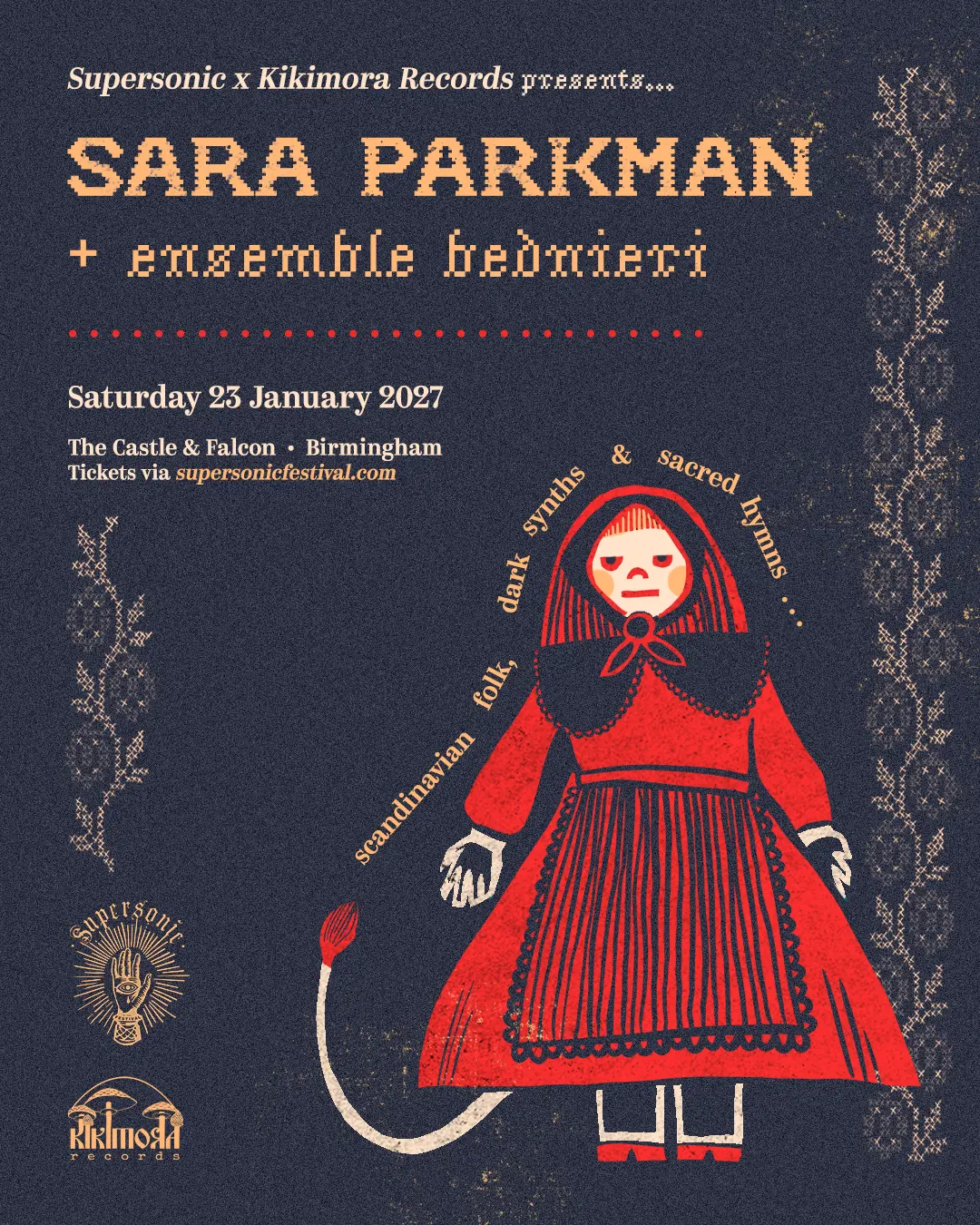
- Saturday, January 23 – Birmingham, The Castle & Falcon (featuring the Ensemble Bednieri)
- Sunday, January 24 – London, Cafe OTO
The Birmingham date at The Castle & Falcon carries unique cultural resonance. The venue hosts a collaborative bill with the Birmingham-based Georgian choir Ensemble Bednieri—an organic, deeply fitting partnership given that the opening motifs of the album’s first track trace directly back to Georgian folk traditions. Furthermore, the performance will coincide with the distribution of a special printed Aster, atlas fanzine available at the merchandise table, celebrating the tactile intersection of print media and musical performance.
Future Outlook
Aster, atlas resists the traditional trappings of modern folk music. Despite occasional nods to avant-pop accessibility (such as the sudden electronic breakdown in “Paradiset”), this is decidedly not an album engineered for outdoor festival main stages or passive background listening.
Instead, it demands architectural intimacy: a mid-sized, acoustically rich room with a low ceiling where sound waves can collide, vibrate, and fully envelope the listener in a four-corner stereophonic embrace. For those who experience it in the right environment—particularly during its upcoming January 2027 live dates—Sara Parkman’s latest masterwork promises to leave audiences spiritually revived, intellectually stimulated, and sonically captivated. It stands not merely as a collection of songs, but as a monumental cultural artifact that securely cements Parkman’s status as one of Europe’s most visionary contemporary artists.