In a bold artistic move that few contemporary regional companies would dare to undertake, Hampstead Garden Opera (HGO) has triumphantly returned to the operatic stage with a searing, intellectually rigorous chamber production of Vincenzo Bellini’s 1831 bel canto masterpiece, La sonnambula. Staged at London’s Jacksons Lane Theatre and reviewed on its opening night on November 7, 2026, this production cuts through the historical baggage of nineteenth-century pastoral clichés. Instead, it reframes the opera as a psychologically sharp, emotionally devastating chamber drama.
Directed with crystalline intelligence by John Wilkie and conducted with stylistic fluidity by Stefano Boccacci, the production benefits immeasurably from a phenomenal star turn by Eyra Norman in the demanding title role of Amina. Supported by a remarkably balanced and capable cast—including Hailey West, Mathilda Goike, Tobias Campos Santinaque, and Michael Roche—HGO has proven once again that the specialized idioms of bel canto opera do not require massive state-theater budgets to achieve profound emotional and theatrical impact. By stripping away traditional Swiss-village stagecraft in favor of an abstract, minimalist design by Jennifer Gregory, Wilkie’s vision challenges audiences to confront the raw, unadorned dynamics of misogyny, societal hypocrisy, and female emancipation embedded within Felice Romani’s libretto.
Detailed Chronology & Production Analysis
Historical Origins and Libretto Mechanics
To fully appreciate the interpretive risks taken by HGO in 2026, one must first look back at the convoluted genesis of La sonnambula. The work traces its lineage directly to a Parisian ballet staged in 1827—featuring a scenario by Eugène Scribe and music by Ferdinand Hérold—at a cultural moment when public fascination with somnambulism (sleepwalking) had reached fever pitch across European artistic capitals. By 1831, Vincenzo Bellini had abandoned plans to set Victor Hugo’s Hernani (an honor that would eventually fall to Giuseppe Verdi in 1844) and instead turned his creative focus to Romani’s adaptation of the sleepwalking theme.
The opera’s full historical title—La sonnambula, ossia I Due Fidanzati svezzeri ("The Sleepwalker, or The Two Swiss Betrothed")—reveals a subtle shift in narrative weight. While the original Parisian ballet placed heavy emphasis on the incoming lord (the archetype for Count Rodolfo), Romani’s libretto quickly loses interest in Rodolfo after Act One. He is introduced as a mysterious, authoritative figure trailing tantalizing hints about a past connection to Amina, yet he ultimately degrades into a stock narrative device. Furthermore, the libretto is riddled with structural loose ends: why, for instance, does Amina possess a stepmother rather than a biological mother?
Librettist Felice Romani was notoriously cavalier with deadlines, consistently prioritizing situations that forced characters into extreme emotional states over airtight narrative logic. Alongside his contemporary Gaetano Donizetti, Romani weaponized plots that subjected heroines to harsh skepticism, wrongful ostracization, and public humiliation, thereby driving them into manic vocal and dramatic displays. La sonnambula thus demands an extraordinary suspension of disbelief from modern audiences; it is not a work pursued for tightly wound theatrical realism, but rather for its cascading waves of pure, unadulterated melodic invention.
The HGO Vision: Abstraction and Feminist Realism
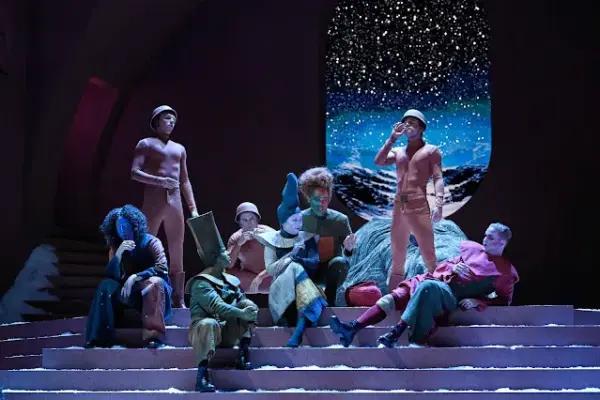
Daring to mount a work that major British houses rarely touch—notable recent exceptions include Buxton’s 2023 staging and the Royal Opera House’s sporadic revivals in 2002 and 2011—HGO opted for complete abstraction. Eschewing Swiss Alps and picturesque timber chalets, designer Jennifer Gregory populated the compact stage at Jacksons Lane Theatre with mobile black metal frames and three minimalist step-pyramids.
This stark architectural choice offered immense visual utility. On a tight stage where performers remained present for much of the evening, the mobile frames created dynamic levels, spatial clarity, and a timeless vacuum where the internal mechanics of the plot could play out unhindered by local color.
Director John Wilkie ingeniously shifted the dramatic center of gravity away from the supernatural or pastoral elements toward the complex, triangulated relationships between the opera’s three primary female characters: Amina (Eyra Norman), Lisa (Hailey West), and Teresa (Mathilda Goike). In Wilkie’s reading, the villagers’ rigid, superstitious dogmatism serves as an indictment of closed-minded communal surveillance. Michael Roche’s Count Rodolfo, clad entirely in black, was reimagined not merely as a local grandee, but as an ominous, authoritative archivist—evoking echoes of a dark fiddler figure from Delius’s A Village Romeo and Juliet. Rodolfo serves as a conduit of hidden truths, distributing books and information while remaining detached from the emotional fallout around him.
Supporting Context & Metrics
The Cast and Musical Execution
HGO’s achievement is all the more remarkable given the sheer logistical hurdles of casting a demanding bel canto score with a young, rising generation of artists. While true Verdian heavyweights remain scarce in the modern market, the vitality of the UK’s Baroque and bel canto training pipeline was vividly on display.
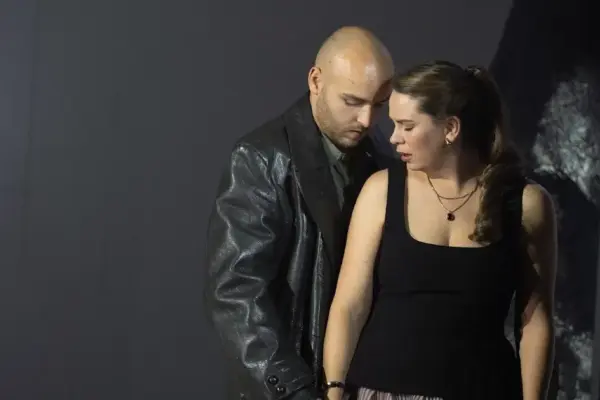
Eyra Norman (Amina): Norman’s portrayal of the sleepwalking heroine anchored the entire evening. Possessing a warm, rich vocal timbre that retained its core resonance across every register, she navigated Bellini’s intricate fioriture not as empty vocal acrobatics, but as expressions of profound psychological state. Her phrasing bore the unmistakable, reverent imprint of Maria Callas’s legendary interpretations, yet Norman maintained a distinct artistic identity. Throughout the notoriously slow-moving first act, Norman transformed Bellini’s expansive, winding melodies into spellbinding vocal theater. Her triumphant final scene discarded the traditional redemptive reconciliation; instead of re-entering the fold of her abusive betrothed, Norman’s Amina boldly tossed aside her wedding ring and strode into an autonomous future.
Hailey West (Lisa): As the fiercely independent innkeeper Lisa, West offered a brilliant, fiery counterweight to Norman’s ethereal Amina. Her voice featured a core of steely strength that brought a distinct edge to her arias. West’s Lisa was entirely unapologetic about her desires, making her aborted wedding in Act Two a compelling study in thwarted ambition.
Tobias Campos Santinaque (Elvino): Fresh off his notable summer appearances at Longborough (including as the sailor in Tristan und Isolde), tenor Tobias Campos Santinaque brought athletic, fearless vocalism to the role of Elvino. His lithe, lyric tenor contrasted sharply with Norman’s darker richness, though a slight vocal dryness occasionally crept into his upper extremes. Dramatically, Santinaque leaned hard into Elvino’s toxic jealousy and hysterical unreasonableness, rendering him thoroughly unlikable, yet eliciting a shred of pathetic sympathy by the final curtain as he dissolved into a broken wreck.
Michael Roche & Mathilda Goike: Roche delivered an upright, commanding Rodolfo with a firm bel canto line, while Goike’s Teresa relied on masterclass facial expressions and nuanced stage presence to communicate the deep-seated conflicts of a stepmother caught between community pressure and maternal affection. Ted Day rounded out the principal ensemble as Alessio, a perpetually sidelined suitor whose romantic aspirations were definitively crushed by Lisa.
Orchestral and Conductorial Metrics
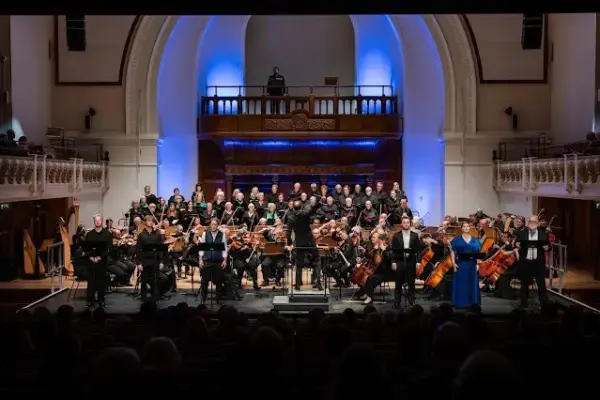
Operating with a scaled-down chamber orchestra consisting of single strings, woodwinds, a single trumpet, two horns, and percussion, conductor Stefano Boccacci displayed an innate affinity for Bellini’s idiom. Positioning the orchestra to the side of the stage presented inevitable acoustic and visual synchronization challenges, leading to occasional minor ensemble slips.
However, Boccacci successfully prioritized musical fluidity over rigid metronomic precision. He granted the vocal soloists ample spatial liberty to shape their long, expressive legato lines while keeping the dramatic momentum moving forward without self-indulgence. The instrumental soloists—particularly the horn section, which Bellini utilizes to evoke pastoral signaling—delivered polished, evocative performances that anchored the vocal acrobatics.
Official Statements & Production Insights
While formal corporate press releases from major national institutions often sanitize the gritty realities of fringe opera production, the artistic team behind HGO’s La sonnambula has consistently emphasized the necessity of theatrical risk-taking. In pre-show notes and director’s statements, John Wilkie highlighted the ideological imperatives driving this specific revisionist staging:
"Bellini and Romani were not interested in the mundane logistics of how people stumble into madness or societal ostracization; they were charting the absolute outer limits of human vulnerability," Wilkie noted. "By removing the safety blanket of Swiss folklore, we force modern audiences to look at how quickly a community turns on its most vulnerable members—and how female solidarity and self-actualization offer the only true path out of the trap."
Conductorial notes from Stefano Boccacci further underscored the architectural demands placed on the orchestra:
"Playing Bellini in a chamber format strips away the sonic cushion of a massive pit. Every single bow stroke and wind entry is exposed. The challenge was maintaining the long-breathed, endless melody characteristic of the bel canto style while navigating the spatial realities of Jacksons Lane Theatre."
Future Outlook
The resounding success of HGO’s La sonnambula signals a vital and encouraging trajectory for independent opera production in the United Kingdom. At a time when economic pressures and funding cuts frequently force regional companies toward safe, middle-of-the-road repertoire choices—such as perpetual revivals of standard Puccini or Mozart staples—HGO has demonstrated that intellectual curiosity combined with high-caliber casting can breathe vibrant new life into neglected masterpieces.
For Eyra Norman, this breakout performance establishes her as a formidable new voice in the international bel canto landscape, signaling a promising career trajectory as she refines her interpretations of Bellini and Donizetti heroines. Meanwhile, HGO’s proven capacity to mount complex, conceptually unified productions on a chamber scale sets a high benchmark for upcoming seasons.
As the company looks toward its future programming, this production of La sonnambula will undoubtedly be remembered as a high-water mark—proving definitively that nineteenth-century opera, when handled with dramatic courage and musical integrity, retains an urgent, contemporary resonance capable of speaking directly to modern social anxieties.