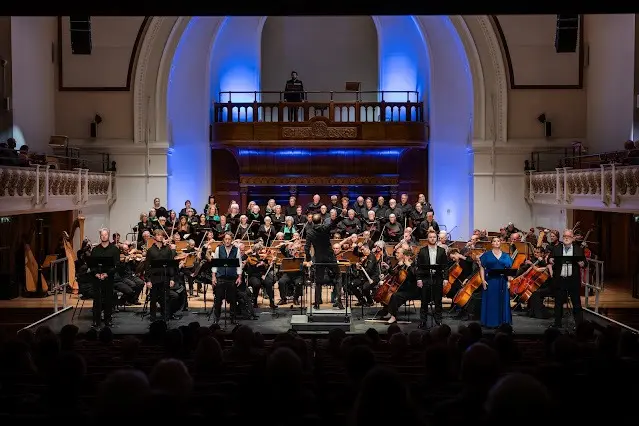
On Sunday, November 1, 2026, London’s Cadogan Hall bore witness to a rare and compelling revival of French grand opera as the Chelsea Opera Group (COG) mounted Ambroise Thomas’s sprawling 1868 masterpiece, Hamlet. Conducted with precision and deep affection by Jonathon Cole-Swinard, Head of Music and Chorus Director at Garsington Opera, the production offered a masterclass in breathing theatrical life into a nineteenth-century score that frequently teeters on the edge of the operatic canon.
While Thomas’s Hamlet may lack the psychological complexity and philosophical density of Shakespeare’s original tragedy—owing largely to a libretto by Michel Carré and Jules Barbier that adapts Alexandre Dumas’s 1847 French stage adaptation—this concert staging played squarely to the work’s formidable musical strengths. Anchored by the magnetic, vocally seductive baritone of Jacques Imbrailo in the title role and Haegee Lee’s dazzling, emotionally resonant Ophélie, COG delivered an evening of immense dramatic tension and orchestral sophistication.
Though stretches of Thomas’s score occasionally descend into conventional nineteenth-century musical tropes, this performance elevated the material through uniformly committed solo contributions, a powerhouse supporting cast, and an imaginative, highly atmospheric orchestral reading. The result was a triumph for the Chelsea Opera Group, proving once again that rare operatic repertoire, when championed by dedicated artists, can pack an extraordinary theatrical punch.
Detailed Chronology
The journey of Thomas’s Hamlet from the grand stages of nineteenth-century Paris to a modern London concert hall is a narrative defined by shifting tastes, performance practicalities, and occasional neglect.
Genesis and the Parisian Premiere (1868)
Ambroise Thomas, often regarded as the "nearly man" of nineteenth-century French composition, was born seven years before Charles Gounod and thirty years before Jules Massenet. Operating as an advance-guard figure following the era of Giacomo Meyerbeer, Thomas achieved his greatest renown with Mignon (1866). Encouraged by that work’s success, librettists Michel Carré and Jules Barbier—who had famously crafted the libretto for Gounod’s Faust—turned their attention to Shakespeare’s Hamlet.
Relying on Alexandre Dumas’s 1847 French adaptation rather than the original English text, the librettists streamlined and fundamentally altered the narrative arc:
- The iconic opening scene on the castle ramparts and the character of Fortinbras were excised entirely.
- A romantic love scene between Hamlet and Ophelia was injected into the first act.
- Claudius was spared from exiling Hamlet to England, rendering Rosencrantz and Guildenstern absent from the plot.
- Most dramatically, the opera concluded with the Ghost of Hamlet’s father returning from the dead to condemn the dying Gertrude, Claudius, and Laerte.
Premiered at the Paris Opéra on March 9, 1868, the title role was written for the baritone Jean-Baptiste Faure because a suitable dramatic tenor could not be secured at the time (though a tenor version was eventually resurrected in 2025).
International Spread and Subsequent Eclipse
Within five years of its Parisian debut, Hamlet was staged across Europe and the Americas, enjoying productions in London (1869, sung in Italian), Leipzig, Budapest, Brussels, Prague, New York City, Saint Petersburg, Berlin, and Vienna. The legendary soprano Nellie Melba famously championed the role of Ophélie, frequently culminating performances with her tour-de-force mad scene.
As musical tastes shifted into the twentieth century, however, the opera fell out of favor. In the United Kingdom, sightings became vanishingly rare. Following a staging at Covent Garden in 2003—the house’s first since 1910—and an Opera North production in 1995, the work remained dependent on the rare convergence of a world-class baritone and soprano. Buxton Festival’s 1980 staging with Thomas Allen and its subsequent 2025 revival under Jack Furness remained notable exceptions to decades of dormancy.
The Cadogan Hall Performance (November 1, 2026)
Against this historical backdrop, the Chelsea Opera Group’s November 1, 2026 performance at Cadogan Hall arrived as a major cultural event. Coinciding with Gothic Opera’s revival of Fromental Halévy’s La Dame de Pique, COG assembled a stellar cast.
Under the baton of Jonathon Cole-Swinard, the performance unfolded across meticulously paced acts:
- Act I & II: Jacques Imbrailo’s brooding, vocally supple Hamlet established immediate dramatic dominance. The innovative use of the saxophone in the players’ scene generated palpable aural tension, culminating in a sprawling, energetic ensemble that let the orchestra off its leash.
- Act III: Serving as the emotional heart of the evening, this act featured Imbrailo’s neo-Shakespearean soliloquy, the tense prayer scene with Richard Wiegold’s Claudius, and a ferocious trio involving Hamlet, Grace Durham’s Gertrude, and Haegee Lee’s Ophélie.
- Act IV & V: Haegee Lee delivered a riveting, score-free mad scene that brought down the house, followed by a briskly paced finale complete with a funeral procession echoing Donizetti’s Lucia di Lammermoor and the dramatic, if vocally understated, return of Thomas D. Hopkinson’s Ghost.
Supporting Context & Metrics
To fully appreciate the scale and execution of the Chelsea Opera Group’s production, one must examine the institutional framework, orchestrational demands, and casting metrics that shaped the evening.

Orchestral and Musical Architecture
Thomas concentrated his most sophisticated compositional efforts within the orchestra pit. The Paris Opéra orchestra of the nineteenth century was among the largest and finest of its day, and Thomas exploited this by expanding the standard full lineup to include:
- An extra harp
- Two cornets
- A prominent saxophone (utilized to brilliant effect in Act Two to heighten theatrical tension)
Jonathon Cole-Swinard elicited a lush, supple, and highly sophisticated performance from the COG orchestral forces. Despite minor, fleeting vulnerabilities in the brass section—notably a transient moment from the first horn—the orchestra maintained a high baseline of stylish phrasing and atmospheric depth. The atmospheric prelude and scene interludes successfully mitigated the work’s occasionally bombastic tendencies.
Cast and Production Metrics
- Total Soloists & Principal Roles: 9 key vocalists, supported by the dedicated choristers of the Chelsea Opera Group.
- Performance Cut-Downs: While presented as a remarkably full version of the score, the production streamlined proceedings by omitting the traditional ballet music and a duet between Gertrude and Claudius, alongside minor internal trims.
- Staging Approach: Executed as a standard concert performance with artists arranged linearly across the stage. Despite the lack of theatrical blocking, the cast performed entirely uninhibited by scores, utilizing facial expressions, physical posture, and intense eye contact to bridge the gap between concert platform and dramatic stage.
Official Statements & Artistic Insights
Reflecting on the artistic merits of the production, the performance showcased how thoughtful casting can elevate a lesser-known Romantic score into a compelling theatrical experience.
Jacques Imbrailo, reflecting his trajectory following his acclaimed Pélléas in Aldeburgh and upcoming engagement as Oreste in Gluck’s Iphigénie en Tauride at the English National Opera (ENO), discussed the vocal demands of the title role:
"From his first entry, Jacques Imbrailo made a vocally seductive and compelling anti-hero… As Hamlet gradually tied himself in knots thanks to the revelation of the Ghost and Claudius’s clear admission of guilt, Imbrailo became more and more intense. This was a persuasive and unassailable performance that elevated Thomas’s opera to the ultimate."
Haegee Lee, returning to COG following her striking turn as Lakmé in 2024, brought vital energy to the role of Ophélie. Critics and observers noted the contrast between her vibrant, intensely colored lyric style and historical interpretations:
"This is not the ‘silver trumpet’ of Melba’s account… but a vividly coloured and intense lyric style. In Act Four, Lee abandoned her score entirely and gave us a wonderfully convincing dramatic scene enlivened by her vibrant coloratura."
Grace Durham, tackling the attenuated role of Gertrude, proved to be an indispensable anchor during the opera’s dramatic peaks:
"Durham’s was a very alert performance, her face and eyes filling in the gaps in Gertrude’s music… she was positively thrilling, the engine of this terrific trio."
Future Outlook
The rapturous reception of Ambroise Thomas’s Hamlet at Cadogan Hall highlights a growing appetite within the UK’s regional and semi-professional opera sector for nineteenth-century French rarities. As major houses increasingly default to standard-repertoire crowd-pleasers, organizations like the Chelsea Opera Group and Gothic Opera play a vital role in expanding the public’s musical palate.
Looking forward, the success of this production demonstrates that Thomas’s Hamlet does not deserve permanent obscurity. While it remains structurally uneven and tethered to the conventions of its era, productions powered by vocalists of Imbrailo and Lee’s caliber prove that the work possesses undeniable stage power.
Whether major institutional theaters will take up the mantle to mount fully staged productions of Thomas’s grand opera remains to be seen. However, for the capacity audience gathered at Cadogan Hall on November 1, 2026, the performance served as an emphatic reminder of the riches waiting to be rediscovered in the margins of operatic history.