Executive Overview
For over four decades, the chilling intellectualism, culinary depravity, and clinical detachment of Dr. Hannibal Lecter have exerted a powerful gravitational pull on the cultural zeitgeist. When author Thomas Harris introduced the former forensic psychiatrist-turned-cannibalistic serial killer in his 1981 novel Red Dragon, he birthed a literary titan. However, it was Jonathan Demme’s landmark 1991 cinematic adaptation of The Silence of the Lambs that cemented the character into global pop-culture immortality. Anthony Hopkins’s iconic portrayal of Lecter—discussing a census taker’s liver with fava beans and a nice Chianti—forever linked the actor to the role, setting a high-water mark for psychological horror.
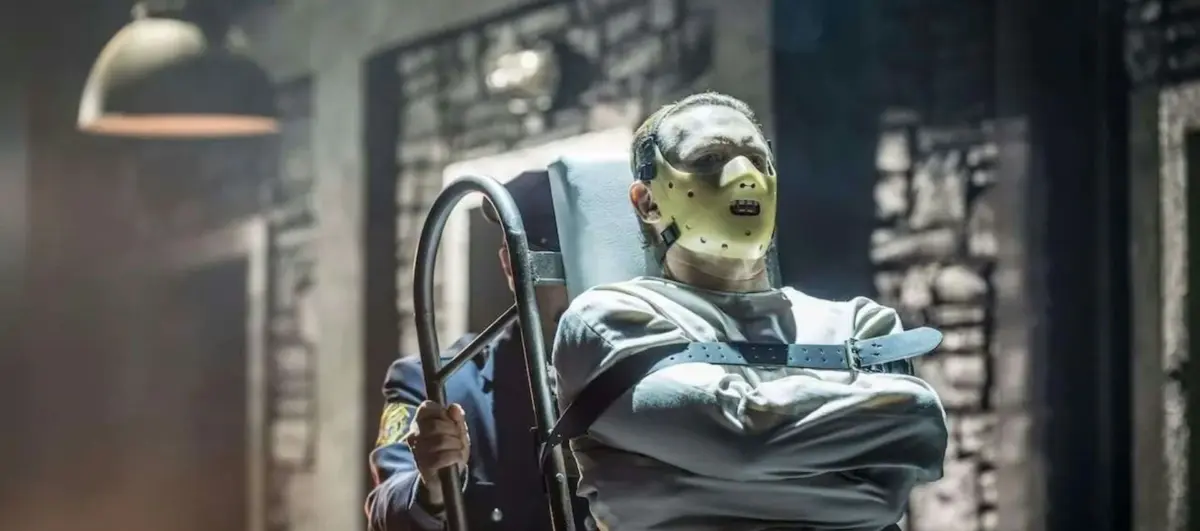
Now, as the property prepares for a major UK and Ireland tour running from October 2026 through June 2027, The Silence of the Lambs is breaking new ground by making its official stage debut. Produced with grand theatrical ambitions, the adaptation walks a tightrope between satisfying the expectations of "knowing audiences"—a term literary theorist Linda Hutcheon uses to describe fans intimately familiar with the source material—and introducing radical structural and thematic re-imaginings.
This production breathes fresh, albeit crimson, life into Harris’s narrative. By leveraging the unique spatial and multimedia capabilities of live theatre, the creative team has crafted a production that moves fluidly between the antiseptic confines of an asylum, the sterile corridors of Quantico, and the suffocating darkness of Buffalo Bill’s subterranean lair. Crucially, the stage adaptation also attempts to rectify some of the historic controversies that plagued Demme’s 1991 film, most notably the regressive portrayal of its primary antagonist, Jame "Buffalo Bill" Gumb.
Anchored by strong performances from John Partridge as Lecter and Mollie Gallagher as Clarice Starling, this theatrical iteration proves that even the most well-trodden corridors of horror can yield fresh terror when viewed under stage lights.
Detailed Chronology: The Evolution of a Cultural Phenomenon
To understand the significance of this theatrical adaptation, one must trace the evolutionary trajectory of Hannibal Lecter across various media over the last forty-five years.
1. The Literary Origins (1981–1988)
Thomas Harris established the framework for modern psychological thrillers with his 1981 novel Red Dragon, introducing readers to FBI profiler Will Graham and the imprisoned Dr. Hannibal Lecter. The publication of The Silence of the Lambs in 1988 expanded on Lecter’s universe, placing him in a complex, symbiotic intellectual chess match with ambitious FBI trainee Clarice Starling. Harris’s prose relied heavily on interiority, exploring the psychological trauma of its protagonists against the backdrop of systemic misogyny and institutional indifference.
2. The Cinematic Wave (1986–2002)
Before Hopkins claimed the role, Michael Mann directed the first screen adaptation of Harris’s work, Manhunter (1986), featuring Brian Cox as an understated, chilling Dr. Lecktor. However, it was Demme’s 1991 masterpiece The Silence of the Lambs that swept the Academy Awards—winning Best Picture, Actor, Actress, Director, and Adapted Screenplay—and defined the visual and auditory language of the franchise. This cinematic success paved the way for Ridley Scott’s grand guignol sequel Hannibal (2001) and Brett Ratner’s prequel remake Red Dragon (2002), both starring Hopkins.
3. The Television Renaissance (2013–2021)
The 21st century saw Lecter migrate to the small screen with two distinct visions. Bryan Fuller’s critically acclaimed psychological horror series Hannibal (2013–2015), starring Mads Mikkelsen as a hyper-stylized, operatic incarnation of the doctor, cultivated a fiercely loyal cult following. Years later, CBS attempted a procedural continuation with Clarice (2021), focusing tightly on Starling’s post-Lambs trauma, though it failed to achieve the cultural resonance of its predecessors.
4. The Stage Adaptation (2026–2027)
Culminating decades of transmedia migration, The Silence of the Lambs arrives on the live stage. Hitting major venues across the UK and Ireland from October 2026 through June 2027, the production translates the claustrophobic intensity of the FBI manhunt into a visceral, present-tense theatrical experience.
Supporting Context & Metrics: Navigating the Stage and Overcoming Controversy
Translating a cinematic masterpiece—one heavily reliant on extreme close-ups, sweeping atmospheric cinematography, and cinematic editing—into a static, physical space like a
theatre presents immense design challenges.
Innovative Staging and Multimedia Integration
The production avoids the sluggish pacing that often plagues novel-to-stage translations through fluid, multi-tiered set designs and inventive multimedia usage. The staging transitions seamlessly between disparate geographical locations:
- The Asylum: Where Lecter resides behind reinforced glass and steel bars.
- Quantico: The austere training academy where Clarice faces institutional hurdles.
- Jack Crawford’s Office: The high-pressure nerve center of the FBI manhunt.
- Buffalo Bill’s House: The claustrophobic residential nightmare where captive Catherine Martin fights for survival.
One particularly striking sequence finds Buffalo Bill physically and metaphorically hovering over the narrative, sitting atop Lecter’s cage while painstakingly sewing his infamous skin suit, even as Clarice and Lecter discuss his psychological profile below. Furthermore, the production employs avant-garde projection mapping. Case files are cast directly across the darkened stage, and a press conference held by Catherine Martin’s mother (played by Jo Mousley) is projected onto a fine, semi-transparent scrim. This allows the audience to simultaneously witness the mother’s televised plea and the unfolding action behind the screen, creating a layered theatrical grammar.
Addressing the Legacy of Queerphobia and Transphobia
Perhaps the most commendable evolution in this new adaptation lies in its handling of Jame Gumb, aka Buffalo Bill. Jonathan Demme’s 1991 film faced intense, organized backlash from LGBTQ+ activist groups, most notably GLAAD. Critics argued that the film weaponized Gumb’s ambiguous gender presentation, cross-dressing, and affection for his poodle against the community. Activists at the time pointed out how the film associated marginalized gender identities with murderous psychopathy—a narrative harm that many cultural historians argue contributed directly to subsequent transphobic and queerphobic societal violence. (The studio’s subsequent 1994 drama Philadelphia, also directed by Demme, was widely interpreted as an artistic and corporate olive branch to the community).
The 2026–2027 theatrical production makes a conscious artistic pivot away from this controversial framing. Instead of relying on tired, harmful tropes that conflate gender non-conformity with villainy, Bill is reframed as deeply childlike—often sitting cross-legged like a schoolchild or roaming the stage in his underwear. This physical vulnerability emphasizes his stunted, "unfinished" nature rather than weaponizing his identity, successfully detoxifying the character for modern audiences without blunting his menace.
Performance Analysis: Partridge, Gallagher, and the Dynamic Between Hunter and Hunted
Stepping into the monolithic shadows cast by Anthony Hopkins and Jodie Foster is no small feat. Yet, the principal cast manages to pay homage to their cinematic predecessors while carving out distinct, live-performance identities.
John Partridge as Dr. Hannibal Lecter
John Partridge approaches Lecter with feline grace, pacing the perimeter of his cage with predatory energy. While he nods to Hopkins through subtle vocal homages—particularly in the clipped enunciation of "F—B—I" and the icy cadence of "Quid pro quo, Clarice"—Partridge’s performance possesses a kinetic, theatrical physicality. He introduces a dynamic energy that makes Lecter less of a stationary museum piece and more of a coiled spring, ready to launch at any moment.
Mollie Gallagher as Clarice Starling
Similarly, Mollie Gallagher channels the foundational vocal texture established by Jodie Foster, utilizing husky tones and a subtle West Virginian (Appalachian) dialect that anchors Starling’s outsider status within the elite, patriarchal structures of the FBI. This linguistic vulnerability is highlighted in the text, recalling how Hopkins’s Lecter weaponized classism against Clarice by mocking her accent and probing into her coal-miner heritage. On stage, the physical proximity between Partridge and Gallagher creates a palpable, suffocating tension that feels entirely unique to the live medium, accelerating the psychological intimacy of their encounters.
Future Outlook
As The Silence of the Lambs embarks on its extensive UK and Ireland tour, its success signals a broader trend in contemporary theatre: the appetite for sophisticated, psychological thrillers adapted from screen to stage.
While purists may debate whether the production introduces entirely revolutionary structural ideas—or if it relies safely on the nostalgia of "knowing audiences"—its achievements cannot be understated. By smartly updating regressive characterizations, deploying cutting-edge multimedia projection, and trusting its actors to deliver emotionally resonant, high-stakes performances, the creative team has ensured that Hannibal Lecter’s theatrical debut is far from a mere novelty.
For lifelong aficionados of Thomas Harris’s universe, the production offers a thrilling, fresh perspective on a familiar nightmare. For newcomers encountering Clarice Starling’s harrowing descent into the mind of a killer for the first time, it stands as an uncompromising, expertly crafted piece of modern theatre that proves some monsters only grow more fascinating with age.