Executive Overview
When Romanian auteur Cristian Mungiu accepted the prestigious Palme d’Or at the Cannes Film Festival in May 2026 for his latest feature, Fjord, the triumph was hailed as a watershed moment for international cinema. Marking Mungiu’s first English-language, internationally-focused production since his 2007 masterpiece 4 Months, 3 Weeks and 2 Days, the film arrives as a sprawling, 147-minute moral drama. Set against the breathtaking, austere backdrop of a remote Norwegian coastal community, Fjord investigates a high-stakes culture clash centered around the controversial state intervention into the family life of immigrant parents.
Yet, beneath the glossy veneer of festival acclaim and a star-studded cast featuring Sebastian Stan and Renate Reinsve, the film has sparked a fierce critical debate. Far from offering a definitive exploration of institutional overreach or the friction between traditionalism and secular liberalism, Fjord has been accused by cultural critics of retreating into a comfortable, arthouse-friendly ambiguity. By fictionalizing real-world child protection controversies—most notably the 2015 Bodnariu family case—Mungiu attempts to pose a provocative, timely question: What if the liberals are the real authoritarians?
However, structural weaknesses, one-dimensional characterizations, and a persistent unwillingness to interrogate the limits of state tolerance transform what could have been a razor-sharp sociological thriller into a toothless exercise in fence-sitting. Rather than challenging liberal pieties, Fjord ultimately flatters them, offering an institutional critique that poses no genuine threat to the status quo. Funded by heavyweights including the Council of Europe, the European Union, and the Nordic Film Institute, the film stands as a prime example of contemporary festival cinema: well-intentioned, beautifully shot, but devoid of ideological courage.
Detailed Chronology: From Real-World Trauma to the Cannes Stage
To understand the cultural tremors surrounding Fjord, one must trace the trajectory from the headlines that inspired it to its eventual coronation on the French Riviera.
The Real-World Precedents
Fjord is not born out of abstract philosophical musings; it is firmly rooted in a series of highly publicized diplomatic and legal crises that have plagued Norway’s child welfare agency, Barnevernet, over the past decade. For years, international media outlets have cast a harsh spotlight on Norway’s stringent child protection laws, which strictly prohibit corporal punishment—including minor physical disciplinary actions like slapping—and prioritize child welfare through aggressive state interventions.
The most direct parallel to Mungiu’s narrative is the 2015 case of Marius and Ruth Bodnariu, a Romanian Christian family living in Norway. After school officials reported that the children were being subjected to physical discipline, Barnevernet removed all five children, including an infant, from the home. The resulting uproar triggered massive international protests, diplomatic friction between Bucharest and Oslo, and widespread accusations that Norwegian authorities were systematically blind to cultural differences regarding parental discipline. The European Court of Human Rights (ECHR) subsequently issued numerous rulings against Norway, finding that its child welfare interventions frequently violated the right to family life under Article 8 of the European Convention on Human Rights.
The Cinematic Translation
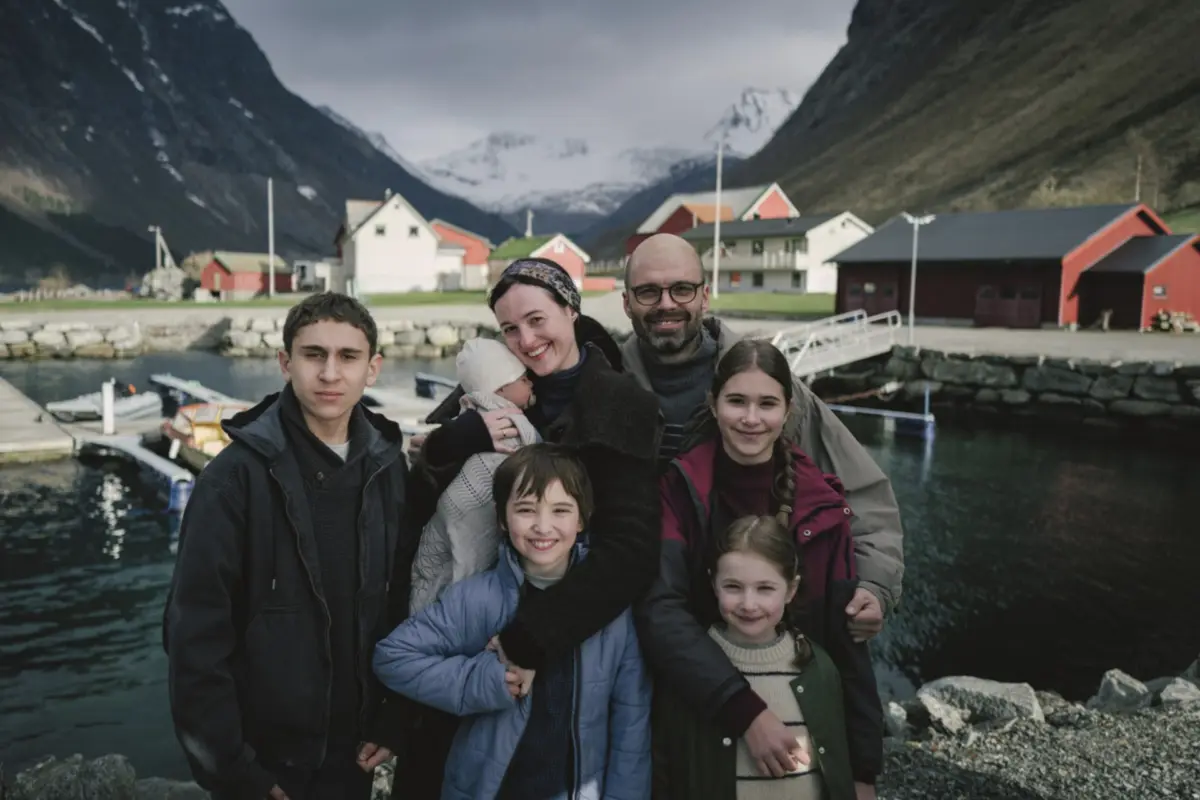
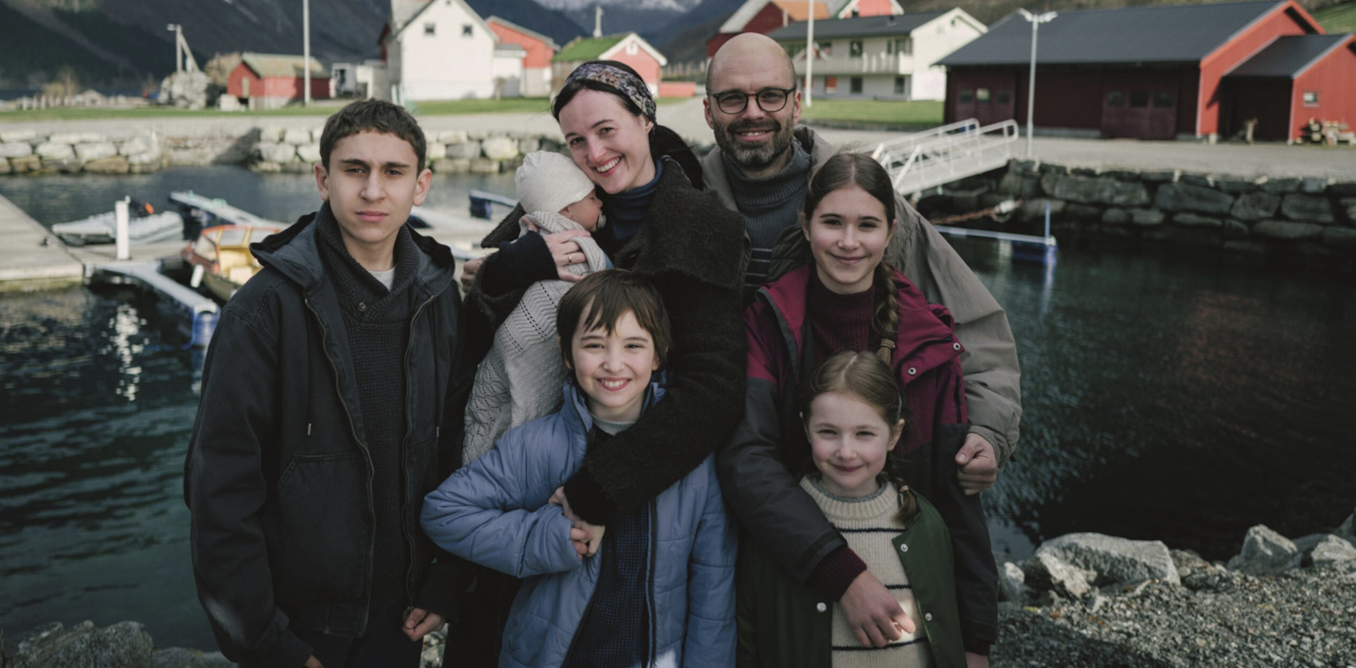
In Mungiu’s hands, this geopolitical flashpoint is transposed to the edge of a dramatic Norwegian fjord. The narrative centers on the Gheorghiu family: Mihai (Sebastian Stan), a fiercely protective Romanian immigrant, and his Norwegian wife, Lisbet (Renate Reinsve). As devout evangelical Christians raising five children, they exist on the margins of a secular, progressive local community.
The plot’s inciting incident occurs when the eldest daughter, Elia, is reported to social services after her physical education teacher discovers bruises on her shoulder. Swiftly and mechanically, the state apparatus swings into motion. All five children are removed from the home and placed into foster care, while Mihai and Lisbet find themselves thrust into a grueling judicial battle. Neighbors are drawn into the fray, including Mats Halberg (Markus Tønseth), a local school headteacher, and his wife Mia (Lisa Carlehed), a pragmatic defense lawyer.
The Festival Triumph and Critical Backlash
Following its secretive production and heavy anticipation, Fjord premiered at Cannes in May 2026 to rapturous applause from festival audiences, culminating in Mungiu’s second career Palme d’Or. Yet, the initial honeymoon phase quickly evaporated as cultural critics began to dissect the film’s ideological plumbing.
While conservative commentators initially hoped the film would serve as a damning indictment of Western European secular paternalism, and liberals anticipated a nuanced defense of universal child rights, both camps were ultimately left wanting. The film’s refusal to take
a firm stance on whether the parents were guilty of severe abuse or merely victims of cultural misunderstanding alienated viewers looking for a definitive moral compass.
Supporting Context & Metrics: The Cinematic and Sociopolitical Landscape
To fully grasp the mechanics of Fjord, one must evaluate it both within the lineage of the Romanian New Wave and against the backdrop of modern European cultural politics.
The Legacy of the Romanian New Wave
Mungiu emerged internationally as a leading voice of the Romanian New Wave, a cinematic movement defined by an unflinching commitment to gritty realism. Directors belonging to this wave forged their aesthetic as a direct rebellion against the orthodoxies of Romanian communism, which demanded that artists project an idealized, falsely harmonious image of the nation. Films like Mungiu’s own 4 Months, 3 Weeks and 2 Days (2007) utilized long takes, sparse dialogue, and razor-sharp observation to expose the moral decay and bureaucratic absurdity of late-communist life.
With Fjord, however, Mungiu crosses borders, stepping out of his familiar Eastern European socio-political sandbox and into the global arena. In doing so, he attempts to capture a distinctly contemporary anxiety: the friction between modern institutional progressivism and traditionalist pushback. The complaints of the so-called "intolerant left"—ranging from mandatory diversity, equity, and inclusion (DEI) quotas and cancel culture to bureaucratic overreach and paternalistic judicial intervention—serve as the subtext for Mihai’s alienation. Yet, unlike his earlier work, which diagnosed specific systemic ills with surgical precision, Fjord generalizes these anxieties into a nebulous, atmospheric fog.
Production Metrics and Institutional Backing
- Running Time: 147 minutes—a sprawling canvas that critics argue exacerbates the narrative’s stagnation.
- Key Financial Backers: The Council of Europe (Eurimages), the European Union’s Creative Europe MEDIA program, and the Nordic Film Institute.
- International Reach: Distributed globally with high-profile releases across major European film festivals, including London and Toronto.
This institutional pedigree is crucial to understanding the film’s artistic compromises. Funded in large part by the very pan-European bureaucratic bodies that mirror the institutional mindset critiqued within the film, Fjord operates within a secure financial ecosystem designed to reward high-minded ambiguity.
Official Statements and Critical Discourse
The discourse surrounding Fjord has exposed deep fault lines among filmmakers, critics, and cultural commentators regarding the responsibilities of political art.
Cristian Mungiu’s Vision
In various press conferences and promotional interviews following his Cannes victory, Mungiu articulated a grand, philosophical ambition for the project. He stated that his goal was to force audiences into an uncomfortable ethical confrontation:
"What if the liberals are the real authoritarians? We live in a society that claims to champion tolerance, but the moment an alternative belief system—whether religious or traditional—refuses to bend the knee to institutional norms, the velvet glove comes off and the iron fist of the state takes over."
Mungiu has repeatedly framed Fjord as a study in "culture clashes," pointing to the multifaceted nature of the friction on screen: the national traditions of Norway versus Romania, the metaphysical worlds of secularism versus evangelical Christianity, and the generational divides of northern and southern Europe.
The Critical Counter-Offensive
Despite the director’s lofty framing, cultural critics have pointed out glaring contradictions in the film’s execution. Writing in major cultural journals, film scholars have argued that Fjord systematically blunts its own sharpest edges.
By hinting at moments of severe, potentially criminal physical abuse by the parents—only to quietly drop or muddy the evidentiary waters—the film evades the very ethical dilemma it purports to explore. As one prominent review noted:
"Had Fjord exhibited genuine, unblinking suspicion about the parents’ behavior, it would present a harrowing, difficult proposition about the limits of cultural toleration in a pluralistic society. Instead, the film pulls its punches, denying viewers the baseline information required to understand what kind of moral dilemma is even being posed."
Furthermore, critics have lambasted the flat characterization of the ensemble. The five children vanish from the narrative the moment the trial begins, stripping the story of its emotional core. Meanwhile, acclaimed Norwegian actress Renate Reinsve is relegated to the background as Lisbet, a character whose internal negotiation between her Norwegian heritage and her husband’s imported patriarchal dogmatism is left frustratingly unexplored.
Future Outlook: The Legacy of Fjord in Contemporary Culture
As Fjord completes its festival circuit run and prepares for wider commercial streaming and theatrical distribution, its long-term cultural footprint is already coming into focus.
A Symptom of "Festival Cinema" Conformity
The film will likely be studied by film historians as a quintessential artifact of 2020s arthouse cinema—a work that wears the mantle of radical dissent while remaining fundamentally safe. By refusing to commit to a political or moral stance, Fjord successfully satisfies the palate of festival juries and cultural bureaucrats who equate ambiguity with profound depth.
The irony of the film’s reception lies in its relationship with modern liberalism. As critics have observed, no belief system enjoys self-flagellation quite like contemporary liberalism—provided that the critique originates from the right, as it validates the system’s professed values of sophistication and open-mindedness. By packaging conservative grievances within a prestige European co-production, Fjord provides institutional liberalism with a badge of honor: proof that it can tolerate dissent, even as that dissent is safely neutralized inside a 147-minute cinematic echo chamber.
What Lies Ahead for Political Filmmaking?
Fjord serves as a cautionary tale for political filmmaking in an era of intense polarization. When art attempts to mirror the fractured reality of the modern culture wars without taking ideological risks, it risks collapsing under the weight of its own hesitation.
While Cristian Mungiu remains one of Europe’s most technically gifted directors, Fjord demonstrates the limits of manufacturing provocative cinema through strategic vagueness. In an era demanding moral clarity and unflinching sociological inquiry, Fjord offers a shimmering, beautifully photographed retreat into indecision—leaving audiences to ponder whether a film about a catastrophic storm of state power and family trauma could have used a great deal more lightning, and significantly less fog.