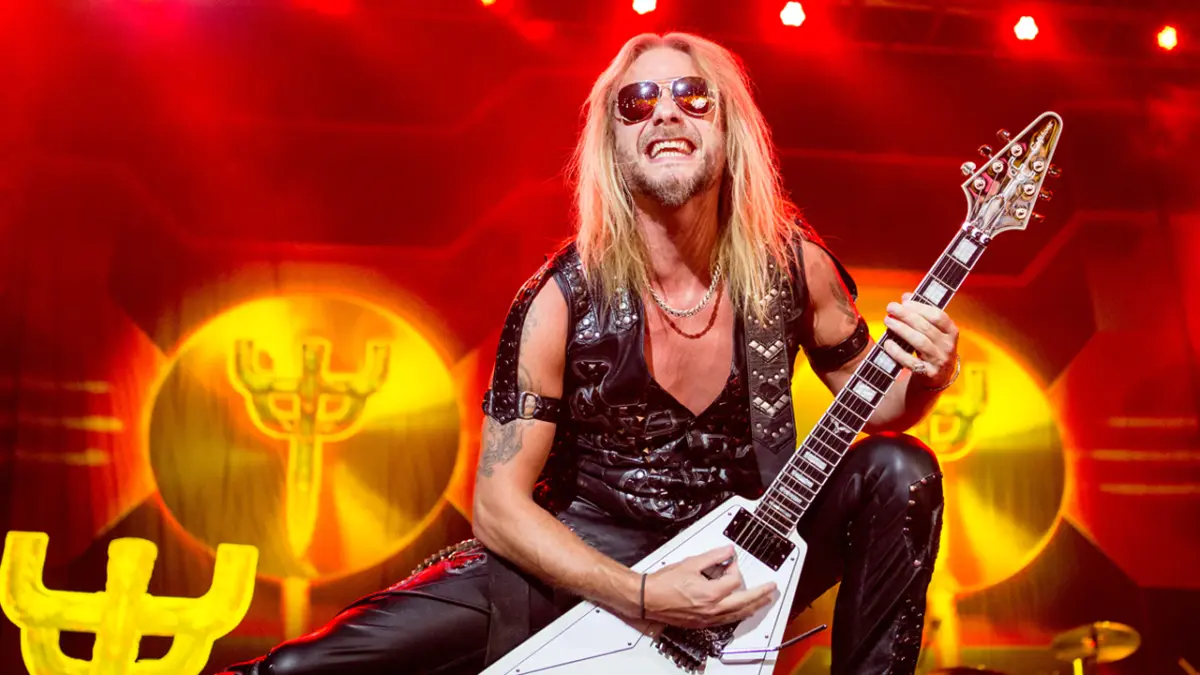
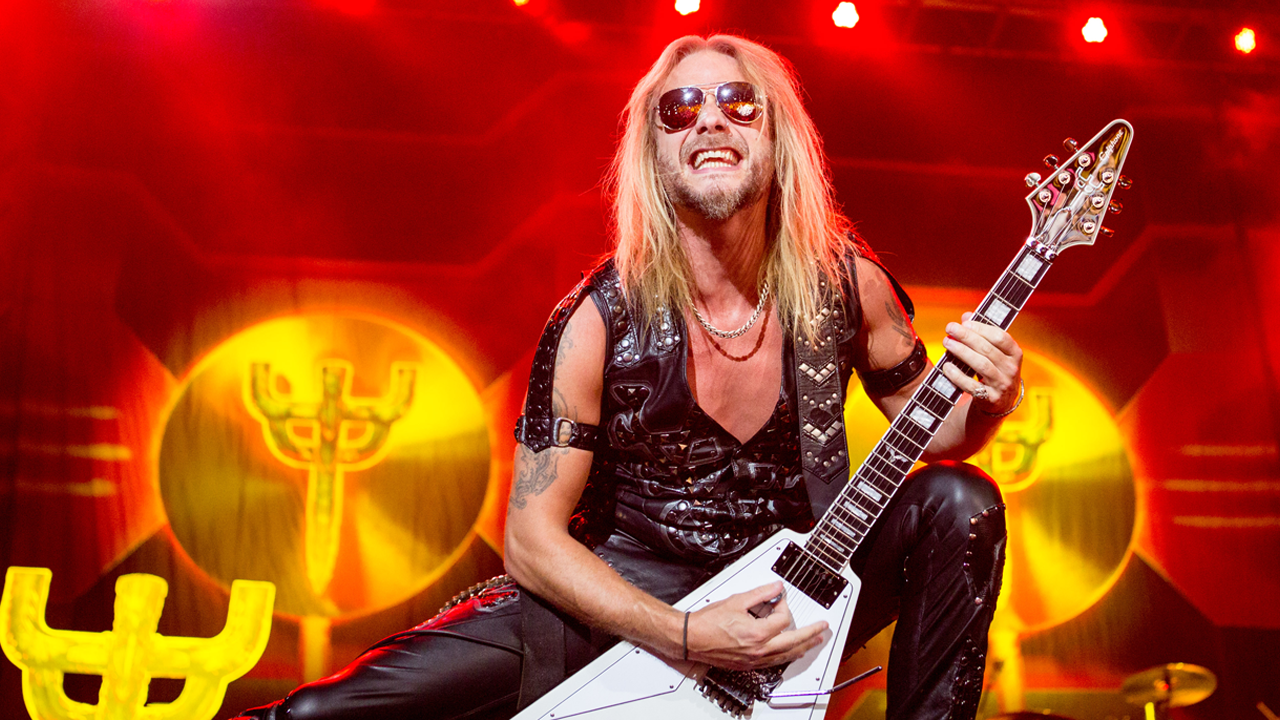
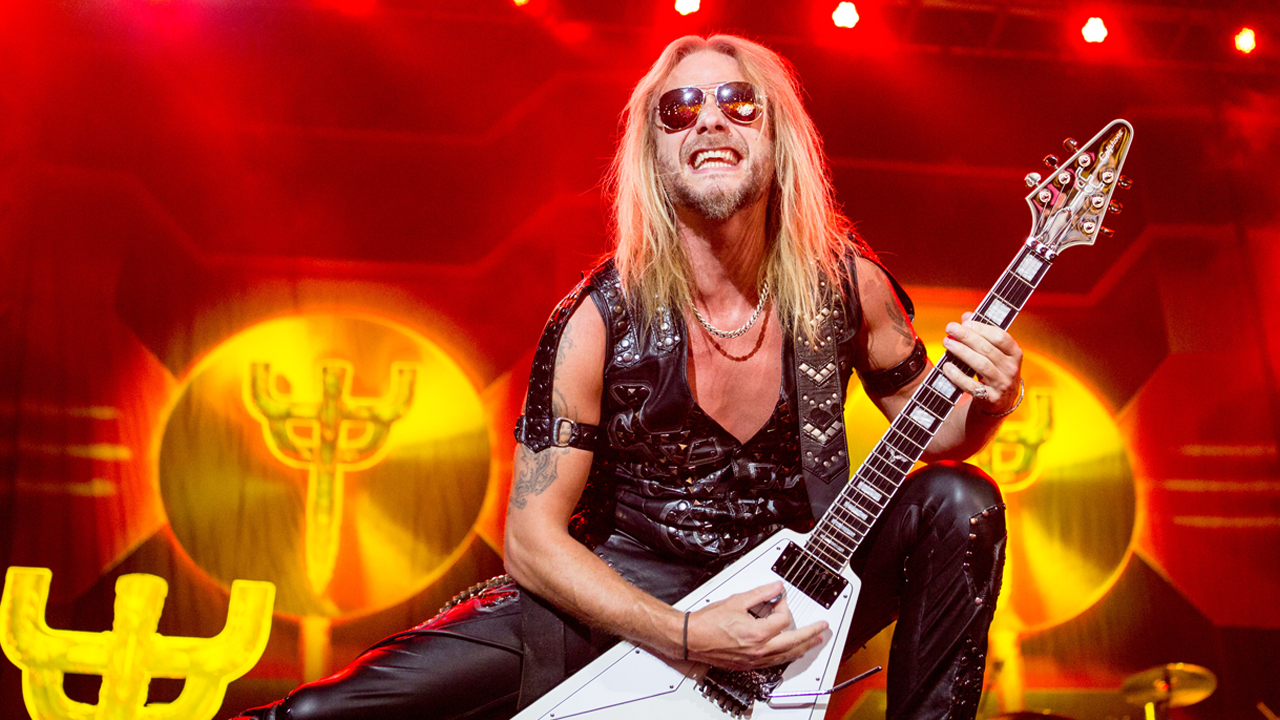
When British guitarist Richie Faulkner stepped onto the global stage in 2011 to replace founding member K.K. Downing in Judas Priest, he was tasked with one of the most daunting assignments in heavy metal history. Replacing a genre-defining hero in a band that literally helped draft the blueprint for heavy metal required more than just virtuosic speed; it demanded an intimate, cellular understanding of the genre’s history, phrasing, and theatrical power.
Over the past decade and a half, Faulkner has not only silenced initial skeptics but has firmly established himself as a primary creative engine within Judas Priest and a formidable force across the broader hard rock landscape. Beyond his defining tenure with the Metal Gods, Faulkner’s resume includes arranging metal symphonies for acting legend Sir Christopher Lee, touring international arenas with Lauren Harris, and launching the heavy metal supergroup Elegant Weapons alongside industry titans.
To understand Faulkner’s journey from a young guitarist practicing in a London bedroom to a global guitar icon, one must examine the sonic landmarks that shaped his musical DNA. From early blues-rock revelations to the complex thrash arrangements of the late 1980s, Faulkner’s career offers a compelling case study in dedication, artistic mentorship, and the transformative power of heavy metal.
Detailed Chronology: From Street Busker to Metal Virtuoso
+-----------------------------------------------------------------------------------+
|                           FAULKNER'S CAREER TRAJECTORY                            |
+-----------------------------------------------------------------------------------+
|  Early 1980s  : First riff learned (Jimi Hendrix) & first arena gig (Bryan Adams) |
|  Late 1980s   : Heavy Metal awakening via Iron Maiden, Metallica, and Pantera    |
|  1990s-2000s  : Pub cover bands (Jeff Beck) & Joining Dirty Deeds (Deeds)        |
|  2008         : Global tour with Lauren Harris supporting Iron Maiden            |
|  2010         : Musical arranger for Sir Christopher Lee's 'Charlemagne'         |
|  2011-Present : Lead Guitarist for Judas Priest                                  |
|  2023-Present : Formed Heavy Metal Supergroup Elegant Weapons                    |
+-----------------------------------------------------------------------------------+
Phase 1: The Early Sparks and Childhood Epiphanies (1980s)
Faulkner’s obsession with six strings began with a borrowed, painted guitar and a ten-pence coin. Introduced to guitar playing by a family friend who lent him a double-cutaway Gibson—painted bright orangey-pink with blue and red splashes—Faulkner gravitated toward Jimi Hendrix’s legendary performance of "Wild Thing" at the 1967 Monterey Pop Festival. After picking out the basic chords, he stepped outside his home onto the street to play. An elderly neighbor placed a 10p coin on a nearby wall, marking the first monetary compensation Faulkner ever received for performing.
Concurrently, his father nurtured his appreciation for live spectacle. Before taking a young Faulkner to his first arena show—Bryan Adams on his Into The Fire tour at Wembley Arena—his father conditioned him for the shear volume of live sound. Driving around listening to Adams’ seminal 1984 album Reckless with songs like "Run To You" cranked to maximum volume, Faulkner absorbed both the power of anthemic songwriting and the electrifying scale of arena rock.
Phase 2: The Metal Awakening & The 10,000-Hour Grind (Late 1980s – 1990s)
While his school peers gravitated toward mainstream hard rock releases, Faulkner veered into heavier territory. His entry point into true heavy metal was Iron Maiden’s double live package, Live After Death. The live album served as an interactive masterclass. Listening through headphones, Faulkner deciphered the distinct panning of guitarists Adrian Smith (left channel) and Dave Murray (right channel). By turning off Murray’s channel, Faulkner could play along with Smith, essentially stepping into the band as a dual-lead partner to master complex tracks like "Hallowed Be Thy Name".
        Iron Maiden "Live After Death" Pan Method
        -----------------------------------------
        [Left Speaker]   --> Adrian Smith  (Faulkner learned)
        [Right Speaker]  --> Dave Murray   (Muted by Faulkner to play along)
As his teens progressed, Faulkner immersed himself in the technical thrash and groove metal of the late 1980s and early 1990s:
Metallica’s …And Justice For All (1988): Introduce Faulkner to complex, syncopated rhythm work and Kirk Hammett’s modal lead techniques, with "One" leaving a lasting mark on his dynamic approach.
Pantera’s Far Beyond Driven (1994): Fired up his passion for aggressive riffing. Track cuts like "Five Minutes Alone" showcased Dimebag Darrell’s legendary tone and groove.
Judas Priest’s Painkiller (1990): The album hit him with explosive force. The album’s relentless double-bass drumming, high-octane tempo, and aggressive dual-guitar onslaught redefined Faulkner’s standard for speed and precision.
Phase 3: The Covers Circuit and Professional Apprenticeship (2000s)
Before reaching international stages, Faulkner honed his craft in local London cover bands, playing standard classic rock and pop repertoire night after night. Performing songs like Jeff Beck’s "Hi-Ho Silver Lining" offered a critical realization: while guitarists often fixate on technical flash, the general public responds to melody and simplicity. This realization taught him how to balance virtuosic solos with structured songwriting.
Faulkner eventually joined hard rock outfit Dirty Deeds (later shortened to Deeds), collaborating with bassist Tony Newton. Produced by Iron Maiden leader Steve Harris, Deeds provided Faulkner with his crucial link to the industry. This relationship led to a gig touring the world with Lauren Harris (Steve Harris’ daughter), supporting Iron Maiden on their massive Somewhere Back in Time World Tour in 2008. Nightly arena exposure, combined with performing tracks like Gun’s "Steal Your Fire," established Faulkner’s reputation as a dependable, world-class performer.
       Steve Harris (Iron Maiden)
            |
            v  (Produced)
       Dirty Deeds / Deeds (with Tony Newton & Richie Faulkner)
            |
            v  (Recruited)
       Lauren Harris Band (Touring globally on Maiden's 'Somewhere Back in Time' Tour)
            |
            v  (Key CV Experience)
       Judas Priest Audition (2011)
Phase 4: Cinematic Metal and the Call from Judas Priest (2010–Present)
In 2010, Faulkner was brought on to arrange heavy metal instrumentation for film icon Sir Christopher Lee’s symphonic metal project Charlemagne: The Omens of Death. Tasked with transforming orchestral compositions into heavy metal backing tracks, Faulkner pushed the intensity of pieces like "Let Legend Mark Me As The King" after Lee specifically requested a heavier sound.
Before Faulkner could record the final album guitar tracks, fate intervened. Judas Priest was auditioning guitarists to replace K.K. Downing ahead of their Epitaph World Tour. Faulkner’s combination of high-level touring experience, deep familiarity with Priest’s catalog, and musical authority made him the definitive choice. Joining Judas Priest in 2011, he transitioned from a respected sideman into a global leader of modern heavy metal.
Supporting Context, Musical DNA, & Key Metrics
The Foundations of Faulkner’s Guitar Style
Faulkner’s playing style bridges classic New Wave of British Heavy Metal (NWOBHM) melodic phrasing and late-80s American thrash precision. His musical approach rests on three distinct pillars:
                  +-----------------------------------+
                  |     RICHIE FAULKNER'S SOUND       |
                  +-----------------------------------+
                                    |
     +------------------------------+------------------------------+
     |                              |                              |
     v                              v                              v
[CLASSICAL DUAL-GUITAR]      [RHYTHMIC PRECISION]         [POP SONGWRITING]
Iron Maiden / Judas Priest   Metallica / Pantera          Jeff Beck / Bryan Adams
• Panned harmonies           • Complex syncopation        • Memorable hooks
• Modal lead trade-offs      • Aggressive groove riffing  • Structural balance
Classical Dual-Guitar Harmonies: Derived directly from studying Murray/Smith (Iron Maiden) and Tipton/Downing (Judas Priest). Faulkner relies heavily on natural minor and Aeolian scales, panned harmony leads, and synchronized rhythm figures.
Aggressive Rhythmic Precision: Influenced by James Hetfield and Dimebag Darrell, Faulkner utilizes tight, alternate-picked rhythm patterns and muted palm-chugging that give post-2011 Judas Priest tracks (Firepower, Invincible Shield) their modern edge.
Hook-Driven Melody: Grounded in his early pub-band days playing Jeff Beck covers and classic pop-rock, Faulkner structures his leads as melodic stories rather than senseless shredding.
Career Impact & Project Metrics
Era / Project
Key Track / Album Influence
Role / Contribution
Core Impact & Career Outcome
Early Influences
Jimi Hendrix – "Wild Thing"
Beginner / Street Busker
First earnings as a musician (10p tip); sparked passion for stage performance.
Arena Preparation
Bryan Adams – "Run To You"
Young Fan / Apprentice
Learned stadium sound dynamics and high-energy showmanship.
Technical Blueprint
Iron Maiden – Live After Death
Self-Taught Student
Mastered dual-lead guitar mechanics via channel panning.
Groove & Thrash Mastery
Metallica – …And Justice For All Pantera – "Five Minutes Alone"
Developing Virtuoso
Integrated tight syncopation and heavy groove into his core riffing style.
Professional Launchpad
Deeds – "Valley Of The Kings"
Lead Guitarist
Met Steve and Lauren Harris; built industry credentials.
Symphonic Metal
Sir Christopher Lee – Charlemagne
Composer / Arranger
Translated orchestral scores into heavy metal arrangements.
Peak Career
Judas Priest – Painkiller (Catalog)
Lead Guitarist / Songwriter
Replaced K.K. Downing; co-wrote critically acclaimed late-career Priest albums.
Supergroup Project
Elegant Weapons – Evolution
Bandleader / Guitarist
Formed new metal supergroup alongside industry veterans.
Official Statements & Firsthand Reflections
Throughout his career, Faulkner has reflected on the key moments, spooky coincidences, and creative lessons that defined his musical trajectory:
On Busking and His Very First Earnings
"The Jimi Hendrix version of ‘Wild Thing’ was the first thing I learned… My dad’s friend had lent us his guitar—a double-cutaway Gibson painted a bright orangey pink and splashed with blues and reds, like a punk thing. So I went out onto the street with his guitar and I was loosely playing ‘Wild Thing’ in front of the house. This little old lady put 10 pence on the wall, so that was the first money I ever made playing the guitar."
On Touring Preparation with His Father
"Growing up in the 80s, Bryan Adams was massive. My father took me to see the Into The Fire tour at Wembley. It was my first live gig in an arena, and my dad used to take me out in the car preparing me for how loud it was going to be. We’d go out in the car and crank Reckless really loud and drive around listening to songs like ‘Run To You’ at full volume."
On Learning Iron Maiden’s Dual Guitar Harmony
"Instead of buying a Guns N’ Roses record like everyone else was, I bought Live After Death by Iron Maiden. I remember trying to learn ‘Hallowed Be Thy Name’ with the light and shade and the different parts. The guitars panned left and right, so you had Adrian Smith on one side and Dave Murray on the other. I’d learn Murray’s bits and then turn him off and play the gig, essentially."
On The Paranormal "JP" Prediction
"We once asked [a Ouija board], ‘Is Richie ever going to be in a famous band?’ and it didn’t say ‘Priest’, but it might have said ‘JP’, which wouldn’t have made much sense at the time."
On Touring with Lauren Harris and Building His CV
"Fast forward 15 years and I’m out on the Somewhere Back in Time tour playing with Lauren Harris… She shared her dad’s DNA; I never saw Lauren back down from anything. And from my point of view, when Priest were looking, it was a big part of my CV. You know, ‘I’ve been around the world, I’ve been on that sort of schedule, played some big stages’. Apart from playing your instrument, I think that helped in the audition process."
On Arranging Orchestral Metal for Sir Christopher Lee
"His team sent the stuff, which was orchestra based, but they wanted it arranged for a heavy metal band. I sent them four or five tracks and Christopher said that he wanted it more metal, so I redid them. I didn’t get to play on the record because I got the call from Priest, but it was a joy to work with him and get to meet a legend like Christopher Lee."
Strategic Future Outlook & Enduring Legacy
Richie Faulkner’s trajectory highlights a unique path in modern rock history. Rather than rising through internet viral fame, he earned his stripes through traditional, high-intensity avenues: pub cover gigs, endless bedroom practice sessions alongside headphone records, and grueling world tours as a supporting musician.
                   RICHIE FAULKNER'S DUAL-TRACK FUTURE
                   -----------------------------------
                                    |
         +--------------------------+--------------------------+
         |                                                     |
         v                                                     v
[JUDAS PRIEST]                                        [ELEGANT WEAPONS]
• Headline World Tours                                • Studio Release: 'Evolution'
• Modern Era Albums ('Firepower', 'Invincible Shield') • Creative Freedom as Project Leader
• Preserving NWOBHM Heritage                          • Collaborations with Metal Elite
What Lies Ahead:
Judas Priest’s Ongoing Reign: As co-songwriter alongside Glenn Tipton and Rob Halford, Faulkner has revitalized Judas Priest’s creative output. Albums like Firepower and Invincible Shield have received critical acclaim, proving that his role in Priest goes far beyond playing legacy solos—he is instrumental in shaping their modern sound.
Elegant Weapons & Solo Creative Outlets: With the release of Evolution via Exciter Records, Faulkner’s side project Elegant Weapons gives him complete creative freedom as a project leader. Featuring high-profile metal veterans like vocalist Ronnie Romero and bassist Rex Brown, the supergroup provides a fresh platform for his riff-driven compositions.
Preserving the NWOBHM Legacy: As classic metal pioneers retire, Faulkner stands as a key bridge between heavy metal’s golden era and its future. His deep appreciation for traditional song structures, combined with modern technical reliability, ensures that classic heavy metal remains vibrant and vital for generations to come.