Executive Overview
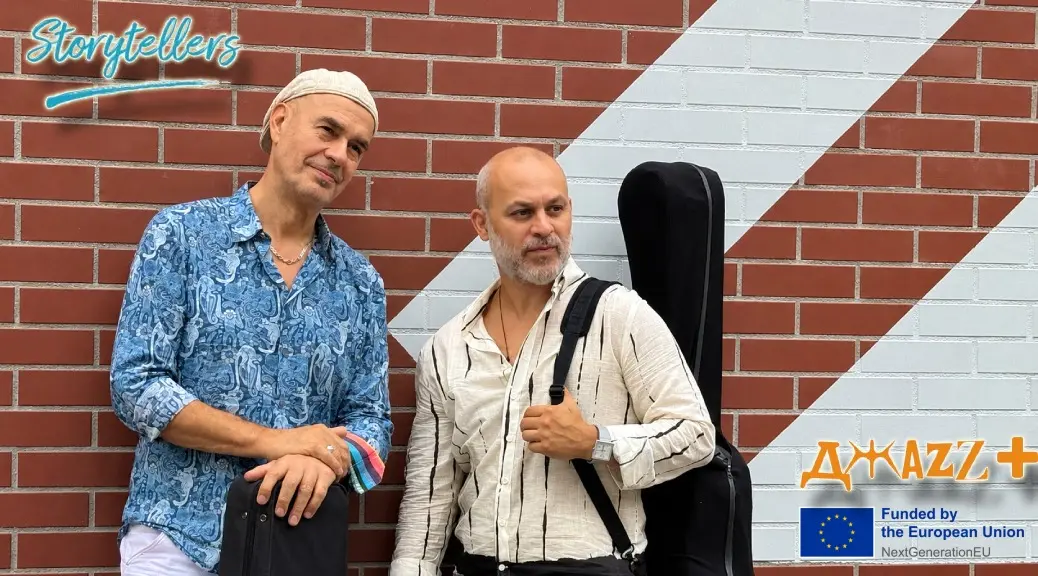
In the contemporary landscape of global instrumental music, few collaborations carry the weight of geographical, cultural, and temporal convergence quite like Storytellers, the landmark collaborative album by Italian acoustic virtuoso Antonio Forcione and Turkish fretless guitar master Cenk Erdoğan. Recorded over the summer of 2025 at Pekarnata Studio in Sofia, Bulgaria, and engineered by Ivan Boshev, the ten-track collection represents far more than a mere meeting of minds; it is the culmination of a twenty-four-year delayed creative dialogue.
The partnership spans hemispheres, stylistic idioms, and generations. Forcione, whose illustrious career includes roughly twenty solo and collaborative albums—most notably his 2006 masterwork Heartplay alongside the late jazz giant Charlie Haden—brings the rich, rhythmic warmth of Western nylon-string traditions. Erdoğan, a pioneer of the baritone fretless guitar whose lineage traces directly back to Turkish microtonal innovators like Erkan Oğur, introduces the haunting, vocal resonance of Eastern modalities.
Distributed across a meticulously sequenced gatefold vinyl, Storytellers operates as a masterclass in cross-cultural composition. Alternating strictly between the two artists’ writing credits, the album balances Forcione’s structured, cinematic storytelling with Erdoğan’s fluid, microtonal landscapes. Bolstered ironically by the bureaucratic apparatus of the European Union—specifically funded through Bulgaria’s share of the NextGenerationEU recovery programme—this long-awaited project proves that while officialdom can delay art, it cannot diminish its ultimate resonance. As the final notes fade into a spoken-word sign-off declaring, "I think we have a good vibe, man," the listener is left with little room to argue.
Detailed Chronology: A Twenty-Year Journey to the Studio
The 2001 Istanbul Encounter
The narrative of Storytellers begins in the autumn of 2001 in Istanbul. Cenk Erdoğan was then a young composition student at İstanbul Bilgi University, deeply immersed in the complexities of contemporary theory and traditional Anatolian sounds. Antonio Forcione, already an established fixture of the international acoustic guitar scene, was visiting the city to perform and host a masterclass at a local guitar festival.
Sitting in the audience, Erdoğan watched as Forcione dissected the mechanics of nylon-string performance. However, when the masterclass opened up to performance, it was Erdoğan’s playing that caught Forcione’s ear. Listening to the young student manipulate a fretless instrument, Forcione recognized an unmistakable, human vocal quality in the microtonal bends—a singing tone that transcends language. Impressed, Forcione extended an impromptu invitation for Erdoğan to join him in London to record and perform.
The Bureaucratic Hiatus
Had geopolitical and administrative realities permitted, the duo’s debut album might have materialized in the early 2000s. Instead, stringent visa regulations, systemic border controls, and the formidable barriers of international arts administration kept the collaboration on hold. For nearly two decades, the project existed only as a hypothetical conversation, occasionally reignited when Forcione’s name surfaced in European jazz circles via mutual collaborators like percussionist Enzo Zirilli, guitarist Tony Rémy, and pianist Robert Mitchell.
During this extended hiatus, both musicians forged formidable independent paths. Forcione solidified his reputation as a genre-defying tour de force, busking his way out of Covent Garden’s historic streets into global acclaim and collaborating with jazz royalty. Meanwhile, Erdoğan immersed himself in the legacy of Erkan Oğur—the visionary who famously defretted a classical guitar in 1976 to capture the elusive microtones of Turkish folk music. Erdoğan pulled the frets from his own instrument, developed an influential pedagogical framework for fretless technique, taught as far afield as Berklee College of Music, and contributed his distinctive textures to Jim “Kimo” West’s Grammy-winning album More Guitar Stories.
The 2019 Reunion and 2025 Recording Sessions
The logjam finally broke in 2019 when Sofia’s Jazz Plus festival organizers successfully brought Forcione and Erdoğan together on the same stage. The onstage chemistry was immediate, sparking a series of live dates across Bulgaria and select European venues.
Realizing the artistic viability of their cross-cultural dialogue, the duo booked time at Pekarnata Studio in Sofia during July and August of 2025. Over the course of these intensive summer sessions, engineer Ivan Boshev captured the organic interplay of their instruments, ensuring that every transient, slide, and over-tone was preserved with pristine fidelity. Appropriately, the finished product bears a European Union funding credit on its gatefold sleeve—a poetic nod to the NextGenerationEU recovery programme, suggesting that European bureaucracy ultimately owed the artists a debt it was finally ready to pay.
Supporting Context & Metrics: The Anatomy of the Dual-String Idiom
To fully appreciate the architectural triumph of Storytellers, one must examine the instrumental and structural metrics that define the album. The record comprises exactly ten original compositions, divided evenly with five pieces attributed to each composer.
| Track Position | Title | Composer | Primary Aesthetic / Stylistic Influence |
|---|---|---|---|
| Side A, Track 1 | Folk Song for Two | Antonio Forcione | Western nylon-string / Egberto Gismonti homage |
| Side A, Track 2 | Da Capo | Cenk Erdoğan | Flamenco-infused contemporary fusion |
| Side A, Track 3 | Children of the World | Antonio Forcione | Reflective, accessible melodic composition |
| Side A, Track 4 | 4 Hands on the Table | Cenk Erdoğan | Turkish folk / culinary-inspired polyphony |
| Side A, Track 5 | Petals in the Ashes | Antonio Forcione | Rural town square wedding dance atmosphere |
| Side B, Track 1 | Dilemma | Cenk Erdoğan | Sitar-esque textures / psychological dialogue |
| Side B, Track 2 | Nena | Antonio Forcione | Cinematic narrative / ECM-esque atmospheric space |
| Side B, Track 3 | Leaving Home | Cenk Erdoğan | Evocative sorrow / transient emotional depth |
| Side B, Track 4 | Turning Pages | Antonio Forcione | Childhood nostalgia / Southern Italian dreamscape |
| Side B, Track 5 | Luna | Cenk Erdoğan | Rhythmic exploration / dynamic closing journey |
Side A: Establishing the Dialogue
The record opens with Forcione’s Folk Song for Two, written with Brazilian multi-instrumentalist Egberto Gismonti in mind. Here, the listener is immediately struck by the divergence of timbres. Forcione anchors the lower and mid-ranges with a percussive, articulate Western nylon-string attack, while Erdoğan responds with the liquid, bending sustain of his baritone fretless instrument.
Erdoğan’s Da Capo follows, injecting a distinct flamenco flare into the sequence. The tension between Erdoğan’s Spanish-styled scalar runs and Forcione’s stabilizing counter-rhythms creates an electric push-and-pull. While Forcione’s subsequent Children of the World leans into an unchallenging, comforting melodic space, the energy surges again with Erdoğan’s 4 Hands on the Table. Named after a professional culinary expression describing two chefs synchronizing their movements in a fast-paced kitchen, the piece pulses with unmistakable Turkish rhythmic idioms that evoke the intricate phrasing of masters like Önder Focan and Okay Temiz. Side A concludes with Forcione’s Petals in the Ashes, evoking the communal, trance-like atmosphere of a rural town square celebration where onlookers lose themselves entirely in the music.
Side B: Deepening the Narrative
Side B opens with what many consider the emotional peak of the album: Erdoğan’s Dilemma. Written as an exploration of the eternal conflict between the heart and the head, the track features an astonishing trade-off of motifs where Erdoğan’s fretless slides take on the otherworldly timbre of an Indian sitar.

Forcione’s Nena subsequently introduces that elusive, spacious sonic quality often associated with ECM Records, unfolding like a silent film driven entirely by acoustic resonance. This leads into Erdoğan’s Leaving Home, a poignant dedication to the loved ones left behind during endless concert tours. In this piece, Forcione establishes a deceptively cheerful opening sequence before Erdoğan subverts it, injecting profound depth and sorrow into the lower registers.
The penultimate track, Forcione’s Turning Pages, serves as a deeply personal meditation on his childhood in Molise, Southern Italy, where he lived with his grandparents while his parents worked abroad. Utilizing a heavier timbre and subtle studio echo, Forcione crafts a dreamlike audio photograph of leafing through vintage family albums.
The album closes with Erdoğan’s Luna. Dedicated to the unpredictable shapes of the moon—though delightfully sharing its name with a beloved canine companion—the track charts a winding path past urban soundscapes and rhythmic milestones, cementing the album’s lasting emotional footprint before the needle settles into the run-out groove.
Official Statements and Liner Notes
The physical presentation of Storytellers elevates the listening experience from a passive audio consumption model to an intimate literary and artistic engagement. The gatefold vinyl package functions as a collaborative diary. Inside, Antonio Forcione pens a warm, welcoming introduction to the listener, while both composers provide supplementary contextual liner notes for every single track.
Rather than relying on sterile musicological descriptions, the artists utilize these micro-essays to share personal touchstones: fragments of childhood memories, dedications to absent friends, aphorisms borrowed from master chefs, and reflections on the transient nature of life on the road. This literary transparency reinforces the album’s core thesis—that music is fundamentally an act of storytelling.
In his notes for Turning Pages, Forcione reflects on the emotional architecture of migration and memory:
"Living with my grandparents in southern Italy while my parents sought work abroad left an indelible imprint on my perception of time and space. When you look through old photo albums as a child, you aren’t just seeing faces; you’re trying to reconstruct a world you were only partially permitted to inhabit. This piece is an attempt to translate that silent, searching gaze into a simple melody and chord progression."
Similarly, Erdoğan’s reflections on Leaving Home capture the heavy psychological toll of the itinerant musician’s life:
"When you live out of a guitar case, the hardest part isn’t the physical exhaustion of travel; it’s the weight of the silence you leave behind in empty rooms. This composition maps the space between the front door closing and the first chord played on a distant stage."
Future Outlook: The Legacy of a Transnational Collaboration
As Storytellers makes its way into the hands of jazz, world, and acoustic guitar aficionados worldwide, the project establishes a new benchmark for cross-cultural improvised music. In an era where international collaborations are frequently assembled via digital file-sharing across disparate continents, the Forcione-Erdoğan partnership serves as a powerful reminder of the irreplaceable value of physical co-presence, shared studio time, and mutual cultural immersion.
Industry analysts and critics note that the success of the Sofia sessions proves the viability of regional European arts funding mechanisms—such as the NextGenerationEU initiative—in fostering profound artistic exchanges that might otherwise suffocate under the weight of modern international bureaucracy. By underwriting a project delayed by two decades of administrative red tape, the recovery programme has inadvertently catalyzed one of the most compelling acoustic guitar albums of the decade.
Looking forward, representatives for both artists have hinted at the possibility of a limited-run international tour throughout late 2026 and 2027, depending on festival scheduling and travel logistics. Given the rapturous critical reception of Storytellers and the deep, symbiotic rapport demonstrated on wax, audiences can only hope that the next chapter of this cross-continental conversation will not require another twenty years to unfold. Until then, listeners are left with ten masterclasses in string-craft, a gatefold full of evocative memories, and a final spoken reassurance that rings entirely true: "I think we have a good vibe, man."