Executive Overview
The enduring power of ancient Greek mythology is once again dominating global cultural conversations. With the arrival of Christopher Nolan’s cinematic adaptation of The Odyssey, a narrative born nearly three millennia ago has seamlessly transitioned onto the modern IMAX screen. Yet, Nolan’s monumental project is merely the latest manifestation in an uninterrupted historical lineage of creative appropriation. Long before the era of multi-million-dollar Hollywood blockbusters, digital CGI, or even the Victorian novel, storytellers, artists, and political agitators were actively repackaging the ancient world for contemporary consumers.
This article investigates the deep-seated cultural mechanisms that allow Greek myths to remain perpetually relevant. While modern entertainment—ranging from Stephen Fry’s accessible literary retellings to Disney’s 1997 animated Hercules—breathes new life into these epics, the phenomenon of modernizing antiquity has surprisingly gritty historical roots.
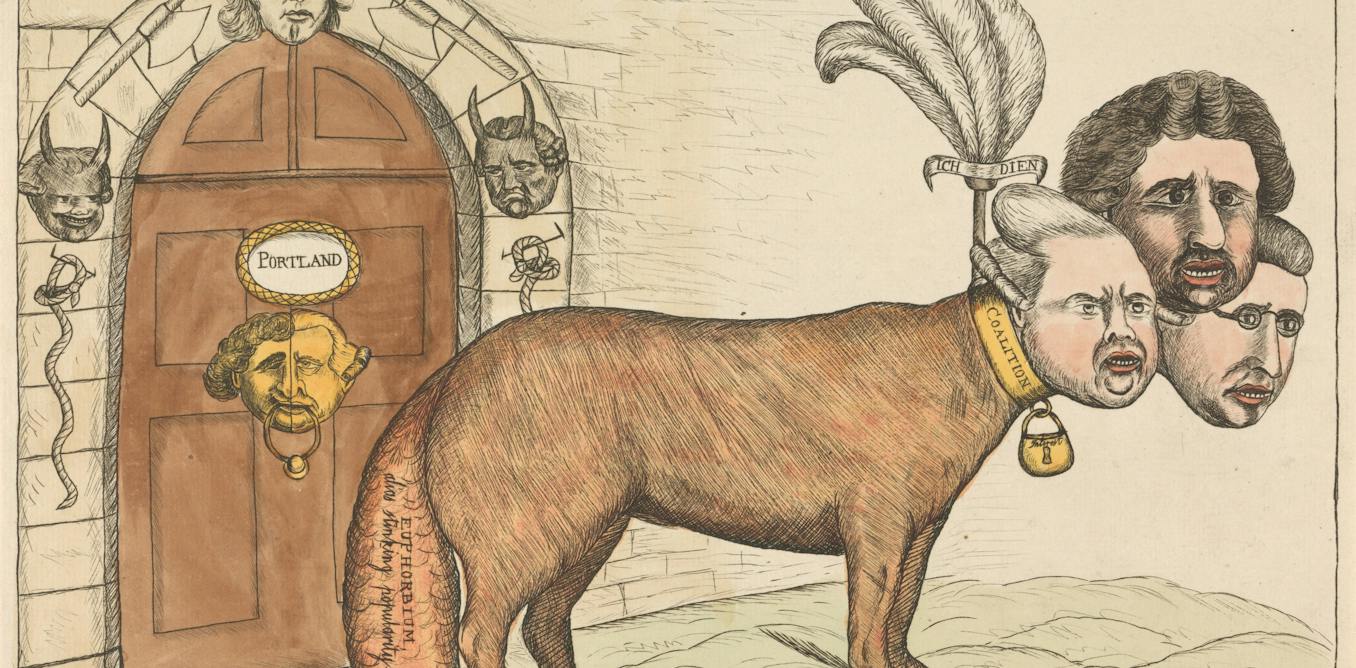
During the 18th century, Britain’s most celebrated political caricaturists transformed classical mythology into the ultimate satirical weapon. Artists such as James Gillray, Thomas Rowlandson, and William Dent bypassed dense academic texts, employing the universally recognized archetypes of Greek gods, monsters, and heroes to mercilessly skewer Georgian-era politicians like William Pitt the Younger, Charles James Fox, and Richard Brinsley Sheridan.
By mapping the timeless narratives of Mount Olympus onto the turbulent theatre of British parliamentary politics, these satirists achieved a rare feat: they weaponized elite classical education for the broader public, establishing a blueprint for cultural commentary that endures to this day. Ultimately, Greek myths survive not in spite of constant reinvention, but precisely because their plastic, fluid nature allows every generation to mirror its own anxieties, ambitions, and follies onto the canvas of antiquity.
Detailed Chronology: The Evolution of Mythic Satire and Adaptation
To understand how Greek mythology transformed from sacred oral tradition into 18th-century political caricature—and subsequently into modern cinematic spectacle—it is necessary to trace the historical evolution of its adaptation across the centuries.
- Pre-Classical Era (c. 8th Century BCE and Earlier): The foundational oral traditions of Greece take shape. Before being codified into definitive texts by Homer and Hesiod, myths existed in a state of constant fluidity. Travelling bards and performers adapted plots, character motivations, and moral lessons to suit the immediate political and social contexts of their specific audiences.
- The Classical and Hellenistic Periods: Greek myths are committed to written and theatrical forms. Playwrights such as Euripides, Sophocles, and Aeschylus subvert traditional stories to critique contemporary Athenian democracy, war, and religious piety, proving that mythology was never a static dogma, but a living civic discourse.
- The 18th Century – The Neoclassical Revival: Fuelled by the Enlightenment and Grand Tours of the Mediterranean, the educated European elite experiences a profound Neoclassical revival. Ancient Greek and Roman art, philosophy, and history become the gold standard of high culture and statecraft. Knowledge of classical languages and mythology serves as a strict class marker for the ruling elite.
- 1783: A pivotal moment in British political history occurs when William Pitt the Younger assumes the office of Prime Minister at the unprecedented age of 24. This sudden accumulation of power by a political neophyte sends shockwaves through Westminster and provides fertile ground for the era’s printmakers.
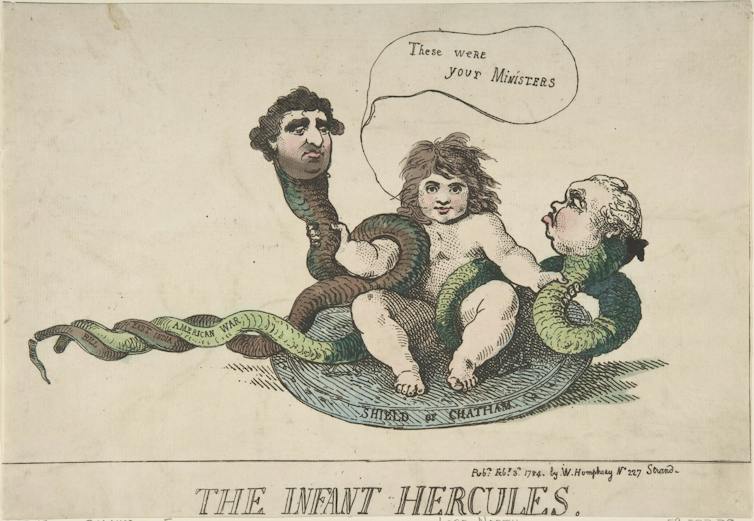
- 1784 (Thomas Rowlandson’s The Infant Hercules): Thomas Rowlandson publishes his iconic satirical print depicting the young Prime Minister Pitt as the infant Hercules strangling serpents (representing political rivals Charles James Fox and Lord North). This marks a masterclass in deploying classical iconography to simultaneously elevate and mock a contemporary politician.
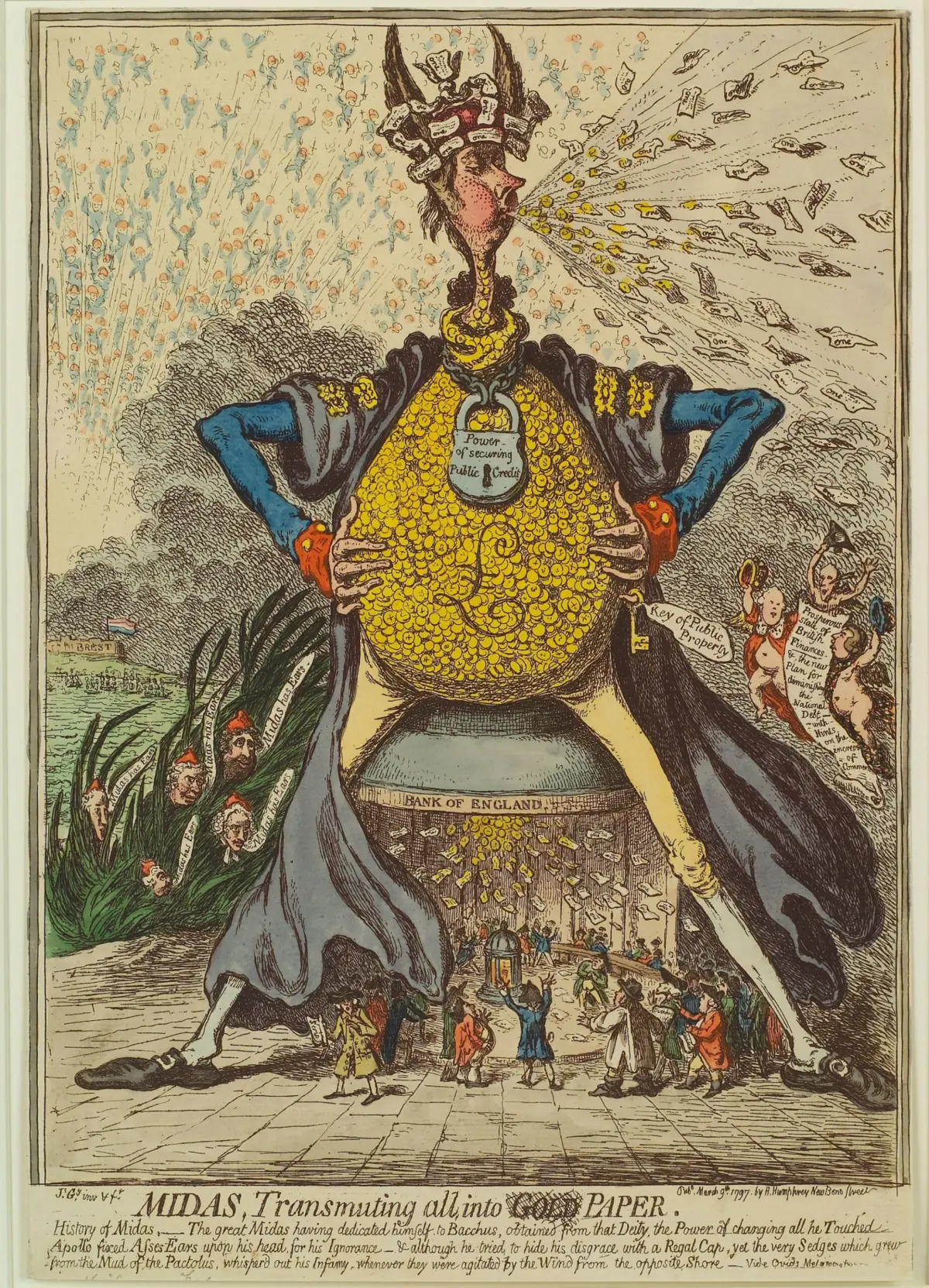
- 1797 (James Gillray’s Midas): James Gillray releases his celebrated caricature, Midas, Transmuting all into Gold [Gold crossed out] PAPER. By transforming Pitt into the mythical Phrygian king who turns everything he touches to ruin, Gillray directly attacks the government’s controversial monetary and taxation policies using instant visual shorthand.
- Late Georgian Era (Charles Williams’s The Modern Calypso): Printmaker Charles Williams adapts Homer’s Odyssey, casting the beleaguered, debt-ridden, and alcohol-fond politician Richard Brinsley Sheridan into the orbit of the nymph Calypso, cementing mythology’s role as a staple of visual tabloid culture.
- The Late 20th Century to Present: Popular culture democratizes mythology completely. Disney’s 1997 Hercules, Stephen Fry’s bestselling literary reimaginings (beginning in 2017), and finally Christopher Nolan’s cinematic spectacle of The Odyssey demonstrate that the appetite for adapting ancient narrative frameworks for mass consumption remains unabated in the 21st century.
Supporting Context & Metrics: The Mechanics of 18th-Century Visual Satire
The 18th-century print market in London—centered heavily around iconic shops in areas like St. James’s and the Strand—operated as the social media of its day. Hand-coloured, single-sheet satirical prints were commercial products, political weapons, and urban conversation pieces all at once.
To appreciate how effectively caricaturists utilized Greek mythology, one must analyze the structural advantages these stories offered:
1. Ready-Made Cultural Semiotics
Greek myths functioned as a pre-packaged lexicon of human behavior. Caricaturists did not need to waste valuable visual space explaining character traits; the mythology carried the narrative weight implicitly:
- Hercules: Instantly signified raw physical or political strength, but when juxtaposed with youth (as in Rowlandson’s depiction of Pitt), it highlighted dangerous immaturity and overreach.
- King Midas: Stood as an immediate shorthand for destructive greed, poor judgment, and catastrophic economic policies—cemented visually by bestowing the character with donkey ears.
- The Hydra: Provided a metaphor for intractable, multiplying political crises that defied simple legislative solutions.
- Calypso’s Isle: Offered a narrative framework to critique entrapment, decadence, personal vice, and moral stagnation among high-ranking statesmen.
2. Multi-Tiered Audience Engagement
The genius of Georgian caricature lay in its ability to operate simultaneously on multiple intellectual levels. Historical analyses of print shop window displays reveal a bifurcated viewing public:
| Audience Segment | Level of Classical Literacy | Nature of Engagement with the Print | Economic/Social Context |
|---|---|---|---|
| The Urban Working & Middle Class | Low to None | Immediate recognition of visual gags (e.g., politicians with donkey ears, babies fighting snakes, characters surrounded by alcohol). | Consumed as cheap street-level entertainment, discussed in local coffee houses and taverns. |
| The Educated Elite & Parliamentarians | High (Trained in Latin, Greek, and Neoclassical philosophy) | Deep appreciation of subtle mythological inversions, political inheritance subtexts, and nuanced policy critiques. | Collected privately, bound in expensive folios, and used as ammunition in elite social and political circles. |
This dual-layer communication model ensured that a print by James Gillray or Thomas Rowlandson could generate both broad working-class amusement and sharp, targeted elite anxiety within the corridors of Westminster.
Official Statements & Historical Perspectives
While contemporary politicians rarely find themselves depicted as mythological figures in hand-coloured copperplate engravings, historians and cultural critics have increasingly recognized the profound legacy of 18th-century satire in shaping modern political discourse.
Dr. Aris Thorne, a specialist in Georgian political history and visual satire, notes the striking continuity between ancient bards, 18th-century caricaturists, and modern Hollywood directors:
"When James Gillray placed William Pitt inside the skin of King Midas, he wasn’t just making a clever art-historical joke; he was performing an act of democratic translation. Classical mythology in the 18th century was strictly guarded by the walls of elite boarding schools and universities. By dragging these Olympian narratives down into the mud of London print shops, satirists democratized classical literacy. They proved that myths do not belong in marble mausoleums—they belong in the public square, used to puncture the bloated egos of the powerful."
Furthermore, literary historians studying the modern resurgence of myth-based media emphasize that the absence of a "definitive version" is the primary engine of the tradition’s survival. Unlike dogmatic texts, Greek mythology invites revisionism.
Cultural theorist Dr. Elena Vance explains:
"Unlike sacred texts, Greek myths have never possessed an authorized, immutable version. From Homer’s oral hexameters to Ovid’s subversions, and onward to Christopher Nolan’s IMAX spectacles or Thomas Rowlandson’s satirical copperplates, these stories are essentially empty vessels. They survive millennia precisely because they are infinitely malleable. Every era pours its own contemporary crises—be it national debt in 1797 or existential technological dread in the 21st century—into the timeless molds of gods and monsters."
Future Outlook: Why We Will Keep Rewriting the Ancient World
As we look toward the future of entertainment, literature, and political commentary, the appetite for classical adaptation shows no sign of diminishing. The release of high-profile adaptations like Christopher Nolan’s The Odyssey signals that contemporary audiences retain a deep, visceral hunger for epic storytelling anchored in familiar archetypes.
Several key trends define the future landscape of mythological adaptation:
- Democratization and Diversification of Mythic Lenses: Just as 18th-century satirists recontextualized myths to reflect Georgian parliamentary corruption, modern storytellers are increasingly subverting classical narratives to center marginalized perspectives, exploring gender, power, and colonialism through the lens of ancient pantheons.
- The Convergence of High Spectacle and Satire: As digital media fragments political discourse, modern meme culture functions in much the same way as 18th-century print culture. Politicians are routinely mapped onto pop-culture and mythological archetypes across social media platforms, proving that the human brain still relies on ancient narrative shortcuts to process complex modern governance.
- The Permanence of Mutability: The ultimate takeaway from the nearly 3,000-year history of Greek myth adaptation is that resilience is rooted in adaptability. Whether rendered as a hand-tinted copperplate print in a fog-shrouded London alleyway or projected across a towering cinematic screen in crystal-clear digital resolution, these stories endure because they reflect our permanent human condition.
Every generation rewrites Greek myth because every generation sees its own reflection in the mirror of antiquity. As long as human ambition, folly, love, and political corruption persist, the gods of Olympus will find new ways to walk among us.