Executive Overview
In the rapidly evolving landscape of electronic music production, the intersection of portability, power, and workflow efficiency remains the ultimate holy grail. For decades, producers, beatmakers, and live performers have sought hardware that bridges the gap between the spontaneous nature of sketching ideas on the go and the deep, intricate capabilities of a full-fledged studio setup. Enter Akai Professional, a titan of music production hardware, with its latest flagship release: the MPK Mini Plus II.
Building upon the legacy of its immensely popular predecessor, the next-generation 37-key MIDI keyboard introduces a comprehensive suite of hardware updates, onboard creative tools, and expanded connectivity options. Designed to help modern producers develop ideas and explore unexpected sonic variations directly from the controller, the MPK Mini Plus II positions itself as more than just an incremental upgrade. With a completely revamped physical aesthetic aligned with Akai’s contemporary design language, a vibrant full-color display, advanced generative composition tools, and robust CV/Gate capabilities, this release aims to redefine what creators can achieve with a portable controller.
Priced competitively at $169.99 / £134.99 / €159.99 and bundled with Akai’s expansive Studio Instrument Collection, the MPK Mini Plus II is available immediately. This comprehensive review and news feature explores the intricate details of Akai’s newest hardware iteration, examining its hardware upgrades, creative toolsets, studio integration, and the broader implications for the modern music producer’s workflow.
Detailed Chronology: The Evolution to the MPK Mini Plus II
To understand the significance of the MPK Mini Plus II, one must contextualize its arrival within the broader historical trajectory of Akai Professional’s product ecosystem. The original MPK Mini line revolutionized home and mobile production by democratizing tactile beatmaking and melody creation, offering a portable footprint that could fit into a backpack alongside a laptop. However, as mobile producers began demanding more expressive control—moving beyond two-octave layouts to accommodate more complex chord voicings and two-handed playing—Akai responded with the original MPK Mini Plus.
The introduction of the MPK Mini Plus a few years ago marked a crucial shift: expanding the keybed to 37 keys, adding dedicated hardware transport controls, and introducing pitch and modulation wheels alongside 5-pin MIDI DIN ports. It proved that producers did not have to sacrifice connectivity or range for portability.

The launch of the MPK Mini Plus II represents the next logical phase in this hardware evolution. Drawing direct inspiration from the design ethos introduced with Akai’s MPK Mini IV keyboards a year prior, the Plus II merges the expanded architecture of its predecessor with a modernized visual identity and significantly upgraded internal processing tools.
Key Hardware Refinements
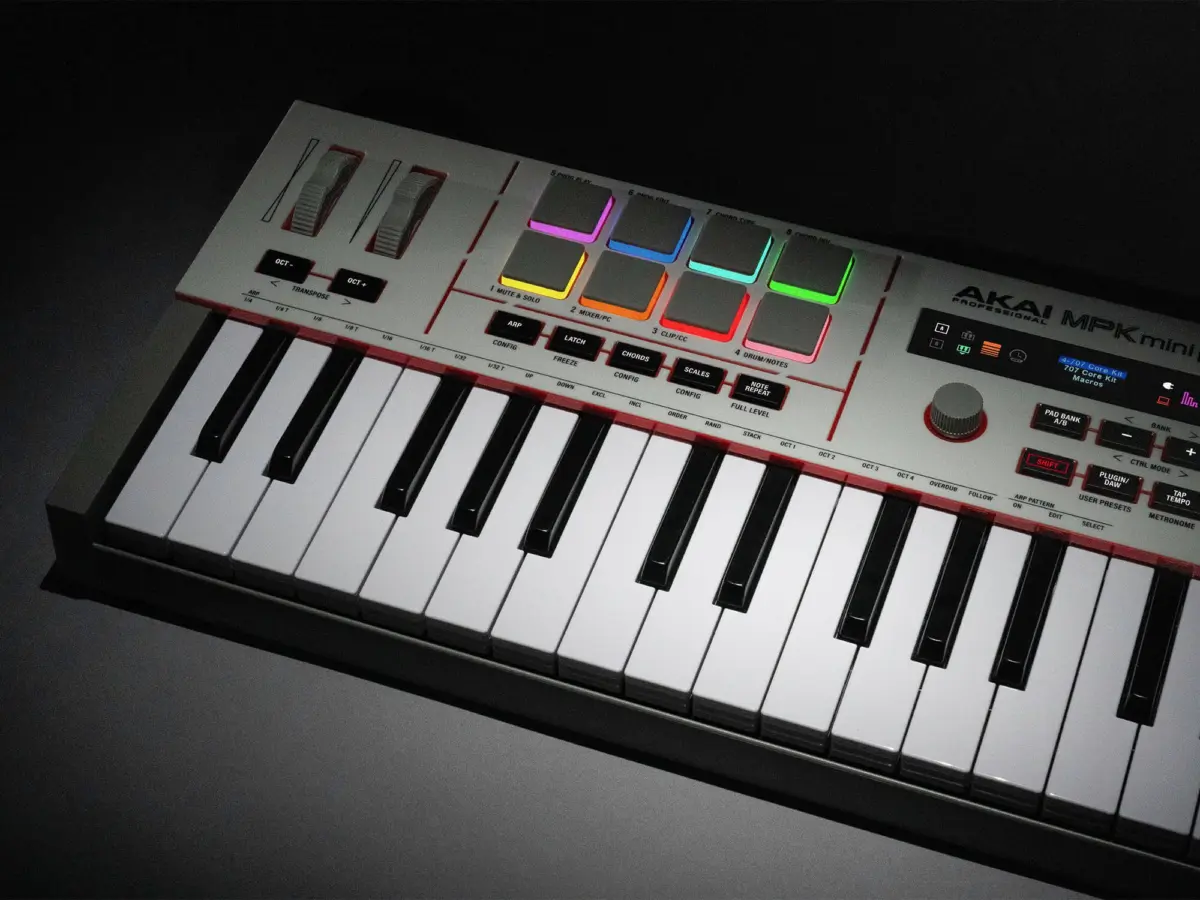
- Aesthetic and Ergonomic Redesign: The physical chassis has been completely overhauled to match Akai’s modern aesthetic guidelines. The front panel features cleaner lines, a streamlined layout, and a more cohesive visual flow that feels unified with the rest of the current Akai hardware ecosystem.
- Upgraded 37-Key Mini Keybed: Akai has revisited its semi-weighted tactile response, implementing a newly upgraded 37-key mini keybed that offers enhanced expression and velocity sensitivity.
- Refined Pitch and Mod Wheels: Moving away from traditional joysticks or stiff ribbon controllers, the MPK Mini Plus II incorporates newly engineered, highly tactile pitch and modulation wheels, offering smoother physical feedback for expressive performance.
- RGB MPC Pads: Eight velocity- and pressure-sensitive RGB pads anchor the rhythm section, inheriting the legendary feel of Akai’s iconic MPC hardware line.
- The Full-Color Display: Perhaps the most striking physical addition is the inclusion of a vibrant, full-color screen. This display provides immediate visual feedback for parameters, patch names, generative tools, and routing configurations, reducing the need to constantly glance at a computer monitor.
Supporting Context & Metrics: Creative Tools and Deep Integration
Modern hardware controllers can no longer rely solely on physical buttons and keys; they must offer intelligent software integration and creative algorithms that stimulate inspiration when writer’s block strikes. The MPK Mini Plus II leans heavily into this philosophy by introducing an array of sophisticated internal tools designed to manipulate melody, rhythm, and harmony on the fly.
Advanced Generative and Expressive Toolsets
The core of the MPK Mini Plus II’s innovative edge lies in its suite of real-time transformation modes. Accessible directly from the hardware interface, these tools allow producers to instantly deconstruct and reimagine their musical ideas:
- Glitch: Introduces stutter, micro-editing, and rhythmic variations to live or sequenced data, perfect for electronic, trap, and IDM production.
- Mutate: Automatically alters notes within a sequence or arpeggio to generate fresh, unexpected melodic variations while maintaining musical context.
- Strum: Allows users to effortlessly simulate guitar-like strumming patterns across chords, adding organic fluidity to synthetic or keyboard-driven tracks.
- Freeze: Captures and holds ongoing melodic states or modulation parameters, enabling textural sound design sweeps and ambient layering.
- Chords & Follow: Streamlines harmonic progression creation, empowering users to trigger complex multi-note voicings with single-finger inputs or scale-locked constraints.
- Expanded Arpeggiator & Note Repeat: Building upon Akai’s legendary timing and swing engines, these modes offer deeper rhythmic control, polyphonic sequencing, and dynamic subdivisions.
Comprehensive DAW and Ecosystem Integration
Hardware versatility is ultimately judged by how seamlessly it integrates into existing studio environments. The MPK Mini Plus II functions brilliantly both as a standalone controller and as an extension of software workstations.
- MPC Desktop & MPC 3 Integration: The controller is engineered to unlock the full potential of the MPC workflow on a compact hardware surface, offering plug-and-play mapping and tight synchronization with MPC 3 software.
- Universal DAW Support: Out-of-the-box mapping is provided for major digital audio workstations, including Ableton Live, Logic Pro, Cubase, and FL Studio, ensuring transport control, mixer adjustments, and plugin parameter mapping require zero configuration hassle.
- Native Instruments NKS Compatibility: Full support for the Native Instruments Komplete Kontrol ecosystem means producers can effortlessly browse, load, and tweak thousands of virtual instruments and effects via the hardware’s interface.
Connectivity and I/O Architecture
Despite its compact footprint, the MPK Mini Plus II punches well above its weight class when it comes to physical connections. It serves as a master controller capable of bridging software and hardware modular setups:

+-----------------------------------------------------------------+
|                   MPK MINI PLUS II I/O PANEL                    |
+-----------------------------------------------------------------+
| [ USB-C Power ]  [ 5-Pin MIDI Out ]  [ CV/Gate (x3) ]  [ Sustain] |
+-----------------------------------------------------------------+- USB-C: Modern, reliable bus power and high-speed data transmission.
- 5-Pin MIDI Output: A full-size MIDI DIN output port allows users to drive external hardware synths, drum machines, and grooveboxes directly without relying on computer MIDI interfaces.
- Triple CV/Gate Outputs: Recognizing the massive resurgence of modular and semi-modular analog synthesis, Akai has included three dedicated CV/Gate outputs, enabling the keyboard to sequence Eurorack gear and analog synthesizers natively.
- Sustain Pedal Input: A standard quarter-inch input accommodates sustain pedals for expressive, traditional piano performance.
The Studio Instrument Collection Bundle
Hardware value is frequently augmented by software bundles, and Akai has not skimped in this department. Every unit of the MPK Mini Plus II ships with Akai’s robust Studio Instrument Collection. This curated software bundle grants users access to over 1,000 professional-grade presets, sounds, and patches crafted by industry leaders including AIR Music Technology, Moog Music, and Akai Professional, covering everything from classic analog synth basses to lush acoustic textures and punchy drum kits.
Official Statements and Industry Perspective
The philosophy behind the development of the MPK Mini Plus II reflects a deep understanding of how modern producers work—often transitioning rapidly between mobile setups, bedroom studios, and professional environments.
Andy Mac, Executive Manager of Content, Artist Relations and Business Development at Akai Professional, emphasized the target audience and design goals during the product’s official unveiling:
"MPK Mini has introduced a lot of creators to hands-0n making music, and MPK Mini Plus II is built for the creator who’s ready for the next step. Tools like Glitch, Mutate, and Strum help turn simple ideas in new directions, while deeper MPC, DAW, MIDI and CV integration gives creators room to build a much bigger setup around one compact keyboard."
Akai further elaborated on the creative ethos steering the product development cycle, noting:

"Together, these tools give beatmakers, songwriters and performers more ways to move from a starting idea toward something unexpected while keeping creative decisions in their hands."
Industry analysts have noted that by incorporating CV/Gate outputs alongside traditional MIDI and deep DAW integration, Akai is successfully targeting two distinct market segments simultaneously: the laptop-based bedroom producer utilizing Ableton or FL Studio, and the hardware-centric enthusiast experimenting with semi-modular desktop synthesizers. This dual-market appeal significantly widens the controller’s potential user base.
Future Outlook: Where Does the MPK Mini Plus II Fit in the Market?
As the market for portable MIDI controllers grows increasingly saturated with budget options, manufacturers must innovate beyond basic velocity-sensitive pads and mini-keys to justify consumer investment. Competitors in the 37-key space have experimented with various workflows, but Akai’s distinct advantage remains its cultural cachet, the enduring legacy of the MPC workflow, and its aggressive software bundling strategy.
The inclusion of generative composition features like Glitch and Mutate signals a broader industry trend: the integration of algorithmic inspiration tools directly into physical hardware. Rather than replacing the human element, these features act as creative catalysts—breaking monotony and sparking new melodic pathways during the composition phase. As producers increasingly seek tactile workflows to escape "mouse fatigue" caused by staring at screens, hardware that encourages physical experimentation while maintaining deep software connectivity will continue to dominate studios large and small.
With the MPK Mini Plus II now shipping worldwide at an accessible price point of $169.99 / £134.99 / €159.99, Akai Professional has cemented its position at the forefront of portable production technology. Whether serving as the central brain for a mobile laptop rig or acting as a versatile keyboard and sequencer for a sprawling analog hardware wall, the MPK Mini Plus II proves that profound musical capability can indeed be packed into a delightfully compact form factor.