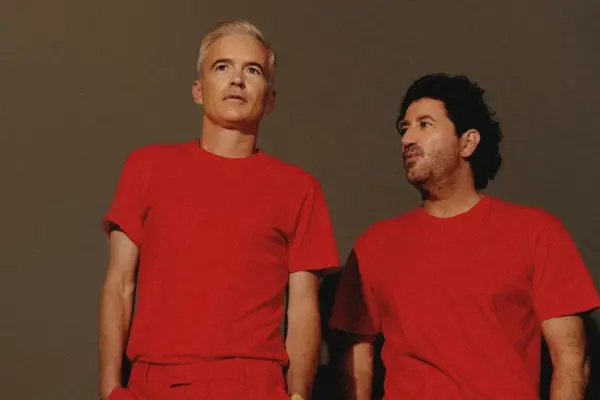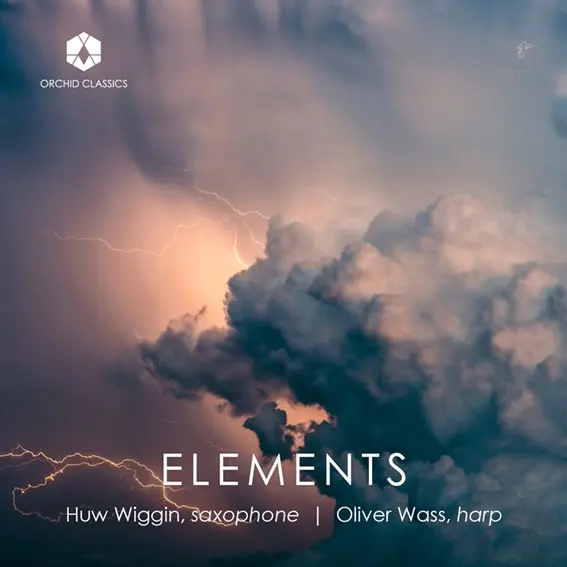
In the contemporary landscape of classical and contemporary art music, sonic pairings are continually pushed beyond traditional boundaries to discover novel, expressive colors. Few combinations, however, achieve the delicate, hypnotic equilibrium found on Elements, a captivating recent release on Orchid Classics. Conceptualized, performed, and recorded by saxophonist Huw Wiggin and harpist Oliver Wass, the album frames the four classical building blocks of the material universe—Earth, Air, Fire, and Water—through an ambitious program of newly commissioned compositions and masterfully realized Baroque transcriptions.
Recorded between July 7 and 9, 2025, at the acoustically resonant All Saints Church in Dunsden Green, Oxfordshire, and officially released to critical acclaim, Elements showcases an unorthodox instrumental alliance that, in the hands of these virtuosos, feels entirely inevitable. Wiggin’s saxophone sings with a vocal purity and flexibility that routinely mimics the human voice, while Wass’s harp provides a translucent, nuanced support system that avoids the heavy-handed, muddy textures that plague lesser orchestrations of early music.
The album’s overarching philosophy relies on juxtaposition: centuries-old masterworks by the likes of Johann Sebastian Bach, François Couperin, Henry Purcell, Antonio Vivaldi, and Arcangelo Corelli are placed in direct dialogue with cutting-edge contemporary works by contemporary luminaries such as Charlotte Harding, Yshani Perinpanayagam, David Wallace, Simon Rowland-Jones, Laura Bowler, and Andy Scott. Enhanced by guest cellist Leander Kippenberg on select tracks, the resulting recording is an immersive sonic journey that tests the physical limits of both instruments while maintaining an intimate, chamber-music ethos. This executive review examines the architectural construction of Elements, detailing its chronological traversal through the elemental themes, contextualizing its place within modern crossover performance, and evaluating its long-term significance for contemporary classical programming.
Detailed Chronology: A Programmatic Traversal of Elements
The tracklisting of Elements is meticulously sequenced, functioning less as a random playlist and more as a carefully curated narrative arc that guides the listener seamlessly across centuries and elemental states.
Act I: Establishing the Soundworld and Aquatic Depths
The album opens with François Couperin’s (1668–1733) Le Rossignol en Amour. Instantly, the listener is enveloped in a seductive, spare soundworld. Wass’s harp accompaniment never overfills the acoustic space, leaving ample room for Wiggin to inject the melodic line with astonishing clarity, stylistic awareness, and a poignant, breath-like phrasing that evokes birdsong without descending into caricature.
Transitioning directly into the modern era, Charlotte Harding’s (b. 1989) Euphotic takes its title from the upper layer of a body of water where sunlight penetration enables photosynthesis. Harding captures this luminous aquatic environment through a fluidly engaging saxophone line that sparkles dynamically against the harp’s running, cascading arpeggios. The piece possesses a thoroughly modern rhythmic impetus while retaining an underlying, haunting elegance.
Returning briefly to the Baroque, the sequence moves to the transcendent Aria from J.S. Bach’s (1685–1750) Goldberg Variations (BWV 988), arranged by Wass. The discreet, pulsing support of the harp allows Wiggin’s saxophone to soar with pristine vocal qualities. This is immediately followed by Henry Purcell’s (1659–1695) legendary "When I am laid in Earth" (Dido’s Lament) from Dido and Aeneas. Here, the duo is joined by cellist Leander Kippenberg, who anchors the piece with the famous, sighing ground bass line. Wiggin keeps his saxophone timbre closely aligned with vocal inflections, creating a deeply moving, austere transcription that prioritizes emotional resonance over virtuosic display.

Act II: Fables, Gales, and Meditative Airs
Yshani Perinpanayagam’s (b. 1983) The Weary Soil and the Greedy Shoot introduces a narrative element to the program, constructed around an imaginary, cautionary fable regarding the consumption of natural resources. Beginning almost from nothing—intimate, concentrated, and deeply thoughtful—the work contrasts the timbral materials of the saxophone and harp. As the harmonic tension slowly tightens under Perinpanayagam’s pen, the piece grows in intensity without ever sliding into melodrama.
Providing a palate cleanser before another gust of wind, the Largo from Antonio Vivaldi’s (1678–1741) Spring (Concerto No. 1 in E major, Op. 8) is heard in a thoughtful transcription by French composer Bernard Dewagtere. This segues smoothly into David Wallace’s (b. 1982) blowing a gale. Wallace constructs a bravura, highly engaging work that ostensibly initiates with a disguised Irish jig in triple time before rapidly transforming into a visceral depiction of rushing air. Despite the dense writing and relentless rhythmic activity, the piece retains an unmistakable Celtic soul.
The program then pivots into profound stillness with Iain Farrington’s stylish, meditative arrangement of the Air from J.S. Bach’s Orchestral Suite No. 3 (BWV 1068). This meditative thread is continued in Simon Rowland-Jones’s (b. 1950) Silent Air. Rowland-Jones deliberately builds his composition out of short, fragmented motifs that appear to be plucked directly from the atmosphere, giving immense weight to the strategic use of silence between phrases.
Act III: Virtuosity, Elemental Fire, and Brazilian Grooves
Oliver Wass steps into the spotlight for a breathtaking solo harp transcription of the Sarabande from J.S. Bach’s French Suite No. 3 in B minor (BWV 814). Wass successfully evokes the solemnity of the Baroque tradition while filtering it through the resonant, shimmering acoustic properties of the modern pedal harp.
Rejoined by Leander Kippenberg, Wass and Wiggin tackle Arcangelo Corelli’s (1653–1713) legendary La Folia (Op. 5, No. 12). The performance oscillates effortlessly between sophisticated elegance and blazing virtuosity, with Wiggin’s swift scalar passages playfully echoed and countered by Kippenberg’s resonant cello lines in an absolute tour de force.
Laura Bowler’s (b. 1986) Caesium serves as the album’s primary fiery centerpiece. Drawn to caesium as a volatile, silvery-gold alkali metal that reacts explosively with water and ignites spontaneously in air, Bowler crafts an edgy, vivid swirl of sonic material. The work ebbs to a state where time appears to stretch indefinitely, before erupting into a final, fiery climax.
After a refreshing interlude featuring J.S. Bach’s Two-Part Invention No. 8 in F major (BWV 779), Andy Scott’s Sussurros Brasileiros injects vibrant global rhythms into the mix. Scott’s stated concept—blending Brazilian grooves and rhythmic syncopations with the expansive color palette of contemporary classical chamber music—results in a wildly catchy, rhythmically snappy triumph.

The journey nears its conclusion with the Allegro from Corelli’s Sonata Op. 5, No. 4 in F major, performed by the trio of Wiggin, Wass, and Kippenberg as a vibrant palate cleanser. Finally, the album closes on an intensely personal note with a second work by Laura Bowler, With You. Originally written for Wiggin to perform at the composer’s mother’s funeral, this sparse, haunting piece for solo saxophone leaves the listener suspended in a state of touching, unresolved emotional vulnerability.
Supporting Context & Metrics
The Instrumental Pairing: Overcoming Acoustic Hurdles
The combination of saxophone and harp is historically rare in classical performance. The saxophone—a single-reed woodwind instrument invented by Adolphe Sax in the 1840s—possesses a penetrating, projective tone capable of both soaring lyricism and aggressive snarls. The harp, conversely, relies on acoustic string resonance, plucking mechanisms, and soundboard diffusion that can easily be overwhelmed by heavier wind instruments.
Wiggin and Wass overcome this fundamental acoustic imbalance not through amplification, but through rigorous arrangement and dynamic sensitivity. Wass treats the harp registry as a chamber piano and percussion hybrid simultaneously, utilizing extended techniques, harmonics, and judicious pedaling to clear frequencies that allow Wiggin’s saxophone to float effortlessly above or weave intricately within the texture.
Recording Logistics and Venue Acoustics
- Recording Venue: All Saints Church, Dunsden Green, Oxfordshire.
- Recording Dates: July 7–9, 2025.
- Label: Orchid Classics (Catalog No. ORCD100457).
- Acoustic Profile: All Saints Church provides a warm, natural reverberation time that flatters the high overtones of the harp while grounding the woody resonance of the saxophone and the deep, anchoring frequencies of Kippenberg’s cello. The engineering balances spatial depth with acute instrumental intimacy, ensuring that complex contemporary passages (such as Harding’s Euphotic and Bowler’s Caesium) do not lose their internal articulation.
Official Statements and Artistic Intentions
The ideological backbone of Elements rests heavily on the stated intentions of its commissioners and arrangers, who sought to bridge historical aesthetics with contemporary elemental metaphors.
- On Contemporary Exploration: Composer Laura Bowler noted of her work Caesium, that her fascination lies in materials that exist on the precipice of stability: "I am drawn to caesium as a highly reactive soft silvery-gold metal that reacts explosively with water and catches fire spontaneously in air." This volatility is mirrored directly in the structural design of the album’s fire-inspired tracks.
- On Cross-Cultural Synthesis: Andy Scott explained his vision for Sussurros Brasileiros as an intentional synthesis of disparate worlds: "My concept was to combine grooves and musical rhythms that I love from Brazil with the many sound worlds that are available to the saxophone and harp via contemporary classical music."
- On Narrative Frameworks: Yshani Perinpanayagam approached The Weary Soil and the Greedy Shoot through a moral lens, constructing an instrumental fable that mirrors contemporary anxieties surrounding sustainability, natural consumption, and ecological fragility.
Future Outlook
The release of Elements on Orchid Classics signals a broader, highly encouraging trend within modern classical music: the decentralization of standard instrumentation in favor of adventurous, flexible chamber duos. By pairing masterworks of the Baroque era with urgent, highly specific contemporary commissions, Huw Wiggin and Oliver Wass have established a compelling performance template that can easily be translated to live recital halls, international chamber music festivals, and cross-disciplinary arts programming.
For the future of the saxophone and harp repertoire, Elements acts as a watershed moment. It proves definitively that the combination is not merely a novelty or a fringe experiment, but a mature, highly adaptable medium capable of profound emotional expression, structural rigor, and stylistic versatility. As classical audiences increasingly seek out innovative programming that challenges traditional boundaries without sacrificing listenership, projects like Elements point the way forward—proving that looking backward to Bach and Couperin while leaping boldly into the avant-garde is a recipe for enduring artistic relevance.