Executive Overview
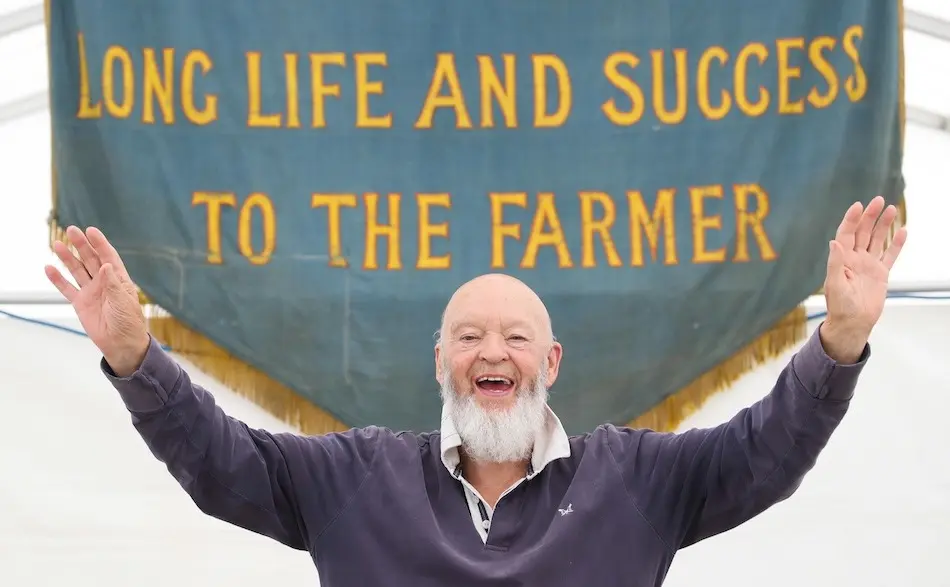
October 17, 2025, marks a monumental milestone in the history of modern counterculture and live entertainment: Sir Michael Eavis, the visionary dairy farmer who birthed the world-renowned Glastonbury Festival from the soil of Worthy Farm, celebrates his 90th birthday. In a reflective and deeply personal interview conducted at his home in Pilton, Somerset, Eavis looked back on over half a century of cultural revolution, resilience, and community building.
What began in 1970 as a modest gathering of 1,500 people paying £1 a ticket—featuring headliners T. Rex and offering free milk from the farm—has evolved into a global cultural phenomenon. Yet, despite the astronomical growth of the festival, the millions raised for charitable causes, and the global fame attached to his name, Eavis remains fundamentally rooted in the land. As he marks his ninth decade, he continues to balance agricultural life with creative oversight, proving that the spirit of rebellion and community that built Glastonbury remains as vibrant as ever.
Detailed Chronology: From Pilton Pop Festival to Global Icon
The Genesis: 1970
The Glastonbury story started not in a boardroom, but in a field in Somerset. Inspired by a performance by Led Zeppelin at the 1970 Bath Festival of Blues and Progressive Music, a 35-year-old dairy farmer named Michael Eavis decided to host his own event. Originally dubbed the Pilton Pop Festival, the inaugural gathering welcomed 1,500 attendees. It was an idealistic enterprise defined by the countercultural ethos of the late 1960s. Eavis recalls those early days not with romantic nostalgia alone, but as a period of relentless friction.
The Decades of Struggle and Survival
For its first three decades, Glastonbury Festival was far from a guaranteed success. It was an existential tightrope walk marked by financial precarity, local resistance, and clashes with authorities.
- The Regulatory Battles: In the interview, Eavis candidly reflects on his younger self being "at war with the council, the village, the local magistrates, and the police."
- Threats of Closure: The opposition was fierce. Eavis recalls a chilling warning from the chairman of the magistrates: "If you do this again, you’ve had it."
- The Catalyst of Conflict: Paradoxically, Eavis credits this intense friction as the very engine of the festival’s eventual triumph. The struggle forced the organization to professionalize, harden its resolve, and forge an unbreakable bond with its audience.
Modern Era and the Fallow Year
Fast forward to the 21st century, and Glastonbury is universally acknowledged as the pinnacle of the global festival circuit. Demand for tickets vastly outstrips supply; as Eavis notes, organizers could likely sell a million tickets and still face immediate sell-outs.
The festival operates on a cyclical model, occasionally taking a "fallow year" to allow the land at Worthy Farm to recover and the local wildlife and grass to regenerate. However, a fallow year does not mean a quiet year for Eavis. True to form, he spends his time collaborating with visionary creators like Joe Rush and the mechanical arts collective Arcadia, ensuring that the creative lifeblood of the festival never stagnates.
Supporting Context & Metrics: Agriculture, Activism, and Community
While Glastonbury Festival dominates cultural conversations globally, it is inextricably linked to the working dairy farm that surrounds it. The dual identity of Michael Eavis—farmer and festival impresario—defines his legacy.
Worthy Farm Dairy and the Co-Op Partnership
The agricultural operations at Worthy Farm remain robust. The milk produced by Eavis’s dairy herd is supplied to Wyke Farms, where it is transformed into distinctive Worthy Farm Cheddar. In a testament to how far the brand has traveled, Eavis shares an anecdote of boarding a train to Scotland, stepping off in Glasgow, and walking into a local Co-op store only to find shelves lined with his own farm’s cheese.
Philanthropy and Social Housing
Beyond music and agriculture, Eavis’s legacy is anchored in profound social impact. Over the decades, the festival has channeled countless millions of pounds into charitable initiatives, supporting environmental, human rights, and humanitarian organizations such as Oxfam, Greenpeace, and WaterAid.
Closer to home, Eavis has addressed one of the most pressing crises in rural Britain: affordable housing. He spearheaded the development of 50-plus social houses in Pilton, designed specifically to ensure that local families and younger generations are not priced out of their home village.
- High-Profile Recognition: The housing project received national attention when football legend and broadcaster Gary Lineker visited to officially open the homes, producing a widely shared documentary feature that highlighted the model’s success.
- Personal Pride: Reflecting on the development, Eavis notes how he drives past the houses on sunny days, watching the light catch the roofs, and marveling at how a simple idea transformed into a permanent community asset.
Official Statements and Personal Reflections
In his milestone 90th birthday interview, Eavis offered candid insights into his worldview, his motivations, and his enduring passions.
- On the Secret to Longevity: When asked how he feels reaching 90, Eavis attributes his vitality to a life defined by excitement and purpose: "It all feels like the culmination of more than 50 years of work… It’s all been a long story of excitement. That’s probably what’s keeping me going!"
- On Musical Highlights: While hundreds of legendary artists have graced Worthy Farm—from David Bowie and Radiohead to Beyoncé and Paul McCartney—Eavis holds a special place in his heart for Neil Young’s Saturday night performance at a recent festival, praising the veteran rocker’s deep connection to the Pilton audience.
- On Politics and Faith: Eavis acknowledges that Methodism has played a foundational role in shaping his moral compass and the festival’s ethos. Glastonbury has never shied away from socio-political commentary, hosting speakers, debates, and fundraisers. Eavis affirms: "There will always be a political angle there. And I think people expect that."
- On Doing It "His Way": Asked about his plans for his 90th birthday party—celebrated locally with family, friends, and villagers—Eavis smiles about his intention to sing three songs with his band. When nudged about whether Frank Sinatra’s anthemic My Way is on the setlist, he offers a knowing confirmation. After all, few individuals have sculpted a legacy so entirely on their own terms.
Future Outlook: A Living Legacy
As Sir Michael Eavis steps into his tenth decade, the question naturally arises: what is the future of Glastonbury Festival and the Pilton community?
While day-to-day operations and curation are increasingly steered by the next generation—most notably his daughter, Emily Eavis—Michael remains the beating heart and spiritual compass of the enterprise. The festival’s enduring independence, protected from corporate takeovers and steadfast in its commitment to charity and art, ensures that Eavis’s blueprint will endure for generations to come.
The challenges of modern event production—rising operational costs, ecological responsibilities, and shifting cultural landscapes—are met by an institution that has survived government opposition, economic recessions, and global pandemics. Glastonbury is no longer merely an annual music event; it is a cultural institution embedded in the British consciousness.
For Sir Michael Eavis, the journey from a modest West Country dairy farmer to a knighted cultural icon is a source of continuous wonder. As he prepares to take the stage in his home village to sing for his neighbors, his sentiment remains grounded in gratitude and relentless optimism: "How did all this happen?" Indeed, the world may ask the same question of the miracle in Somerset, grateful that a visionary farmer refused to back down.