Executive Overview
In an era defined by the algorithmic homogenization of streaming—where tracks are routinely truncated for immediate short-form engagement and listeners frequently bypass the cohesive architecture of a full-length body of work—British singer-songwriter Raye has mounted a defiant, cinematic counter-offensive. Her latest opus, This Music May Contain Hope, which recently earned her the prestigious Mercury Prize, stands as a sprawling, 73-minute masterclass in artistic conviction. Spanning old-Hollywood jazz, big-band arrangements, and sweeping orchestral movements, the album is less a collection of commercial singles and more a deeply personal, meticulously structured theatrical production.
Raye’s ascent to this milestone has been characterized by high-stakes resilience. Just three years after escaping a protracted seven-year battle with her former major label—ultimately freeing herself to independently release her acclaimed debut, My 21st Century Blues in 2023—she has captured one of the music industry’s highest accolades. Her triumph is emblematic of a broader, transformative shift in the contemporary music landscape: a movement where visionary female artists are fiercely seizing the mantle of creative direction, reclaiming total authorship over their narratives, and subverting the assembly-line norms of the modern music business.
Detailed Chronology: From Corporate Purgatory to Independent Mastery
To understand the breathtaking scope of This Music May Contain Hope, one must trace the arduous trajectory that forged Raye’s artistic ethos. For nearly a decade, the British artist found herself trapped in corporate purgatory, relegated to writing hits for other pop acts while her own proposed studio albums were repeatedly shelved or compromised by major-label executives who doubted her commercial viability.
[2016 - 2021] Seven-Year Label Strugle & Blocked Album Releases
       │
       ▼
[February 2023] Independent Debut: 'My 21st Century Blues' Released
       │
       ▼
[October 22, 2026] Mercury Prize Win for 'This Music May Contain Hope'- The Seven-Year Stalemate (2016–2021): Bound to a major recording contract, Raye lobbied persistently to release a cohesive debut album, only to be met with institutional resistance. Her creative output was micro-managed, sliced into discrete, algorithm-friendly singles, and delayed indefinitely.
- The Independent Breakout (February 2023): Breaking free from her label constraints, Raye chose autonomy over security. She independently released her debut album, My 21st Century Blues, which resonated globally as a visceral document of survival, industrial exploitation, and artistic rebirth. The album proved that an artist could bypass traditional gatekeepers and achieve both critical adoration and commercial success.
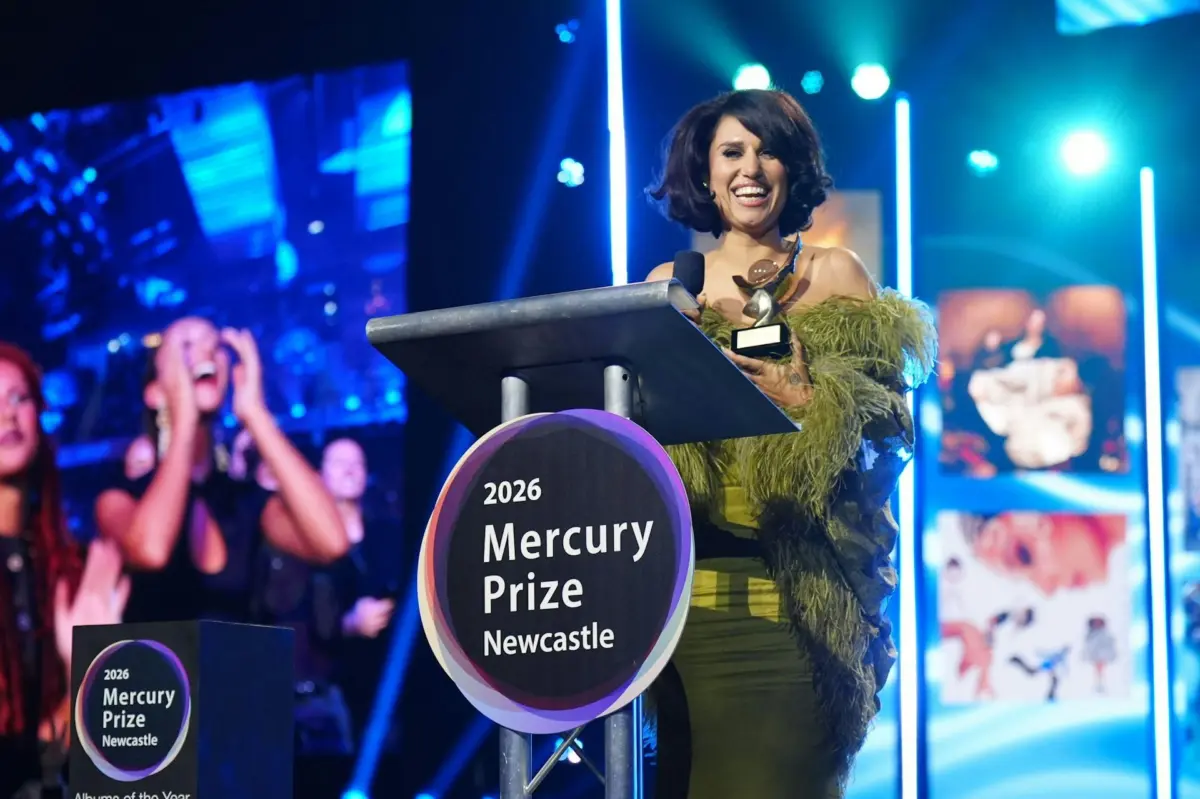
- The Mercury Prize Triumph (October 22, 2026): Culminating years of relentless touring, writing, and independent production, Raye accepted the Mercury Prize in Newcastle. Clutching her golden trophy, she shared a poignant reflection with her supporters on social media: "Being able to even create an album is a privilege I will never take for granted."
- The Cinematic Evolution (Late 2026): With the release of her Mercury-winning follow-up, Raye transitioned from a survivor of industry politics to a fully empowered creative director, operating without artistic compromise across 17 sprawling tracks.
Supporting Context & Metrics: The Architecture of an Opus
This Music May Contain Hope is a technical marvel that defies minimalist trends in contemporary pop production. Across its 17 tracks, the album functions as a multi-genre exploration, utilizing opulent brass sections, meticulously layered vocal harmonies, and intimate voice notes sourced directly from the artist’s inner circle.
The crown jewel of these collaborations is "Click Clack Symphony," an ambitious joint venture with legendary film composer Hans Zimmer. The track merges raw, cathartic emotional release with an expansive, cinematic soundscape, proving that pop music can successfully inhabit the sonic territory traditionally reserved for major motion pictures.
Structural Contrasts and Genre-Bending Production
Raye’s mastery as a director lies in her deliberate cultivation of stark contrasts:
- Thematic Juxtaposition: On tracks like "I Hate The Way I Look Today," raw, deeply confessional lyricism regarding body image and self-doubt is placed directly against the opulent, glittering backdrop of an old-Hollywood big-band arrangement.
- Linguistic and Temporal Bridging: "The WhatsApp Shakespeare" exemplifies her penchant for bridging centuries; it opens with a contemporary R&B beat before abruptly shifting into an up-tempo swing rhythm, ultimately dissolving into a haunting, James Bond-esque cinematic outro.
- Radical Transparency in Credits: In an industry where production credits are traditionally buried in microscopic typography or digital metadata, Raye utilizes the six-minute closing track, "Fin," to explicitly name every single contributor who worked on the record. This transparent acknowledgement transforms the album liner notes into a communal roll call.
Vocal Range and Narrative Delivery
Raye’s vocal performance transcends conventional pop belting. Navigating effortlessly between operatic upper registers, soulful ad-libs, and playful scatting, her voice serves as the primary navigational instrument through the album’s melodrama.
Unlike critics who have occasionally targeted her live performances for "oversharing" during long spoken interludes, This Music May Contain Hope integrates these spoken passages with surgical precision. On "Beware.. The South London Lover Boy," she adopts a posh narrative persona to deliver an introductory warning about the track’s titular character. Similarly, the opening of "Nightingale Lane"—"This is a song about the greatest heartbreak I’ve ever known"—shatters the fourth wall, invoking the intimate, confessional storytelling style seen in modern television scripts like Fleabag.
Official Statements & Industry Perspectives
The release of the album and its subsequent award recognition have sparked vigorous debate among music critics, industry analysts, and the artist herself regarding the viability of the long-form album in the streaming age.
The Artist’s Vision
Addressing her supporters following her Mercury Prize victory, Raye emphasized the sacred nature of the long-form recording medium:
"Being able to even create an album is a privilege I will never take for granted. Allow me to set the scene… This album is not merely a selection of individual singles; it is a piece of highly personal storytelling designed to be experienced from the opening note to the final cadence."
Critical Reception: A Polarizing Masterpiece
While the consensus among major critical outlets has largely celebrated the record’s audacity, certain reviewers have noted its density. Some critics have characterized the 73-minute project as "overstuffed with musical ideas" and, at times, "over-indulgent and messy."
However, cultural analysts argue that these very criticisms miss the point. Such maximalism is the direct psychological and artistic result of an artist breaking free from a seven-year drought of creative suppression. When creators are finally handed the keys to their own kingdom after years of systemic restriction, the resulting work is naturally exuberant, overflowing, and unapologetically expansive.
Future Outlook: A Paradigm Shift for Women in Music
Raye’s milestone victory does not occur in a vacuum; it sits at the vanguard of a massive paradigm shift in the global music industry. Across genres, visionary female artists are increasingly seizing total creative control of their work, moving past the historical limitations imposed by patriarchal and corporate gatekeepers to deliver ambitious, conceptually unified masterpieces.
┌─────────────────────────────────────────────────────────────┐
         THE RISE OF THE FEMALE CREATIVE DIRECTOR IN MUSIC
└─────────────────────────────────────────────────────────────┘
  │
  ├─► Beyoncé (2025): 'Cowboy Carter'
  │     └─ Reclaiming Black female lineage in country music.
  │
  ├─► Rosalía (2025): 'Lux'
  │     └─ A multi-lingual meditation on female divinity in 13 languages.
  │
  └─► Raye (2026): 'This Music May Contain Hope'
        └─ A genre-defying cinematic masterwork winning the Mercury Prize.
Recent years have underscored this movement through landmark releases by artists who function simultaneously as vocal powerhouses, executive producers, and conceptual directors:
- Beyoncé’s Cowboy Carter challenged institutional segregation within the American country music genre while honoring its foundational Black female lineage.
- Rosalía’s Lux offered a breathtaking, avant-garde meditation on female divinity, sung across 13 distinct languages.
- Raye’s This Music May Contain Hope solidifies her status within this elite echelon, proving that pop music can maintain immense commercial viability while pursuing high-art cinematic ambition.
As the streaming economy continues to favor bite-sized, disposable content, artists like Raye are proving that audiences still yearn for immersive, narrative-driven worlds. By stubbornly refusing to compromise her vision, Raye has not only secured her own artistic legacy but has also illuminated a clear path forward for the next generation of independent creators. Her closing promise on the album—"Just hold on to happier times, alright darlin’?"—is ultimately addressed to anyone fighting for the right to express their authentic truth against the machinery of conformity.