Executive Overview
In a stunning convergence of world-class artistry and grassroots musical education, internationally acclaimed cellist Sheku Kanneh-Mason recently delivered a masterclass in mentorship and community engagement at The Glasshouse International Centre for Music. Fresh from a critically lauded regional tour alongside the Royal Northern Sinfonia and conductor Dinis Sousa—where he performed Camille Saint-Saëns’ demanding Cello Concerto No. 1 across Middlesbrough, Gateshead, and Kendal—Kanneh-Mason traded the formal concert hall stage for the vibrant, open-air concourse of The Glasshouse.
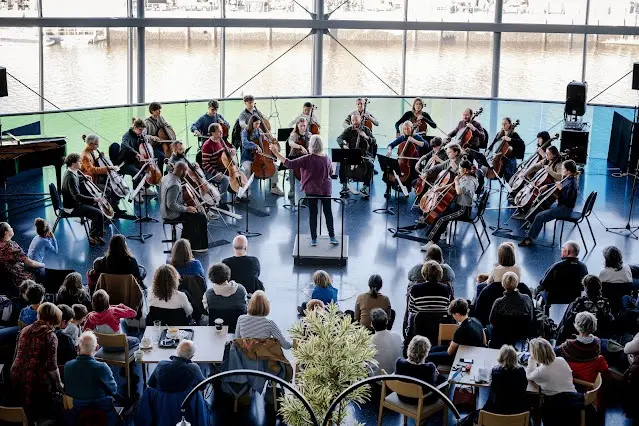
There, he stood shoulder-to-shoulder with 24 aspiring young cellists, ranging from students in the institution’s esteemed Young Sinfonia and Centre for Advanced Training (CAT) programmes to dedicated tutors, professional orchestra members, and alumni of its educational initiatives.
This breathtaking pop-up performance formed the emotional crescendo of a busy weekend, functioning as a key component of The Glasshouse’s broader "Make Music Young People" initiative. Following an intensive rehearsal session tucked away in the state-of-the-art Northern Rock Foundation Hall, the 24-piece cello ensemble surprised and delighted weekend visitors with a lively, eclectic programme featuring works by Heitor Villa-Lobos, George Gershwin, and Scott Joplin.
By seamlessly bridging the gap between an elite professional touring schedule and hands-on youth mentorship, Kanneh-Mason not only underscored his reputation as one of classical music’s most dynamic cultural ambassadors, but also illuminated the transformative power of accessible music education in the North of England. This comprehensive report explores the anatomy of this extraordinary collaboration, the institutional structures that made it possible, the wider cultural implications of youth music engagement, and the profound testimonies of those who participated in this landmark musical event.
Detailed Chronology: From Orchestral Triumph to Concourse Collaboration
The sequence of events leading up to the massed cello performance on The Glasshouse concourse highlights a grueling yet deeply rewarding schedule for Sheku Kanneh-Mason, the Royal Northern Sinfonia (RNS), and the eager student musicians who orbited his residency.
The Regional Tour: Mastering Saint-Saëns
The week began with a high-profile collaborative tour that saw Kanneh-Mason traverse northern venues, interpreting Saint-Saëns’ Cello Concerto No. 1 in A minor, Op. 33. Known for its continuous, flowing structure where three distinct movements are seamlessly interwoven without traditional pauses, the concerto demands absolute technical mastery, emotional depth, and physical endurance.
Performing alongside the Royal Northern Sinfonia under the visionary baton of conductor Dinis Sousa, Kanneh-Mason captivated audiences in Middlesbrough and Kendal before arriving at The Glasshouse in Gateshead. Critics and concertgoers alike praised the synergy between soloist and orchestra—a dynamic interplay of rich, velvety tone and razor-sharp ensemble precision. Yet, even as Kanneh-Mason commanded the main auditorium stages, his commitment to the educational mission of classical music remained palpable. Rather than treating his residency strictly as a performance gig, he viewed his time in the North as an opportunity to actively engage with the regional musical ecosystem.
Rehearsal in the Northern Rock Foundation Hall
On Sunday morning, the atmosphere shifted from the hushed reverence of the grand auditorium to the electric, bustling energy of the Northern Rock Foundation Hall. Here, 24 cellists gathered for a private rehearsal that felt less like a masterclass and more like a collaborative summit.
The ensemble was a striking cross-section of the musical pipeline fostered by The Glasshouse. It featured prodigious teenagers from the Centre for Advanced Training (CAT) and Young Sinfonia, seasoned instrumentalists from the Royal Northern Sinfonia, dedicated local tutors, and alumni who had once sat in the very same youth chairs before pursuing professional careers.

Kanneh-Mason entered the rehearsal room not as an untouchable virtuoso, but as a collaborative peer. Working through intricate harmonies, dynamic shifts, and stylistic nuances, he offered gentle guidance, technical insights, and encouraging smiles. The rehearsal focused heavily on the unique textural challenges of writing for a massed cello choir—an arrangement that requires precise intonation and collective breath control to prevent the deep, resonant frequencies of the instruments from muddying the overall acoustic texture.
The Concourse Performance
Following the meticulous fine-tuning in the rehearsal hall, the 24-piece ensemble migrated to the sweeping, light-filled concourse of The Glasshouse. Designed to break down the physical and psychological barriers traditionally associated with classical music venues, the concourse serves as a public thoroughfare where art casually intersects with daily life.
As unsuspecting weekend visitors paused their strolls, grabbed coffees, and gathered around the ground-floor balconies, the cello ensemble struck up their first notes. Part of The Glasshouse’s ongoing Lunchtime Concerts series—a staple program providing free, accessible mini-performances on Sundays—the setlist was designed to be as engaging as it was technically accomplished.
The ensemble opened with a sweeping movement from Heitor Villa-Lobos’s Bachianas Brasileiras No. 1, a masterwork written for an orchestra of cellos that brilliantly marries Brazilian folk idioms with the counterpoint of Johann Sebastian Bach. The rich, soaring melodies echoed across the architectural expanse of the building, instantly commanding the attention of the public.
The mood then shifted toward the swinging rhythms and syncopated charm of the United States in the early 20th century, with the ensemble performing spirited arrangements of pieces by George Gershwin and Scott Joplin. The sight of Sheku Kanneh-Mason—one of the most recognizable cellists on the global stage—playing side-by-side with teenagers holding rental and student instruments created a powerful visual and sonic testament to the inclusive nature of the event.
Supporting Context & Metrics: The Architecture of Youth Music at The Glasshouse
To fully appreciate the significance of this massed performance, one must examine the institutional framework that supports youth music-making in Gateshead. The Glasshouse International Centre for Music (formerly Sage Gateshead) has long been celebrated as a beacon of cultural regeneration and educational innovation in the UK.
Make Music Young People & The Centre for Advanced Training (CAT)
The collaboration was anchored by two vital pillars of The Glasshouse’s institutional mission: the Make Music Young People programme and the Centre for Advanced Training (CAT).
- The Centre for Advanced Training (CAT): Funded in part by the Department for Education’s Music and Dance Scheme, the CAT programme at The Glasshouse is designed for exceptional young musicians aged 11 to 18 who show significant potential and dedication to their craft. It provides rigorous, high-level instrumental and compositional training, masterclasses, performance opportunities, and mentorship, preparing students for potential careers in the conservatoire system and the professional music industry.
- The Weekend School and Inclusive Ensembles: Beyond the elite training track of the CAT, The Glasshouse operates an expansive weekend school featuring non-auditioned, highly inclusive ensembles, bands, and choirs. Open to young people of all ages and abilities with applications accepted year-round, these groups are intentionally designed to dismantle elitism and ensure that every child—regardless of socioeconomic background—has access to collaborative music-making.
The Power of Massed Ensembles in Music Pedagogy
Musicologists and educational theorists have long championed the benefits of massed ensemble playing, particularly for string instruments like the cello. While individual lessons build technical proficiency and chamber music fosters listening skills, a massed ensemble of 24 cellos offers a distinct psychological and sonic advantage:
- Acoustic Confidence: Young musicians who might feel intimidated playing solo gain immense confidence when their sound is buoyed by a collective wall of resonance. The physical vibration of 24 cellos playing in unison can be felt in the floorboards, enveloping the student in a tangible wave of sound.
- Peer-to-Peer Learning: When students sit next to professional players from the Royal Northern Sinfonia and international soloists like Kanneh-Mason, learning occurs through osmosis. Observing how a professional breathes, shifts bow pressure, and physically reacts to a musical cue provides an educational depth that cannot be replicated in a traditional classroom textbook.
- Community Identity: Participating in a high-profile public performance validates the long hours of solitary practice that young musicians endure. Seeing families, local residents, and casual visitors stop to applaud their work reinforces the idea that their art matters to the broader community.
Official Statements & Reflections
The emotional resonance of the day was captured eloquently in the reflections of the participants, organizers, and the star soloist himself.

Reflecting on the whirlwind week and the culminating Sunday morning performance, Sheku Kanneh-Mason shared his perspective on the younger generation of musicians:
"After my concerts in Middlesbrough, Kendal, and then here at The Glasshouse this week, it was a really special conclusion to hear the young cellists play in the rehearsal and then to join them out on the Concourse, on Sunday morning. The next generation of musicians matters so much, and I loved seeing all the enthusiasm and hearing the talent."
Organizers at The Glasshouse echoed these sentiments, noting that moments like these validate the years of infrastructural investment poured into regional music education. By pairing world-touring artists with regional youth programs, the institution actively breaks down the ivory-tower perception of classical music.
Local music teachers and CAT tutors who participated in the 24-cello ensemble also highlighted the immediate psychological boost the students received. For many of the teenage cellists, the experience of sharing a music stand or a melodic line with Kanneh-Mason transformed abstract career aspirations into an attainable reality. It demystified the life of a touring professional musician, proving that world-class artists emerge from the exact same regional youth orchestras and weekend training schools in which they were currently performing.
Future Outlook: Sustaining the Momentum of Grassroots Classical Music
As the final notes of Joplin and Villa-Lobos faded from the glass-and-steel curves of The Glasshouse concourse, the broader implications of the event resonated far beyond a single Sunday afternoon. In an era where arts funding faces continuous political and economic pressure across the United Kingdom, initiatives that tangibly demonstrate the value of community music education are more critical than ever.
The Vital Need for Accessible Arts Funding
The success of the Make Music Young People programme and the Centre for Advanced Training relies heavily on a delicate ecosystem of government grants, philanthropic donations, regional partnerships, and institutional vision. Events like the Kanneh-Mason collaboration serve a dual purpose: they provide an unforgettable artistic experience for the public while functioning as powerful advocacy tools for cultural stakeholders and policymakers. When funders witness 24 young musicians performing with poise, precision, and infectious joy alongside a global superstar, the return on investment in the creative industries becomes undeniably clear.
Expanding Pathways for Regional Talent
Looking ahead, The Glasshouse aims to expand its outreach pipelines, ensuring that geographic isolation in the North of England never serves as a barrier to musical excellence. By maintaining open-door policies for its weekend schools and expanding scholarship opportunities within the CAT program, the institution continues to democratize access to high-level music training.
Furthermore, the willingness of artists of Kanneh-Mason’s caliber to integrate grassroots educational outreach directly into their touring schedules sets a new benchmark for the classical music industry. Modern virtuosos are increasingly recognizing that their cultural footprint extends far beyond the ticket sales of a main-stage recital; it is measured equally by the seeds they plant in regional rehearsal halls and public concourses.
Conclusion
The image of Sheku Kanneh-Mason surrounded by 24 young cellists on the sunlit concourse of The Glasshouse will long endure as a powerful symbol of modern classical music at its finest—inclusive, rigorous, deeply collaborative, and radically accessible. As these young musicians return to their weekly practice rooms, armed with the memory of sharing a stage with a global icon, the future of the cello—and the future of regional music culture in the North—looks remarkably bright.