Executive Overview
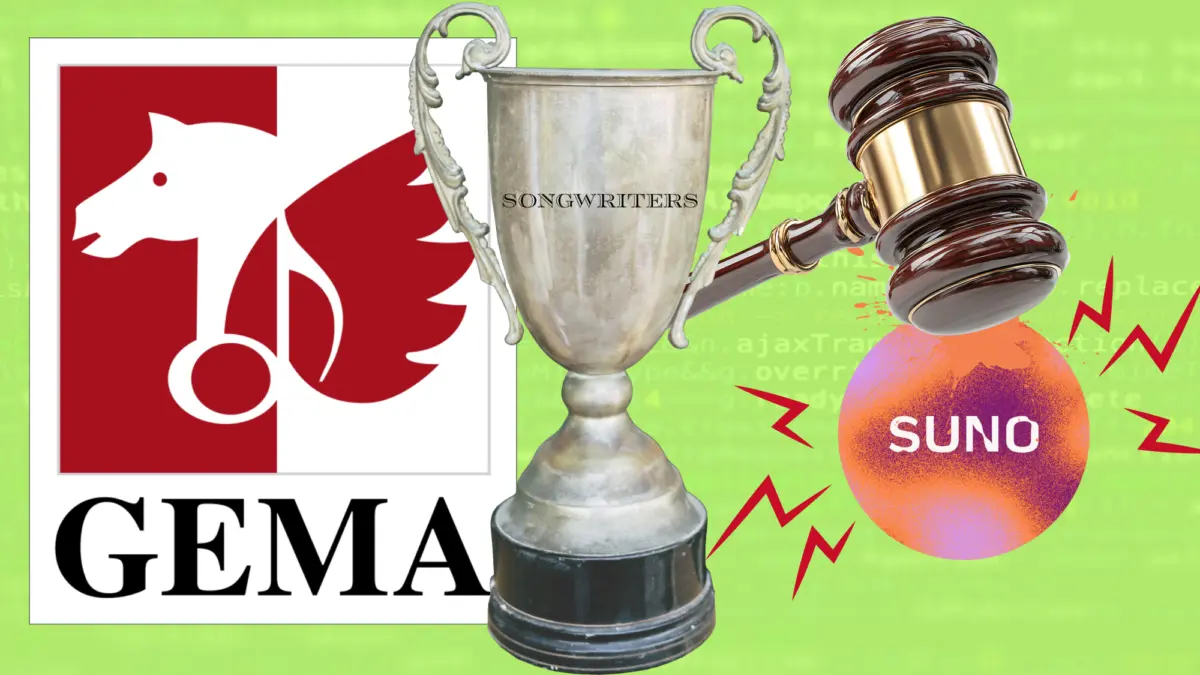
In a legal watershed moment for the intersection of artificial intelligence and intellectual property law, the Munich Regional Court has delivered a decisive victory to Germany’s primary songwriter collecting society, GEMA, in its high-stakes copyright infringement lawsuit against generative AI platform Suno. Announced this morning, the preliminary ruling serves as one of the most critical test cases globally regarding the jurisdictional reach of European copyright law over foreign-based AI developers.
The German court upheld all three core allegations brought forward by GEMA, finding that Suno illegally reproduced copyrighted works during its US-based model training phase, stored infringing model weights on German servers through a process identified as "memorisation," and generated outputs nearly indistinguishable from protected compositions.
While the litigation initially targeted just six specific works to manage the evidentiary burden, the legal reasoning embedded within the judgment effectively shields GEMA’s entire repertoire across the European Union. Consequently, unless Suno acquires a comprehensive licensing agreement, its operational capacity within Europe is severely compromised.
As generative AI companies increasingly face mounting legal pressure from creators worldwide, this ruling establishes a robust European precedent: foreign technology firms commercializing models built on unauthorized intellectual property within EU borders cannot hide behind foreign legal doctrines like "fair use."
Detailed Chronology & Legal Breakdown
The legal battle between GEMA and Suno unfolded at the Munich Regional Court through a meticulously crafted strategy by the collecting society’s legal team. Rather than overwhelming the judicial process with hundreds of disparate claims, GEMA strategically centered its complaint on six iconic musical works, utilizing them as bellwether cases to challenge Suno’s core technological architecture and data acquisition pipelines.
The Three Pillars of Infringement
The Munich court systematically dismantled Suno’s defense by ruling in favor of GEMA across three distinct legal infractions:
- Unauthorized Training Data Acquisition: The court found that Suno committed direct copyright infringement by scraping and making unauthorized copies of GEMA-controlled musical works to assemble its training databases, predominantly executed in the United States.
- Server-Side Storage and "Memorisation" in Germany: The judges determined that Suno’s finished AI model—stored on servers physically located in Germany—retained intrinsic elements of the copyrighted training data. This phenomenon, legally defined as "memorisation," occurs when an algorithm’s parameters do not merely abstract generalized patterns from a dataset, but instead appropriate and encode specific content.
- Infringing AI Outputs: The court observed that Suno’s platform was capable of generating music almost identical to well-known compositions, such as Lou Bega’s "Mambo No. 5" and Boney M.’s "Daddy Cool," when subjected to specific prompting techniques.
Dissecting the "Memorisation" Argument
Suno’s legal defense heavily relied on the assertion that its models function similarly to a human student learning music theory; they absorb general stylistic traits rather than storing exact digital replicas of copyrighted scores. However, GEMA’s legal representatives successfully demonstrated that through iterative, complex prompting, the AI could reproduce substantial portions of protected works.
In its published summary, the Munich Regional Court addressed this technical nuance directly:
"Memorisation exists where, in the course of training, the AI models do not merely derive information from the training dataset, but where the parameters specified after training also reflect an appropriation of the content of the training data."
The judges further noted that given the complexity and length of the musical works successfully replicated by the model, pure coincidence or algorithmic hallucination could be statistically excluded. Because this memorized data was actively hosted and distributed via servers located inside Germany, the court ruled that European copyright protections superseded Suno’s reliance on the European Union’s text and data mining (TDM) exceptions. Furthermore, the court held that the existence of these direct output capabilities invalidated Suno’s reliance on US-style "fair use" exemptions for its international training activities.
Supporting Context & Metrics: The Global AI Copyright Battleground
The conflict between GEMA and Suno does not exist in a vacuum. It is part of an escalating global campaign by creative industries to rein in artificial intelligence companies that have historically operated under a Silicon Valley ethos of "move fast and break things"—often translating to scraping first and negotiating licenses later.
US vs. European Legal Frameworks
Most high-profile litigation involving generative AI has thus far been centered in the United States, where major record labels, independent publishers, and superstar creators have filed class-action lawsuits against firms like Suno, Udio, OpenAI, and Anthropic. In these American proceedings, tech enterprises routinely defend their web-scraping practices under the umbrella of "fair use" doctrine, arguing that algorithmic training constitutes a transformative, non-infringing use of data.
However, as these US-trained models are deployed, monetized, and marketed globally, they inevitably run headfirst into the more rigid copyright regimes of other jurisdictions. Europe, in particular, boasts some of the world’s most stringent creator protections, fortified by the EU Directive on Copyright in the Digital Single Market.
GEMA’s Track Record as a Global Pioneer
GEMA has rapidly positioned itself as the most aggressive and successful collecting society in challenging unregulated AI practices. Prior to its breakthrough against Suno, GEMA secured a landmark victory against OpenAI concerning the unauthorized reproduction and output of copyrighted lyrical works via ChatGPT.
While the OpenAI victory sent shockwaves through the literary and publishing sectors, the ruling against Suno carries direct, existential implications for the multi-billion-dollar recorded music industry. By proving that generative music platforms are legally vulnerable within European courts, GEMA has effectively redrawn the battlefield.
Financial and Operational Impact on Suno
As a direct consequence of the Munich Regional Court’s judgment, Suno faces immediate operational restrictions within Germany and broader Europe:
- Injunction: Suno must immediately cease the reproduction of the six specific works utilized in GEMA’s test case for model training and operational purposes.
- Financial Transparency: The company is legally compelled to provide GEMA with comprehensive telemetry data detailing the precise scope of infringed works utilized within its systems.
- Revenue Accounting & Damages: Suno must account for all commercial revenues generated within the jurisdiction and pay statutory damages to the collecting society.
- Repertoire-Wide Licensing Imperative: Although the formal injunction names only six compositions, the legal logic dictates that any GEMA-managed work present in Suno’s training dataset represents an ongoing infringement. To continue operations in Europe without facing serial litigation, Suno is functionally forced to negotiate an enterprise-wide licensing agreement with GEMA and its sister societies.
Official Statements & Industry Reactions
The global music community has responded to the Munich ruling with overwhelming approval, viewing it as a long-overdue validation of creators’ rights in the digital age.
GEMA Leadership
Tobias Holzmüller, CEO of GEMA, issued a fiery statement following the release of the judgment, emphasizing that the court’s decision permanently shatters the impunity previously enjoyed by tech startups operating in the generative audio space:
"The Munich Regional Court has made one thing crystal clear: AI models built on stolen IP have no protection under the law in Europe. AI service providers must pay for licences rather than helping themselves to our members’ works free of charge."
Holzmüller further underscored the geopolitical significance of the ruling, noting that it reinforces Europe’s standing as a sanctuary for cultural preservation:
"Today’s ruling has significantly strengthened Europe’s position as a cultural centre, demonstrating that when AI service providers operate their systems in Europe, claims can be brought against them in European courts."
Creator Advocacy Groups
Tom Gray, Chair of The Ivors Academy—which represents songwriters and composers across the UK and Ireland—praised GEMA for committing critical financial resources to spearhead the litigation. Gray did not mince words regarding the necessity of European jurisprudence independent of American precedents:
"This is proof, were it needed, that on this side of the Atlantic we have our own rules and our own copyright law. Waiting for the USA to produce flawed precedents on the copyright obligations of AI companies is not the path. Songwriter collecting societies around the world need to take note."
Across the continent, other collecting societies are following GEMA’s playbook. Notably, Danish collecting society Koda has initiated parallel legal proceedings against Suno, echoing the sentiment that technological innovation cannot be built upon a foundation of misappropriated cultural goods.
Future Outlook & Industry Implications
Despite the magnitude of GEMA’s initial win, the legal war is far from over. The decision handed down by the Munich Regional Court is a preliminary judgment and will almost certainly be subjected to a rigorous appeals process by Suno’s legal counsel.
Suno’s Defense Strategy on Appeal
In anticipation of higher court reviews, Suno has maintained its defiant stance, publicly asserting that German judges fundamentally misunderstood both the underlying mechanics of its neural network architecture and the jurisdictional application of American copyright law. Suno’s appellate strategy will likely focus on proving that its training parameters do not constitute illegal "memorisation" under German statutory definitions, and that the outputs generated during prompting sessions were anomalies rather than systemic architectural flaws.
A Shift Toward Compulsory Licensing?
Even as Suno prepares its appeal, the specter of sustained European litigation may fundamentally alter the company’s corporate strategy. Facing the very real prospect of being locked out of the lucrative European streaming and consumer markets, AI music developers may find that entering negotiations for collective licensing agreements is far more commercially viable than enduring protracted court battles across multiple EU member states.
For music publishers, major labels, and independent artists alike, the Munich ruling marks a pivotal paradigm shift. It signals to the tech sector that the era of uncompensated scraping is drawing to a close, establishing a legal framework where technological innovation and copyright protection can—and must—coexist through fair, transparent market licensing.