Executive Overview
Ten years after the curtains closed on Madison Square Garden on August 28, 2016, the MTV Video Music Awards (VMAs) of that year remain an indispensable cultural touchstone. Widely regarded as the apex of an era, the 2016 ceremony captured the absolute zenith of traditional pop superstardom. It was an evening defined by monumental career milestones, unforgettable performances, and high-stakes drama—featuring career-defining showcases from Beyoncé and Rihanna, seismic moments from Drake and Kanye West, and a glittering constellation of A-list talent that hasn’t been replicated since.
In a recent installment of the Greatest Pop Stars podcast series—titled Great Moments in Pop Star History—host Andrew Unterberger and Billboard deputy digital editor Katie Atkinson re-examined the 2016 VMAs a decade after the fact. Their discussion peeled back the layers of nostalgia to analyze why that specific night felt like the center of the pop universe, why it signified the end of an era for music award shows, and whether contemporary pop culture can ever recapture the collective magic of getting so many icons under one roof.
This retrospective article expands upon those themes, offering an in-depth journalistic investigation into the mechanics of the 2016 show, its lingering cultural footprint, the unprecedented challenges facing modern award ceremonies, and the enduring questions that still fascinate pop music historians a decade later.
Detailed Chronology: A Night of Unprecedented Highs
The 2016 VMAs were packed tightly with a sequence of events that pushed the boundaries of live television production and pop myth-making. From the red carpet to the final closing notes, the night unfolded as a masterclass in event television.
The Lemonade Phenomenon: Beyoncé’s Masterclass
Few artists in the history of live television have commanded a stage with the absolute authority Beyoncé displayed during her career-spanning Lemonade medley. Coming off the critical and commercial success of her visual album, Beyoncé delivered a nearly 16-minute performance that transitioned seamlessly through tracks like "Pray You Catch Me," "Hold Up," "Sorry," "Don’t Hurt Yourself," and "Formation."
Far more than a standard promotional slot, the medley functioned as a cinematic installation, an assertion of artistic independence, and a masterclass in choreography and staging. Critics and fans alike immediately crowned it one of the greatest award-show performances in television history—a high-water mark that redefined what artists could demand from networks in terms of production scale and creative control.
Rihanna’s Multi-Act Vanguard Coronation
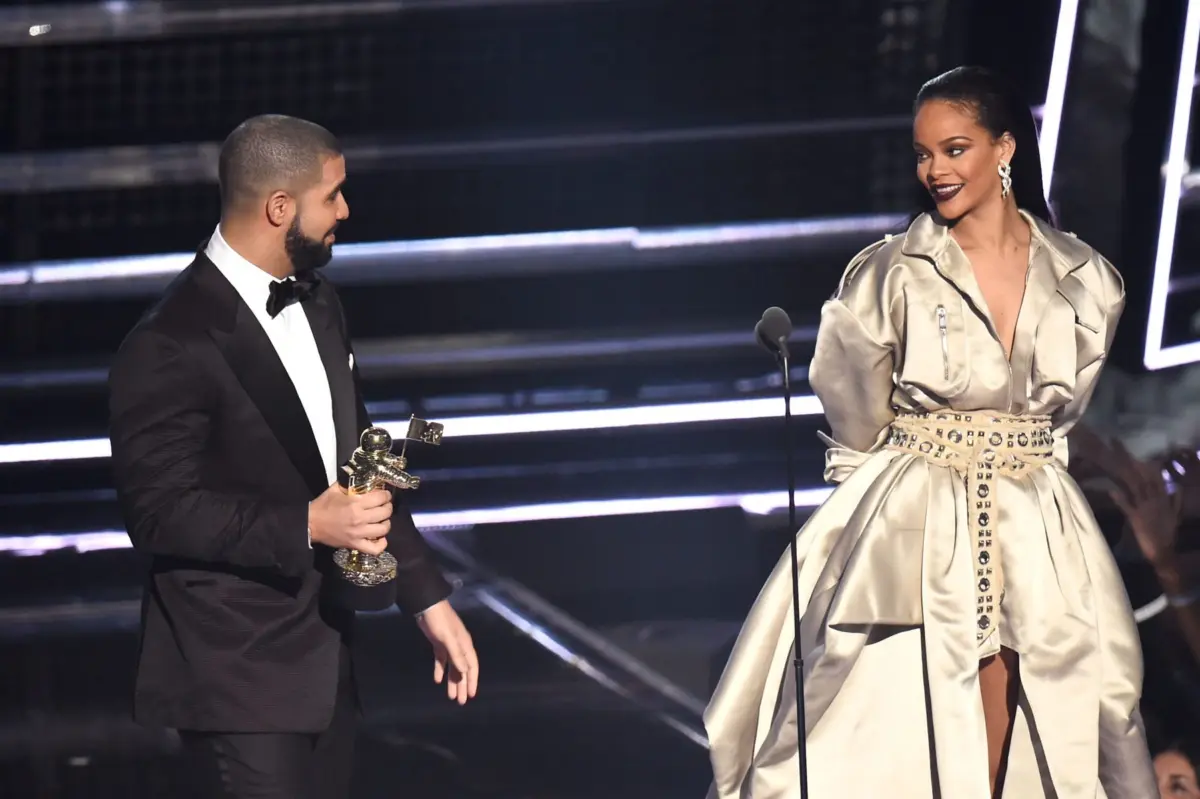
Honored with the prestigious Michael Jackson Video Vanguard Award, Rihanna was granted something rare in modern television: multiple performance blocks spaced throughout the evening. Rather than delivering a single retrospective medley, Rihanna commanded four distinct stages across the night, tracing her trajectory from island-pop breakout to global powerhouse with hits like "Don’t Stop the Music," "Disturbia," "Work," "Needed Me," and "Stay."
The performance cemented her status as an untouchable pop and fashion deity, yet it was her interaction with presenter Drake that generated the night’s most scrutinized viral moment.
The Drake and Rihanna Saga
Drake, who had openly professed his enduring love for Rihanna earlier in the evening while presenting her with the Vanguard trophy, leaned in for a kiss on stage. Rihanna’s subtle, expertly executed sidestep—effectively "curving" him in front of millions of live viewers—sent shockwaves through social media.
Ten years later, podcasters Unterberger and Atkinson explore the lasting impact of that micro-interaction on both artists’ mythologies. It encapsulated the high-stakes, soap-opera-like drama of 2010s pop culture, where public flirtations and rejections played out in real time under the microscope of global media.
Britney Spears and G-Eazy: The Ambivalent Comeback
The 2016 ceremony also marked the heavily anticipated return of pop royalty Britney Spears to the VMA stage, performing "Make Me…" alongside rapper G-Eazy. Coming on the heels of her critically praised Glory album rollout, the performance carried enormous expectations.
However, looking back a decade later, the performance occupies a complicated space in pop history. Beset by staging limitations, stiff choreography relative to her historic 2000s peaks, and a mixed critical reception regarding her chemistry with G-Eazy, the comeback did not land with the seismic cultural impact fans had hoped for. It remains a poignant subject of debate: How much of the performance’s underperformance can be attributed to external staging constraints, and how much fell on the shoulders of her collaborators?
Supporting Context & Metrics: The End of an Era for Music Television
To understand why the 2016 VMAs felt like the end of an era, one must examine the shifting economics and logistics of the music industry and television landscape.
The Gathering of the Titans
In the early-to-mid 2010s, the VMAs still served as the primary battleground and meeting place for the music industry’s elite. Securing Beyoncé, Rihanna, Drake, Kanye West, Britney Spears, and Ariana Grande in a single room required immense industry pull, but the cultural payoff for the artists was undeniable. It was an ecosystem where a single unscripted moment could dominate global news cycles for weeks.
Fragmentation and the Shift in Artist Promotion
In the decade following 2016, getting major superstars into the same building at the same time has grown increasingly difficult. Several macroeconomic and industrial shifts explain this decline:
- The Rise of Niche Streaming and Algorithmic Stardom: Pop culture has fragmented. Instead of a handful of monocultural titans dominating the charts, audiences are dispersed across countless micro-genres and digital subcultures.
- Direct-to-Consumer Digital Marketing: Artists no longer rely on traditional television monoliths like the VMAs to launch eras or market albums. Social media platforms—TikTok, Instagram, and YouTube—allow stars to communicate directly with fans on their own terms, reducing the perceived risk and necessity of high-stakes live television performances.
- Touring Economics: Modern pop stars operate on grueling, highly lucrative global tour schedules where the risk of injury, vocal strain, or negative PR from a live award show misfire far outweighs the promotional benefit.
Official Statements & Podcast Insights
During their deep-dive episode of the Greatest Pop Stars podcast, Andrew Unterberger and Katie Atkinson unpacked these complex dynamics, offering candid insights into how the 2016 VMAs look through a modern lens:
"The 2016 VMAs felt like the absolute apex of a specific golden age of pop culture," Unterberger noted during the broadcast. "You had all these titans of the industry operating at the absolute peak of their powers, and they all actually showed up. Looking back a decade later, it’s remarkable to realize that we may never see a convergence of that magnitude on a live broadcast again."
Atkinson added nuance to the discussion regarding the shifting expectations placed on legacy acts versus contemporary stars:
"Revisiting performances like Britney’s comeback or Nick Jonas’s underrated single ‘Bacon’ gives you a fascinating cross-section of where the industry was at that exact second. It was a transitional moment where streaming was taking over, but the old-school rules of pop spectacle still applied. The question isn’t just whether the VMAs can match 2016—it’s whether the idea of the pop monoculture can ever be put back together."
Future Outlook: Can the VMAs—and Award Shows—Reclaim Their Former Glory?
As the entertainment industry looks toward the latter half of the 2020s, the future of traditional music award shows remains a subject of intense debate among industry analysts, network executives, and music fans.
The Evolution of Live Event Production
To remain relevant in an era dominated by on-demand streaming and short-form video, award shows have had to adapt. Producers increasingly lean into immersive stage design, augmented reality, and real-time social media integration. However, production tricks cannot substitute for genuine star power.
The primary challenge for producers of the VMAs, the Grammys, and similar ceremonies is incentivizing the modern generation of streaming giants—artists whose primary engagement happens via digital algorithms—to treat physical award shows as essential cultural moments.
The Lasting Legacy of 2016
Ultimately, the 2016 MTV Video Music Awards stand as a magnificent monument to a bygone era of pop music. They captured a moment when the industry was still large enough, unified enough, and theatrical enough to command the attention of the entire world for two hours on a Sunday night.
Whether future ceremonies will ever manage to recapture that lightning-in-a-bottle energy remains to be seen. But as long as pop music historians, podcasters, and fans continue to dissect the triumphs, the awkwardness, and the pure spectacle of Madison Square Garden in August 2016, that legendary night will endure as the ultimate standard by which all modern pop pageantry is measured.
To listen to the full discussion, check out the "Great Moments in Pop Star History" episode of the Greatest Pop Stars podcast on Apple Podcasts, Spotify, or your preferred podcast platform. New episodes drop every Thursday.
Support Trans Rights and Advocacy
In alignment with the ongoing mission of the Greatest Pop Stars podcast team, readers who are able are encouraged to support organizations fighting for transgender rights, healthcare access, and equality: