Executive Overview
For specialty coffee buyers, commercial roasters, and green bean procurement teams operating at scale, post-harvest processing methods are just as influential as terroir in shaping a coffee’s final sensory profile, physical stability, and green storage longevity. While origin characteristics—such as volcanic soil composition, altitude, and microclimate—lay the foundational bedrock for a coffee’s potential, it is the transformation from cherry to export-ready parchment that ultimately dictates how a lot will behave in the roastery and perform in the cup.
Within the vibrant and geographically diverse landscape of Indonesian specialty coffee, two primary processing methodologies dominate the commercial and specialty export markets: traditional Wet Hulling (internationally recognized by its Indonesian name, Giling Basah) and Washed Processing (frequently referenced as fully washed or wet processing).
While both methods utilize water as an initial agent to depulp the outer fruit, their mechanical timelines, drying mechanisms, and biological phases differ radically. These divergent pathways produce starkly contrasting cup profiles, physical green bean attributes, and distinct shelf-life considerations for B2B procurement managers.
This technical report provides an exhaustive, authoritative breakdown of Giling Basah versus Washed processing in Indonesia. By examining the mechanical differences, sensory implications, storage stability dynamics, and systemic quality control measures enforced by modern processing innovators like Bali Origins, this guide equips commercial buyers with the data needed to navigate origin sourcing with precision.
Detailed Chronology: From Cherry Reception to Export-Ready Green
To fully understand the structural and chemical differences between Indonesian Wet-Hulled and Washed coffees, one must trace the step-by-step chronology of each post-harvest processing methodology. The divergence begins immediately after harvest and dictates how moisture is systematically removed from the seed.
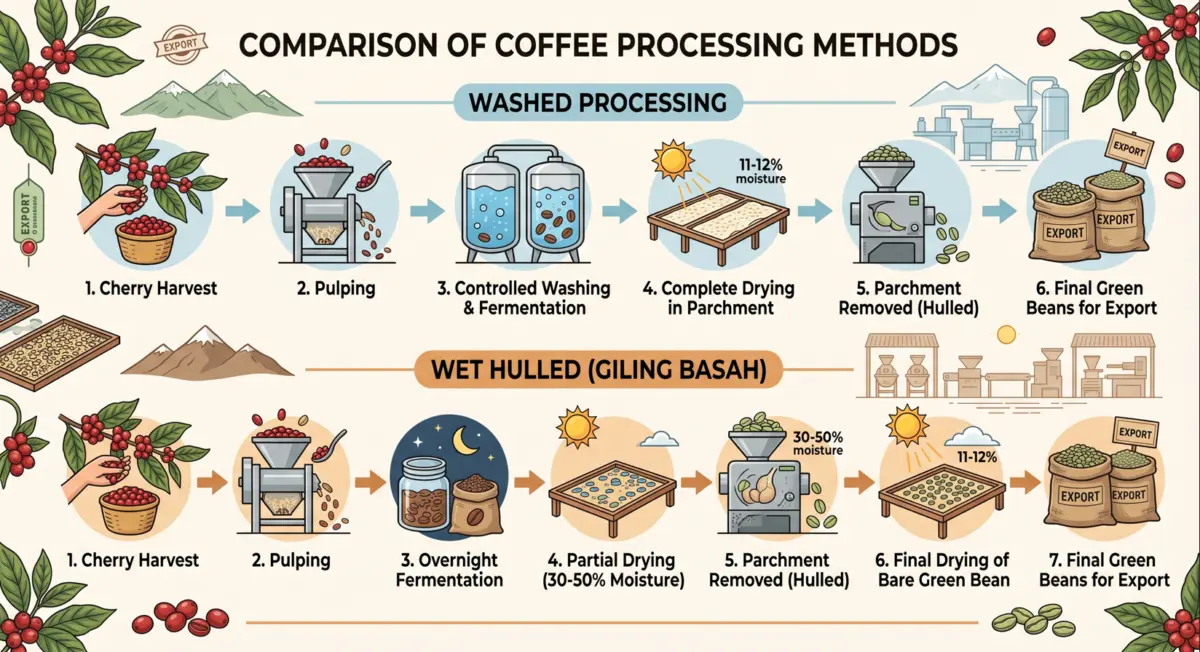
The Chronology of Giling Basah (Wet Hulling)
Giling Basah is an indigenous Indonesian processing method developed out of necessity in the humid, tropical microclimates of Sumatra, Sulawesi, and parts of Bali. Because consistent, prolonged periods of intense sunlight are historically difficult to secure in these regions, farmers engineered a rapid-drying workaround that strips the protective parchment layer prematurely.
- Cherry Harvest & Sorting: Ripe coffee cherries are selectively hand-picked from trusted smallholder plantations. Floating tanks are often used to separate under-ripe fruit and floaters from dense, high-sugar cherries.
- Initial Depulping (Mechanical Pulper): Using locally built, hand-cranked or small motor-driven pulpers, farmers strip away the outer skin (exocarp) of the coffee cherry.
- Short Mucilage Fermentation: Unlike African or Latin American washed processing, where mucilage is completely broken down via prolonged fermentation and washing, Giling Basah involves a very brief, often rudimentary fermentation stage (ranging from zero to a few hours) where the sticky pectin layer (mesocarp) remains largely intact on the parchment-covered seed.
- Washing & Initial Drying (High Moisture State): The parchment coffee (still coated in sticky mucilage) is washed briefly and laid out on patios, tarps, or roadside concrete to undergo its first phase of drying. Crucially, this drying phase is cut short. While standard processing dries coffee down to 10–12% moisture while still inside its protective parchment, Giling Basah coffee is removed from drying when the internal moisture content is still exceptionally high—typically between 30% and 35%.
- Wet Hulling (The Defining Step): At 30–35% moisture, the green bean inside is semi-soft, rubbery, and highly vulnerable. Farmers or local collectors pass this semi-dried parchment through mechanical hullers. The process strips away the endocarp (parchment layer) while the bean is still wet, exposing the bare, pale-green or white seed directly to the elements.
- Secondary Drying: The naked, wet green beans are spread out once again on patios or tarps to finish drying down to the export-standard 11–12% moisture level. Because the protective parchment shell is absent during this secondary phase, the bare seed is exposed directly to ambient air, humidity, and surrounding organic particulate matter.
The Chronology of Washed Processing
In contrast, the Washed processing method—increasingly optimized across progressive Indonesian estates using an engineering-led approach to washed coffee processing—relies on rigorous water management and extended protection of the seed.
- Cherry Harvest & Density Sorting: Cherries are harvested at peak ripeness and subjected to rigorous floatation tanks and manual sorting to remove defects.
- Precision Depulping: High-efficiency mechanical depulpers remove the outer skin cleanly, leaving minimal residual pulp on the parchment.
- Controlled Fermentation & Mucilage Breakdown: The parchment coffee is transferred to clean fermentation tanks (or depulped mechanically via demucilaginous machines). In traditional tank fermentation, natural yeasts and bacteria break down the sticky pectin layer over 12 to 36 hours.
- Channel Washing: The fermented coffee is rigorously washed in clean channels or washing stations, stripping away all remaining fruit residue and leaving clean, water-saturated parchment.
- Extended Drying in Parchment: The clean parchment coffee is laid out on raised African beds, patios, or mechanical dryers. The coffee remains securely encased inside its hard, woody endocarp (parchment) throughout the entire drying cycle, until internal moisture drops safely to 10–12%.
- Dry Hulling (Milling): Only after the coffee has stabilized and rested in its parchment for a designated conditioning period is it passed through a dry hulling machine immediately prior to export and bagging.
Supporting Context & Metrics: Sensory & Physical Profiles
The mechanical divergence between these two methods triggers a cascade of chemical reactions, structural modifications, and sensory expressions. For the B2B buyer, understanding these metrics is vital for matching origin lots to target market segments.
Sensory Profile Comparison Matrix
| Sensory Attribute | Wet Hulled (Giling Basah) | Washed Processing |
|---|---|---|
| Acidity | Muted, gentle, low-toned, highly subdued | Bright, crisp, vibrant, sparkling, citrusy |
| Body / Mouthfeel | Heavy, syrupy, rich, coating, opulent | Medium, clean, elegant, silky, weightless |
| Flavor Notes | Dark cocoa, cedar, herbal, tobacco, sweet spices, damp earth | Floral aromatics, clean honey, citrus, delicate stone fruit |
| Cup Clarity | Low to medium (complex, rustic, wild) | High (high transparency, distinct origin notes) |
| Target Application | Heavy-bodied anchor beans for dark espresso blends & milk drinks | Vibrant single-origin pour-overs, light-roast espresso, filter coffee |
Why the Sensory Profiles Differ
The distinct flavor profiles of Indonesian coffees are direct results of their processing physics:
- The Giling Basah Effect: Because wet hulling exposes the bare green bean directly to ambient air, humidity, and microbial activity during its secondary drying phase, the bean absorbs ambient organic compounds. This alters its internal chemical structure, reducing chlorogenic acid degradation rates and dampening bright citric acids. The result is a cup defined by heavy, earthy, and spiced notes with a distinct absence of sharp acidity.
- The Washed Effect: Conversely, keeping the bean protected inside its parchment shield during drying preserves its volatile aromatic compounds and locks in clean, unadulterated origin characteristics. This yields high cup clarity, showcasing the true terroir of the volcanic soils without processing-induced earthiness.
Storage Stability and Green Bean Shelf Life
For green coffee importers, large-scale roasters, and warehouse managers, shelf life and structural stability matter just as much as initial cup score. Supply chains require beans that stay fresh, hold their moisture equilibrium, and resist lipid oxidation and fading during extended maritime transit and warehousing.
[Harvest & Processing]
       │
       ├─► Washed Processing (Protected Parchment Drying)
       │         └── High Cell Wall Integrity ──► 12+ Month Stability
       │
       └─► Giling Basah (Exposed Naked Bean Drying)
                 └── Porous Cell Structure ────► Rapid Aging / Accelerated Flavor Shift
The Physics of Green Bean Aging
- Moisture Equilibrium & Water Activity ($a_w$): Washed coffees, dried slowly within their parchment, achieve a uniform moisture gradient from the core of the seed to its outer edge. This results in stable water activity levels that resist mold growth and slow down staling. Wet-hulled coffees, undergoing a violent mid-process hulling while semi-soft, often exhibit internal moisture imbalances, making them more susceptible to localized moisture pockets.
- Cell Wall Integrity: The parchment layer acts as a thermal and physical insulator against ultraviolet light, oxygen, and ambient humidity during the most delicate phase of drying. Stripping this layer away at 30% moisture leaves the cellular structure of the bare green bean more porous and exposed. Consequently, wet-hulled coffees tend to lose their green vibrancy faster (transitioning from jade-green to a bleached, whitish color known as "baggy" or "old crop" coffee) more rapidly than washed counterparts.
- B2B Procurement Implications:
- Washed Lots: Ideal for long-term inventory planning, offering predictable aging curves and maintaining freshness for 10 to 14 months when stored in hermetic packaging (e.g., GrainPro or vacuum seals) under climate-controlled conditions.
- Wet-Hulled Lots: Demands rigorous inventory turnover. While prized for their unique, heavy-bodied profiles, procurement teams must manage logistics closely to ensure these lots are roasted within peak freshness windows (typically 6 to 9 months post-harvest) to prevent the emergence of woody or papery defect notes.
Systemized Quality Control in Indonesian Processing
Historically, Indonesian coffee processing—particularly within smallholder-dominated regions—suffered from batch inconsistency, variable moisture content, and physical defects. However, the modernization of origin infrastructure has transformed how processing facilities operate.
To keep green coffee stable, clean, and consistent, modern post-harvest processing facilities implement strict, engineering-led quality control protocols at every critical control point:
- Rigorous Farm Sourcing & Traceability: Establishing direct partnerships with vetted smallholder groups ensures that cherry ripeness, harvesting cleanliness, and delivery times are tightly regulated before processing even begins.
- Precision Moisture & Temperature Monitoring: Utilizing digital hygrometers, refractometers, and climate-monitored drying tables, processing technicians eliminate guesswork. Whether executing a meticulous washed process or managing the delicate stages of Giling Basah, tracking drying curves prevents case-hardening and internal seed cracking.
- Mechanical Sorting & Density Grading: Modern mills employ multi-stage dry-milling machinery, including gravity tables, color sorters, and screen-sizing screens. This eliminates insect-damaged beans, black beans, unhulled parchment, and foreign matter, ensuring high physical uniformity.
- Stabilization & Resting Periods: Processed green coffee is allowed to rest in temperature-controlled warehouses for mandatory conditioning periods, allowing internal moisture equilibrium to stabilize before vacuum-packing or export container stuffing.
Future Outlook: The Evolution of Indonesian Specialty Sourcing
As the global specialty coffee market matures, the demands placed upon origin partners are evolving rapidly. B2B buyers no longer accept the binary choice between rustic wet-hulled coffees and standard washed lots; instead, they demand precision, transparency, and uncompromising batch consistency.
Forward-thinking processing enterprises and exporters are bridging the gap between traditional heritage methods and modern processing science. By applying rigorous scientific rigor to traditional methods—such as micro-lot Giling Basah executions with extended anaerobic rest phases, or experimental washed processing protocols utilizing controlled fermentation environments—Indonesian producers are unlocking unprecedented flavor clarity while honoring regional traditions.
For roasters seeking reliable batch consistency, production-ready single-origin lots, and transparent supply chains, partnering with a systems-driven manufacturer is paramount. Organizations like Bali Origins exemplify this next-generation approach, integrating farm-level education, advanced engineering in washed coffee processing, and rigorous quality control protocols to ensure that every harvest meets the exacting standards of the global specialty market.
As the industry moves forward, the synergy between traditional Indonesian processing heritage and modern scientific oversight will continue to redefine what is possible in the cup—securing Indonesia’s position as a powerhouse of specialty coffee innovation for decades to come.