Executive Overview
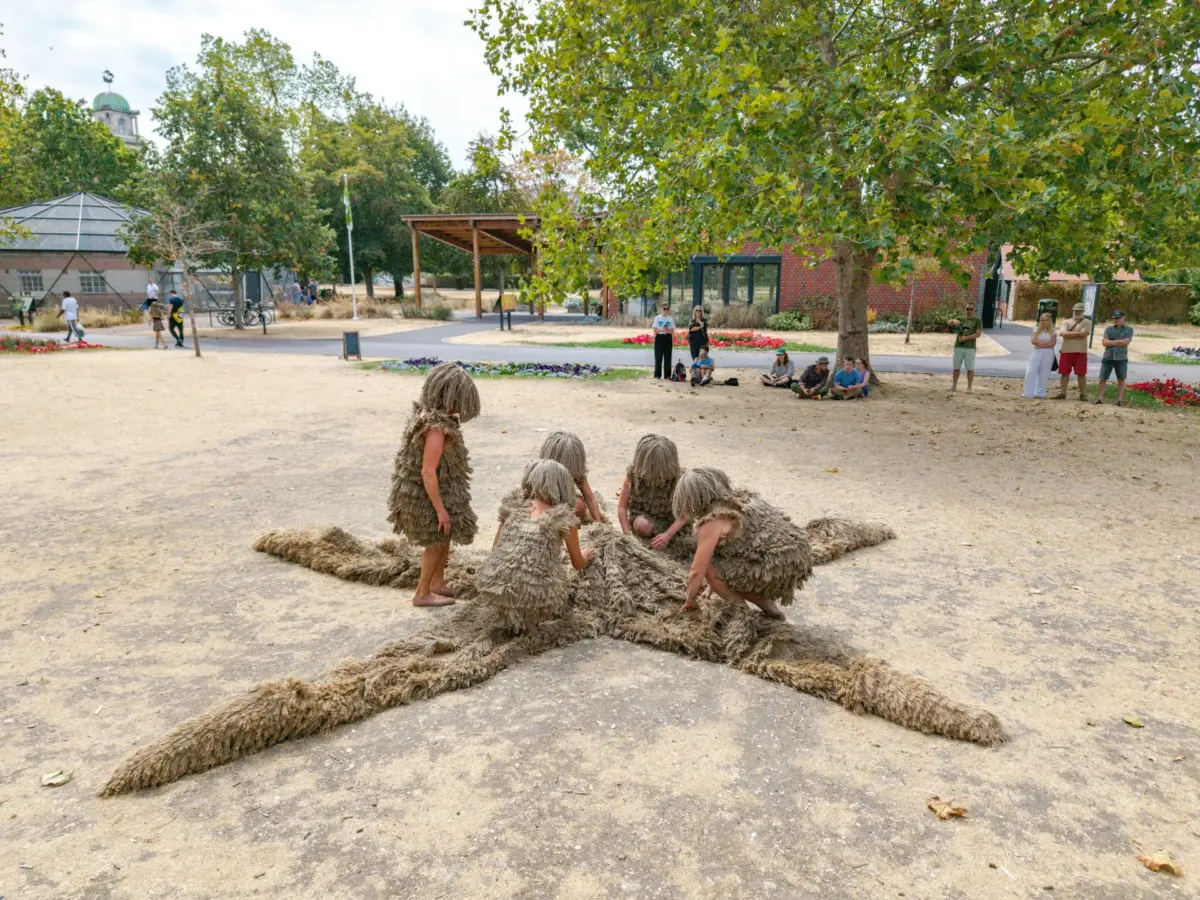
Against the sun-scorched, drought-yellowed turf of a municipal park in Portsmouth, England, five interconnected silhouettes move with slow, unsettling deliberation. Draped in layered, hessian-coloured fabrics and crowned with wild, overgrown fiber-dreadlocks that blur individual identities into a single collective organism, the figures process toward a deflated, five-armed star shape lying inert on the ground. This is Between Land and Tide, a striking durational living sculpture and performance art piece conceived by Portsmouth-based artist Olana Light in close collaboration with local contemporary dancers.
Scheduled to run across the summer and deep into the autumn months—culminating on September 27, 2026—the project merges sculpture, choreography, and ecological commentary. By invoking the radial symmetry of echinoderms—specifically the starfish—Light and her performers construct a poetic, apocalyptic, and deeply hypnotic meditation on climate vulnerability. The performance deliberately challenges anthropocentric assumptions, reframing the earth not as a passive resource for human consumption, but as a dynamic, fragile theatre where human bodies and marine ecosystems entwine.
As part of a broader cultural reckoning with how to communicate the climate crisis through art rather than sterile data, Between Land and Tide offers a visceral entry point into the conversation. It recalls the speculative, mutation-haunted landscapes of science fiction master John Wyndham while echoing the pioneering land art traditions of feminist icons like Ana Mendieta. This in-depth report explores the genesis, execution, and cultural reverberations of Light’s living sculpture, situating it within contemporary eco-art practices and examining its capacity to foster ecological awareness through somatic storytelling.
Detailed Chronology: The Anatomy of a Performance
To understand the impact of Between Land and Tide, one must trace the physical evolution of the performance as it unfolds across the municipal park’s parched terrain. The temporal arc of the piece is divided into distinct phases, each mirroring biological imperatives, environmental stress, and a surreal metamorphosis.
Phase One: The Procession and the Gathering
The work begins at the perimeter of the park. Five performers, bound visually and rhythmically by their muted, earth-toned hessian garments, enter the public space. Their movement is not the swift transit of urban commuters, but a slow, deliberate processing that commands the environment. On their heads, the organic, tangled headdresses create a visual bridge between botanical roots and marine tentacles.
They advance as a singular entity toward the center of the green, where a deflated hessian starfish rests flat against the scorched grass. The atmosphere is quiet, heavy with anticipation. Spectators, caught off guard during their routine park visits, pause to watch the unfolding ritual, moving between curiosity and amusement as the performers encircle the limp fabric form.
Phase Two: Somatic Hydraulics and the Awakening
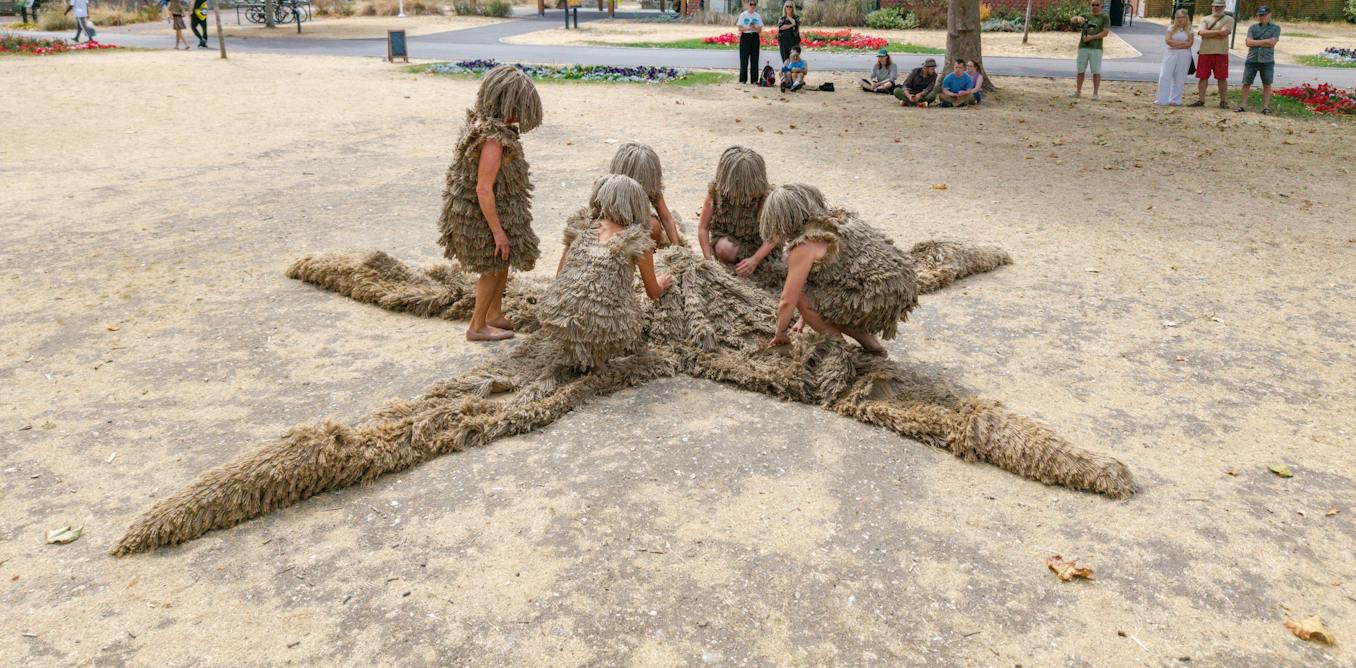
Upon reaching the starfish structure, the dancers drop down, weaving their limbs into the empty pockets of the five-armed sculpture. Here, the choreography mimics the biology of echinoderms. Because starfish possess no muscles, they rely entirely on hydraulic water vascular systems to generate movement, creating a liquid opacity and slow hydraulic push.
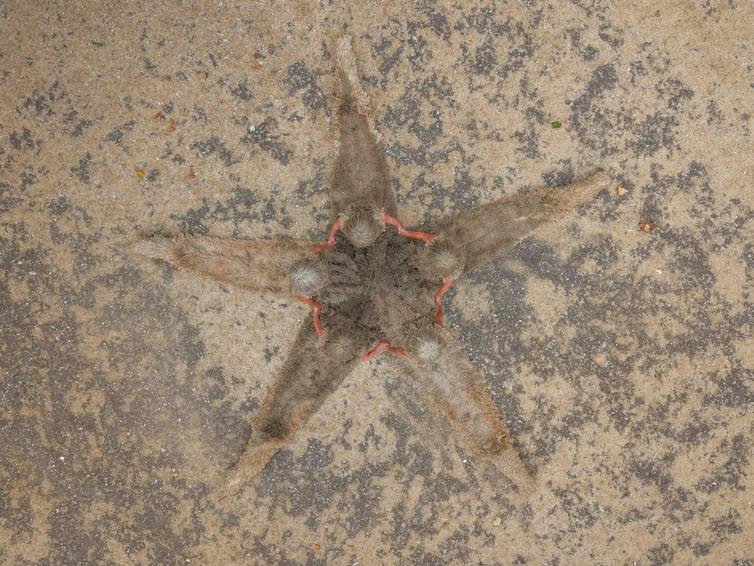
The dancers translate this biological reality into human movement. They breathe, pulse, and writhe, pushing outward from the core of the textile structure. Slowly, the inert, flat form begins to swell and rise. The performers’ bodies act as artificial muscles, pumping life into the inanimate material until the starfish takes on a volumetric, looming presence against the drought-stricken earth.
Phase Three: The Apocalyptic Mutation
As the performance reaches its climax, the boundary between human and animal dissolves entirely. Observers catch fleeting glimpses of human lips and mouths straining from within the textile folds, emphasizing the claustrophobic entrapment of the organism. The starfish’s arms sweep the air and score the parched earth, searching desperately for the moisture, safety, and solace of an ocean that is miles away.
The movement takes on an increasingly uncanny, dystopian tone. There are moments when the performers resemble oversized, textured sleeping bags convulsing with life; at other times, they evoke the strange botanical horrors of John Wyndham’s speculative fiction. The climax arrives when human limbs violently split the sculptural seams from the inside out. The performers tear free, dragging the exhausted, dismembered arms of the starfish behind them across the grass, leaving the landscape looking like the aftermath of an ecological trauma. They depart the space not as triumphant heroes, but as post-apocalyptic slugs—scarred, mutated survivors of a transformed world.
Supporting Context & Metrics: Art, Ecology, and the "Taskscape"
The climate crisis has long suffered from a communications failure. Statistics regarding carbon parts-per-million, rising sea levels, and glacial retreat often fail to stir the human imagination in a way that drives sustained empathy or action. Between Land and Tide addresses this crisis of narrative by operating at the intersection of somatic art, environmental science, and cultural anthropology.
The Science of Echinoderms in Urban Spaces
Placing a marine invertebrate—an echinoderm—in the center of an inland municipal park creates an immediate geographical and psychological dissonance. Starfish are creatures of the intertidal zone, vulnerable to thermal stress, desiccation, and ocean acidification. By displacing the starfish onto scorched, drought-yellowed parkland, Olana Light draws an explicit parallel between terrestrial heatwaves and marine collapse. The performance highlights how climate change bridges terrestrial and aquatic boundaries: rising global temperatures scorch inland parks just as marine heatwaves suffocate coastal ecosystems.
Feminist Land Art and the Body as Medium
Light’s practice places her firmly within a lineage of radical women artists who have utilized their own bodies to negotiate with the natural environment. Most notably, the Cuban-American artist Ana Mendieta (whose major retrospective at the Tate Modern has drawn renewed critical acclaim) pioneered silueta works and land-body sculptures like Tree of Life (1976–79). Mendieta embedded herself into mud, trees, and sand, exploring the primal bond between the female body and the earth.
While Mendieta often focused on permanence, ritual traces, and earth-to-earth assimilation, Light introduces an element of industrial-organic hybridity. Her sculptures are constructed from tactile, everyday materials like hessian—burlap fabric historically used for agricultural transport and bagging—tying the work to human labor and commerce.
Tim Ingold’s "Taskscape" and Human Impermanence
Anthropologist Tim Ingold’s concept of the "taskscape" provides a vital theoretical framework for analyzing the performance. A taskscape is a social space shaped not merely by physical objects, but by the ongoing, cumulative marks of human labor and bodily interaction over time.
As the dancers press their bodies into the park’s turf, they leave temporary traces: flattened grass, disturbed soil, and the lingering visual memory of the giant marine creature haunting the inland green. However, as Ingold argues, these human inscriptions are ultimately ephemeral. The Earth, through natural processes of weather, growth, and decay, eventually reabsorbs these taskscapes, underscoring human impermanence. Light’s living sculpture serves as a physical reminder of this precarious entanglement: human societies, like the performances themselves, leave fleeting marks on a planet that will outlive our current ecological crises.
Official Statements and Artistic Intentions
While formal academic reviews and public commentary have largely defined the immediate reception of Between Land and Tide, the underlying ethos of the project speaks directly to the urgency of modern creative expression.
In statements accompanying the exhibition run, artistic circles in Portsmouth have praised Light’s ability to turn public parks into arenas of ecological reflection without resorting to didactic preaching. The work avoids the trap of heavy-handed environmental propaganda, opting instead for visceral, aesthetic engagement.
"The audience I was part of looked intrigued and amused by the performance," notes one observer documenting the early summer runs. Yet beneath the initial curiosity lies a profound disquiet. By blurring the lines between human form, textile artifact, and marine animal, the performance forces viewers to confront their own separation from the natural world.
Cultural critics have increasingly championed this interdisciplinary approach—often categorized under the umbrella of "Climate Storytelling"—as a vital tool for the arts sector. By bridging the gap between scientific observation and emotional storytelling, projects like Between Land and Tide prompt audiences not merely to fear an apocalyptic future, but to reimagine their place within a complex, interconnected biosphere.
Future Outlook: The Legacy of Between Land and Tide
As Between Land and Tide continues its residency in Portsmouth through the waning days of summer and into the brisk autumn air of late September 2026, its long-term implications for local arts programming and ecological advocacy become increasingly clear.
- The Evolution of Public Art: The project demonstrates that site-specific, durational performance art does not require elite gallery spaces to achieve critical resonance. By embedding challenging ecological themes directly into municipal parks—accessible to casual dog walkers, families, and commuters alike—artists can democratize environmental discourse.
- Interdisciplinary Collaborations: The success of Light’s collaboration with local Portsmouth dancers points toward a sustainable model for community-engaged art. Future iterations of the work may inspire similar regional projects across the UK coastline, using local dance troupes and sustainable materials to stage localized ecological narratives.
- The Ongoing Climate Storytelling Initiative: As part of a wider cultural movement to reinvent how society discusses the climate crisis, works that engage somatic memory and uncanny aesthetics will play a central role. By moving away from fear-based messaging and toward imaginative, bodily engagement, Between Land and Tide provides a blueprint for how art can inspire hope and transformative action.
Ultimately, when the final performance concludes on September 27, 2026, the physical hessian starfish will be packed away, and the flattened grass of the Portsmouth park will slowly spring back to life. Yet the lingering image of the human-marine hybrids crawling across the scorched earth will remain—a haunting, beautiful reminder of the delicate thread binding humanity to the wider, vulnerable web of planetary life.