Executive Overview
For decades, attending a massive stadium concert came with an accepted, albeit frustrating, set of acoustic compromises. Millions of music fans grew accustomed to paying top dollar for seats that delivered an echoey, muddy wash of sound where guitar riffs smeared together and vocals were swallowed by the cavernous architecture of arenas built for sports, not symphonies.
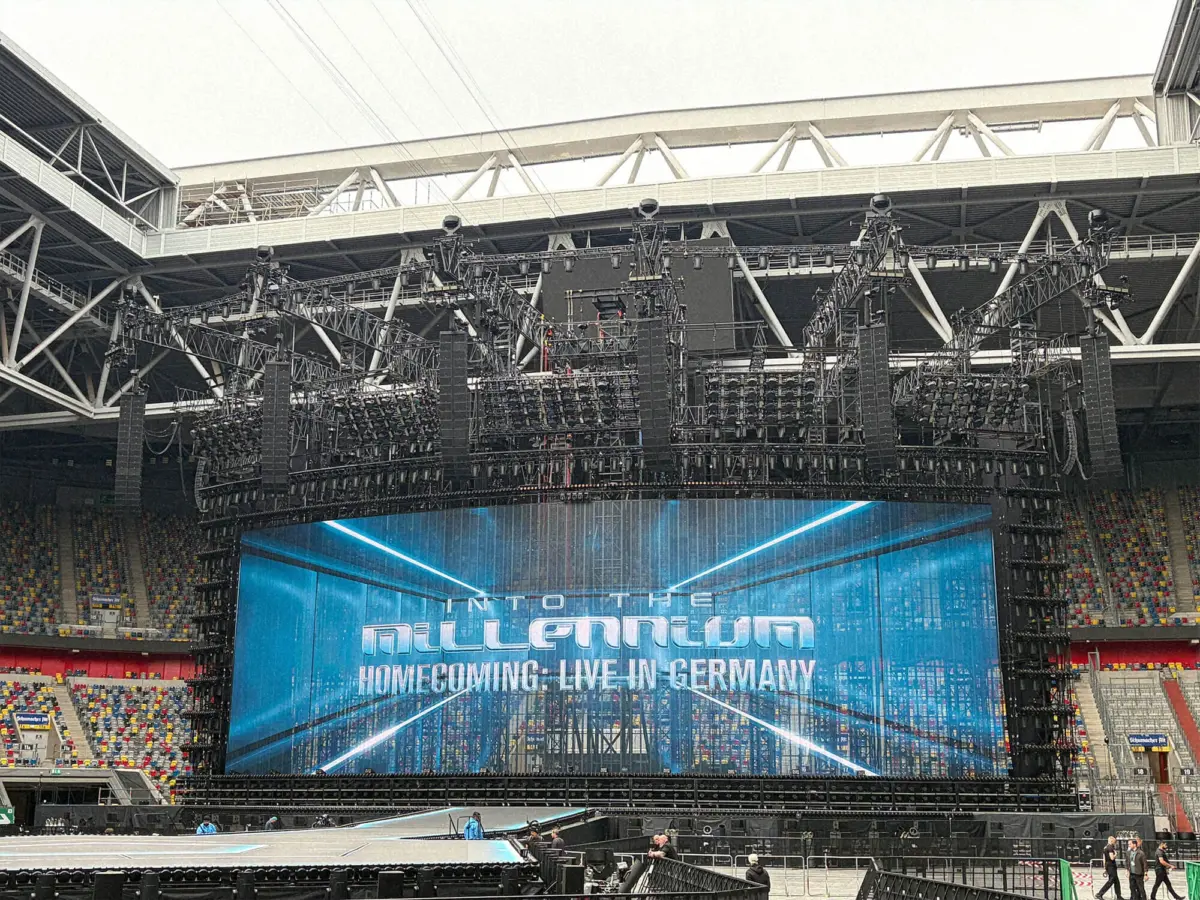
However, a paradigm shift is underway in the live entertainment industry. During the sixth night of the Backstreet Boys’ sold-out, ten-date residency, Into The Millennium – Homecoming, at Düsseldorf’s gargantuan Merkur Spiel-Arena, a technical milestone quietly unfolded. Playing to 45,000 ecstatic fans—part of a staggering half-million total attendance over the course of the run—the iconic nineties boy band didn’t just deliver a nostalgia-fueled performance; they debuted the largest deployment of spatial audio ever realized in a venue of this scale.
Powered by L-Acoustics and their groundbreaking L-ISA spatial sound system, the production utilized an intricate web of 350 loudspeakers to construct a 360-degree, object-based sound field. Orchestrated by systems designer Carlos Mosquera and veteran front-of-house (FOH) engineer James McCullagh, this massive auditory undertaking sought to vanquish the historical curse of stadium acoustics.
Rather than relying on traditional left-right stereo reinforcement—which often forces engineers to heavily compress and EQ instruments just to force them through a congested sonic window—the L-ISA system physically placed sounds within a three-dimensional space. The result was a revelation: pristine vocal harmonies, pinpoint spatial localization, and an astonishingly uniform mix that maintained its fidelity whether one was standing right at the mixing console or tucked away in the venue’s most remote, acoustic-heavy corners.
Detailed Chronology: From Concept to Execution
The journey to transforming the Merkur Spiel-Arena into a hi-fi sanctuary was neither quick nor simple. It required an eight-month-long masterclass in planning, engineering, and sonic re-imagination.

The Eight-Month Blueprint
When L-Acoustics and the Backstreet Boys’ production camp first conceptualized the deployment, they were venturing into uncharted waters. While L-ISA technology had previously elevated performances by world-class acts like Adele, Lorde, and Bon Iver, deploying it in a stadium holding tens of thousands of people represented a massive high-stakes gamble.
Carlos Mosquera, an audio engineer and immersive systems designer who previously worked at L-Acoustics helping develop the software for L-ISA, knew the magnitude of the hurdles ahead. “It’s the first time we’ve ever done this,” Mosquera notes. “Because of the size of the venue, you get more challenges. So, I started with the basics to see if it would work or not.”
Of course, looking at the final physical architecture of the rig reveals that "basic" is a relative term. The speaker configuration comprised:
- Six hanging line arrays spanning the entire width of the stage.
- Two additional hangs positioned strategically at the rear corners of the stadium’s standing floor area.
- 15 supplementary speaker hangs distributed in a ring around the venue’s circumference to reinforce sound for the higher-tier seating sections.
- 147 amplified L-Acoustics controllers powering the massive network.
Preparing the Musical Material
Designing the physical rig was only half the battle; the musical arrangements themselves required a comprehensive overhaul. Veteran FOH engineer James McCullagh—whose touring pedigree includes massive acts like Journey, INXS, Katy Perry, and the Backstreet Boys—collaborated closely with the band and their musical director. Together, they meticulously rebuilt and, in several cases, re-recorded specific musical elements to ensure they could be effectively spatialized in a 3D environment.
“We knew it could work in theory,” McCullagh recalls, “but we had to roll the dice on making it a reality.”

Showtime: The Physics-Defying Entrance
As showtime approached, the tension inside the control hub was palpable. McCullagh manned a mixing setup that resembled the flight deck of a starship, surrounded by a dozen monitor screens displaying real-time visualizations of sound placements, detailed incoming frequency spectrograms, and flickering volume meters. Meanwhile, Mosquera patrolled the upper tiers with an iPad, making micro-adjustments to the sub-mixes.
Then, defying both logic and traditional expectations of stadium openings, the Backstreet Boys descended from the ceiling on neon-lit hoverboards. As they touched down and launched into their opening smash hit, Larger Than Life, the traditional stadium echo was entirely absent. Every distinct vocal harmony cut cleanly through the roar of 45,000 screaming fans, immediately signaling that live audio standards had just been rewritten.
Supporting Context & Metrics: The Technology Behind the Magic
To truly understand how the Backstreet Boys’ Düsseldorf residency achieved such pristine acoustic clarity, one must examine the hardware and software ecosystems that made it possible.
L-Acoustics’ Industry Footprint
L-Acoustics is no stranger to revolutionizing the concert landscape. The company famously invented the modern line-array system, which rapidly became the global gold standard for large-scale concert reinforcement. Furthermore, their SoundVision software fundamentally modernized how audio engineers model and design arena and festival setups. Today, over 50% of the world’s largest music festivals rely on L-Acoustics hardware, and their acoustic engineering powers prestigious modern spaces such as London’s Apple Music Hall.
The Contrast Between Stereo and 3D Mixing
To grasp why spatial audio represents such a profound leap forward, McCullagh points out the fundamental limitations of traditional stereo mixing:

"In a stereo system, you’re using equalization, compression, panning, and reverb to create separation… But there’s a compromise because you’re taking a source and putting in compression or EQ to make it fit into a space with a large composition of frequencies. Whereas on this system, you don’t need to degrade or change the tone or sonic characteristic because the sound is being physically placed in the sound-field."
However, mixing 90s pop presents its own unique paradox. Pop music from that era relies heavily on a dense, "squashed," wall-of-sound aesthetic. Maintaining that cohesive, high-energy impact while simultaneously utilizing a spatial system that inherently creates physical separation between instruments required a delicate touch. For McCullagh, tools like compression and EQ shifted from mandatory crutches to deliberate artistic choices.
AI-Powered Source Intelligence
One of the secret weapons of the production was Source Intelligence. Running on a dedicated L-ISA Processor II Core unit, this AI-driven tool acts as an advanced audio-cleansing mechanism. In a complex stage environment where multiple open microphones capture ambient bleed from drums, guitars, and massive PA systems, feedback and mud are constant threats.
Source Intelligence isolates the vocal signals by stripping away unwanted stage spill. As Mosquera explains: "Here, you have sounds coming from so many different places to the microphones. Source Intelligence cleans the signal and leaves just the voice. There’s no drums, there’s no guitars, it’s just the voice. We need that; otherwise, I don’t think we could make it work."
Official Statements & Industry Insights
Throughout the production, the creative and engineering leads offered profound insights into the philosophy of immersive live sound and the psychological hurdles of introducing new tech to the mainstream.

-
On Spatial Restraint:
James McCullagh emphasized that the goal of spatial audio is never to distract the listener with gimmicks. "You don’t want to draw attention to yourself," he states. "It’s not about me. The fans are here to see the Backstreet Boys, and if somebody is distracted by moving sounds, then you’re doing it wrong." While sound effects occasionally spiraled creatively between songs, they melted away during vocal performances to prioritize tight, recognizable harmonies. -
On Audience Coverage & Experience:
While physical limitations in massive spaces mean absolute perfection is impossible for every single attendee, Mosquera noted the exceptional reach of the L-ISA deployment: "There’s always better seats… But a different experience doesn’t mean a bad experience, and, using L-ISA, I think at least 70% of the people in the venue get a really good immersive experience." -
On Changing Industry Mindsets:
Mosquera did not mince words regarding why spatial audio has been slow to penetrate mainstream stadium touring. "Some people don’t want to understand it," he shrugs. "Or they don’t care. Usually, they care about how big the screen is or how many lights you have. They’re used to going to concerts where it sounds like shit. Stadiums always sound like shit, but that’s what I’m trying to fix; stadiums should sound better."
Future Outlook: The Next Frontier in Live Performance
The success of the Into The Millennium – Homecoming residency in Düsseldorf marks a definitive turning point for live event production. By proving that object-based spatial mixing can successfully scale up to 45,000-capacity stadiums without catastrophic acoustic failure, L-Acoustics, Carlos Mosquera, and James McCullagh have opened the floodgates for a new era of concert design.
With another massive, fully immersive stadium residency already locked in for Toronto, Canada, the production team is eager to push the envelope even further. Freed from the anxiety of whether the underlying technology would hold up under stadium-level pressures, Mosquera looks ahead with confidence: "Now that I know it works, I can take more risks."

Ultimately, the hallmark of truly great audio engineering is invisibility. As fans filed out of the Merkur Spiel-Arena buzzing with satisfaction, few likely dissected the complex array of 350 loudspeakers, AI-driven processors, or 147 amplified controllers that delivered the show. They simply experienced music the way it was meant to be heard: clear, powerful, and utterly enveloping. For an industry too long tolerant of sonic mediocrity, the Backstreet Boys’ spatial audio experiment proves that the future of live sound has finally arrived—and it sounds magnificent.