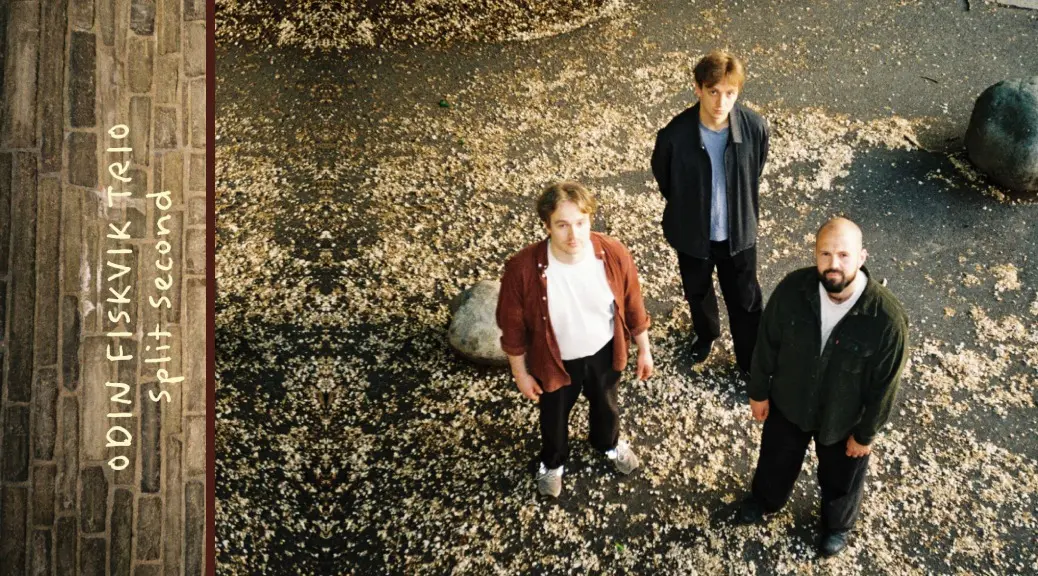
In an era where contemporary jazz is frequently measured by its complexity, polyrhythmic acrobatics, and restless avant-garde ambition, the debut release from the Odin Fiskvik Trio offers a compelling counter-narrative. Titled Split Second, this thirty-minute studio offering champions the profound pleasure found in simplicity: the crystalline clarity of a well-crafted melody, the comforting familiarity of a well-phrased cadence, and the effortless, organic grace with which three distinct instrumentalists can converge upon a shared aesthetic vision.
Led by Norwegian guitarist and composer Odin Fiskvik, and rounded out by the foundational rhythm section of bassist Eskild Okkenhaug and drummer Øyvind Leite, the trio sidesteps grandstanding in favor of genuine camaraderie. Rooted in deep-seated personal friendships and disparate musical upbringings, the ensemble successfully bridges the gaps between contemporary jazz, traditional folk, Americana, and melodic pop.
While the album occasionally skirts the edge of being overly comfortable—leaving critics to yearn for sharper contrasts, sudden stylistic left-turns, and heightened structural disruption—Split Second remains a remarkably charming and cohesive introduction. It captures a moment in time where craftsmanship and collaborative trust take center stage, establishing Fiskvik and his collaborators as artists well worth watching on the burgeoning Nordic jazz landscape.
Detailed Chronology: The Genesis and Evolution of Split Second
Laying the Groundwork: Friendship as a Foundation
The genesis of the Odin Fiskvik Trio did not begin in a sterile conservatory practice room or through corporate talent matchmaking; rather, it was forged organically in the crucible of long-standing personal relationships. Fiskvik, Okkenhaug, and Leite each navigated unique, winding musical paths before converging. Coming from varied backgrounds across the Norwegian musical ecosystem, the three instrumentalists brought distinct technical vocabularies to the table. However, they shared a singular, unifying artistic desire: to create an environment where individual instincts could flourish without the pressure of ego-driven dominance.
This commitment to mutual support dictates the trajectory of Split Second. From the earliest writing sessions in Fiskvik’s notebook to the final takes laid down in the studio, the collaborative ethos remained paramount. The band approached the material not as a vehicle for individual pyrotechnics, but as a collective canvas designed to showcase space, breath, and dynamic interplay.
The Track-by-Track Journey
Split Second unfolds with a deliberate, episodic pacing, feeling less like a dense suite of heavy symphonic movements and more like a curated collection of intimate sonic sketches.
"Go Ahead": The album opens with this robust statement of purpose. Balancing a distinctly bluesy undercurrent with a sophisticated jazz vocabulary, "Go Ahead" announces the trio’s arrival with understated confidence. It establishes the conversational tone that defines the record, immediately highlighting Okkenhaug’s warm, woody basslines and Leite’s responsive, tasteful percussion.
"Summer Sketch (Intro)" and Its Full-Length Counterpart: By splitting a central melodic idea into a brief introductory vignette and a fully realized companion piece, the trio demonstrates a fascination with narrative framing. The melody is handled with an exceptionally gentle hand, allowing listeners to acclimate to Fiskvik’s signature blend of Scandinavian crispness and warm Americana twang.
"Waldemar" and "For Now": These middle-album tracks lean heavily into the conversational quality of the ensemble. The rhythm section acts as a flexible, supportive framework, holding the structural space open while Fiskvik embarks on his melodic explorations. Leite’s drumming throughout these movements is particularly nuanced, shifting seamlessly to match every subtle inflection in dynamic and mood.
"Yesteryears": Perhaps the most emotionally resonant piece on the record, "Yesteryears" carries a heavy veil of nostalgia. Yet, it manages a difficult balancing act: it honors a fondness for the past without ever sliding into cloying sentimentality or melodrama.
The Intermezzo Sequence ("Interlude" and "Says Who"): These brief transitional moments function as palate cleansers, maintaining the conversational flow before the album builds toward its climax.
"Moving Forward" and "Country": "Moving Forward" hints at expansive horizons and broader stylistic possibilities for the ensemble. The record closes with "Country," a track that explicitly brings Fiskvik’s deeply ingrained Americana leanings to the forefront, neatly tying together the cross-continental musical influences that inspired the project.
Supporting Context & Metrics: Navigating the Scandinavian and Global Jazz Landscapes
The Anatomy of the Sound: Blending Traditions
To fully appreciate Split Second, one must examine the diverse sonic palette Fiskvik draws upon. The guitarist’s compositional style relies heavily on accessible, song-oriented structures—a trait more commonly associated with folk and pop singer-songwriters than with academic jazz instrumentalists.
Contemporary Jazz Space: Drawing inspiration from the ECM-adjacent Scandinavian jazz tradition, the trio utilizes silence, negative space, and atmospheric resonance as active instruments.
Americana and Folk Contours: Fiskvik’s guitar work frequently incorporates the open tunings, resonant strumming patterns, and storytelling sensibilities of American roots music and country traditions.
Avant-Garde Undercurrents: Though primarily melodic and digestible, the music occasionally flirts with subtle avant-garde textures, preventing the tracks from devolving into predictable, easy-listening territory.
Project Metrics at a Glance
Total Runtime: Just over thirty minutes, placing the release squarely in the historical tradition of the concise jazz LP (reminiscent of classic Blue Note or Prestige vinyl lengths).
Primary Geographic Influence: Norway (compositional sensibilities, spatial awareness) blended with American roots traditions.
Primary Reviewer Consensus: Praised for its undeniable charm and collaborative warmth, with constructive criticism directed toward a desire for broader structural contrast and unpredictability.
Official Statements and Critical Perspectives
The Artist’s Vision
While promotional materials for debut albums often lean heavily on hyperbole, the Odin Fiskvik Trio has consistently framed Split Second as an exercise in authenticity over technical intimidation. In press statements accompanying the release, the ensemble emphasized that the primary objective was to record a project that felt honest to their interpersonal dynamics.
"Not every musical encounter needs to be built around complexity or restless ambition," notes the foundational ethos of the project. "Sometimes the pleasure lies in the simplicity of a melody, the familiarity of a phrase or the ease with which three musicians find common ground."
This philosophy permeates every track, reflecting an artistic maturity that resists the compulsion to over-play or overcrowd the sonic spectrum.
Critical Reception and Analysis
Industry critics, including noted jazz commentator Mike Gates, have offered a nuanced and balanced reception to Split Second. Reviewers have been quick to praise the genuine sense of shared purpose and the warm, inviting interplay between the three players.
However, critical discourse surrounding the album has also highlighted areas for future artistic growth. Several analysts have pointed out that at just over half an hour in length, the material occasionally flirts with an overly comfortable plateau. The critique suggests that while the compositions are unfailingly pleasant, future releases would benefit immensely from:
Increased Structural Development: Pushing melodic ideas into more challenging harmonic territory.
Heightened Contrast: Juxtaposing the album’s prevailing warmth with moments of tension, dissonance, or rhythmic disruption.
Greater Individuality: Carving out a more distinct, signature sonic footprint that immediately differentiates the trio from the dense crowd of contemporary guitar-led jazz ensembles.
Despite these constructive observations, the overarching verdict remains decidedly optimistic, positioning the album as a vital first step for a promising young ensemble.
Future Outlook: Where Does the Trio Go From Here?
As the dust settles on the release of Split Second, the music community finds itself looking ahead to what the Odin Fiskvik Trio might accomplish next. Debut albums are, by their very nature, transitional documents—they capture an artist at the inception of their public journey, freezing a specific moment of stylistic exploration in amber.
For Fiskvik, Okkenhaug, and Leite, the challenge of the sophomore release will lie in building upon the strong foundation of trust and melodic accessibility they have already established, while boldly courting the unpredictability and surprise that critics felt was missing from their maiden voyage.
With their interpersonal chemistry already firmly locked in, the trio possesses the rarest and most valuable asset in modern instrumental music: an innate, unforced groove and a shared musical language. If they can channel their considerable technical talents into expanding their compositional boundaries, introducing sharper dramatic contrasts, and leaning further into their unique cross-genre synthesis, the Odin Fiskvik Trio has all the requisite tools to transform early promise into lasting, substantial artistic individuality.
For now, jazz enthusiasts and lovers of melodic, unpretentious musicianship would do well to spend thirty minutes with Split Second—a refreshing, charming reminder of what happens when artists value human connection above all else.