Executive Overview
History is rarely a neutral archivist; more often than not, it is a curator with deeply ingrained biases. For centuries, the classical music canon has functioned as an exclusive fortress, meticulously guarding its gates against those who did not fit the archetype of the canonical master. While the systematic sidelining of women composers is a well-documented tragedy of cultural history, the specific mechanisms of erasure—how a thriving, celebrated artist vanishes entirely from the collective consciousness—remain a subject of profound critical inquiry.
Enter Charlotte Sohy (1887–1955), a prodigious French composer whose life bridged the Belle Époque and the mid-20th century. Sohy moved within elite artistic circles, studied under the titans of French musical pedagogy, wrote ambitious large-scale works championed by legends like Paul Dukas and Maurice Ravel, and possessed a domestic life so musically integrated that her parents installed a majestic Cavaillé-Coll organ directly into their family living room. Yet, despite a rich catalogue encompassing masses, art songs, chamber music, a symphony, and a lyrical drama, Sohy’s name drifted into virtual obscurity following her death, a phantom footnote in the grand narrative of French classical music.
How does a composer of such caliber simply disappear from history? And, more importantly, what does it take to resurrect a voice that was wrongfully silenced by time, institutional neglect, and gendered historical structures?
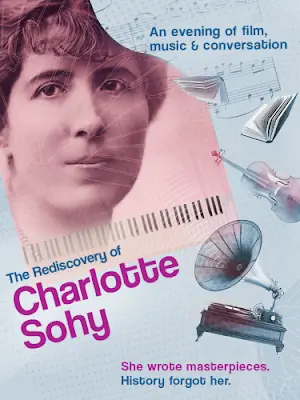
These pressing questions will take center stage on October 23, 2026, during a landmark event at the Maison Française d’Oxford. Titled The Rediscovery of Charlotte Sohy: An evening of film, music & conversation, this multi-disciplinary gathering promises to be a watershed moment for musicologists, performers, and classical enthusiasts alike. Curated by acclaimed pianist Reiko Fujisawa, the evening will feature the United Kingdom premiere of the documentary Charlotte Sohy: la consécration d’une compositrice, an engaging live Q&A panel featuring Sohy’s great-grandson Matthias Weber, co-director Laurence Uebersfeld, and music writer Peter Quantrill. The night will culminate in live performances of Sohy’s spellbinding Petite Suite and her deeply expressive Piano Trio Op. 24, executed by virtuoso chamber musicians Gina McCormack (violin), Adrian Bradbury (cello), and Reiko Fujisawa (piano).
This comprehensive report delves into the intricate life of Charlotte Sohy, the systemic factors governing her historical eclipse, the mechanics of her modern resurrection, and the broader cultural implications of restoring forgotten women to the classical canon.
Detailed Chronology: The Life, Times, and Works of Charlotte Sohy
Formative Years and the Belle Époque Cradle (1887–1905)
Born in Paris in 1887 into an affluent, cultured family, Charlotte Sohy entered a world where industrial wealth met high-society artistic patronage. Her father, an industrialist, recognized and actively nurtured his daughter’s undeniable musical inclinations from an early age. The Sohy household was not merely a home; it was a cultural salon.
Sohy’s early musical education was underpinned by pedigree. Her initial teachers included a direct pupil—and relative—of the legendary César Franck, embedding the rich, chromatic harmonic language of the Franckist school deep into her musical DNA. This foundational training was bolstered in 1903 by a remarkable domestic installation: her parents had a magnificent Cavaillé-Coll organ built directly into their living room. For a young, aspiring composer, having immediate, daily access to the king of instruments—built by the most revered organ architect in French history—was an extraordinary privilege that profoundly shaped her textural thinking, sense of polyphony, and harmonic grandeur.
Mentorship, Networks, and Creative Flourishing (1905–1920s)
As Sohy transitioned from a prodigy into a mature composer, her sphere of study expanded to encompass the absolute pinnacle of the French musical establishment. She studied under Alexandre Guilmant, the titan of the organ and co-founder of the Schola Cantorum; Louis Vierne, the legendary blind organist of Notre-Dame de Paris; and Vincent d’Indy, the formidable composer, pedagogue, and director of the Schola Cantorum who championed rigorous counterpoint and classical forms.
Furthermore, Sohy operated within a peer group of extraordinary historical significance. She studied alongside and forged deep friendships with Nadia Boulanger—who would go on to become the most influential composition teacher of the 20th century—and Mel Bonis, another brilliant female composer navigating the male-dominated waters of the Parisian musical scene.
Sohy’s creative output during these decades was astonishingly diverse and ambitious. Eschewing the stereotype that female composers of the era were confined to the parlor or the drawing-room with lightweight miniatures, Sohy penned grand works:
- Sacred and Vocal Music: Comprehensive masses and evocative art songs (mélodies) that displayed a profound sensitivity to French poetry and text-painting.
- Large-Scale Orchestral Works: A powerful, emotionally charged Symphony that showcased her mastery of orchestration and symphonic architecture.
- Dramatic Works: The sweeping lyrical drama L’Esclave couronnée, which demonstrated her theatrical instincts and vocal writing capabilities.
- Chamber Music: Intricate piano pieces, expressive trios, and rigorously structured string quartets that demanded the highest technical proficiency from performers.
During her lifetime, Sohy’s talent was recognized by the heavyweights of French modernism. Her works were performed and championed by luminaries such as Paul Dukas, Maurice Ravel, and Gabriel Fauré. To have compositions performed by the architects of French impressionism and post-romanticism implies that Sohy was not merely a provincial dabbler, but an active, respected participant in the avant-garde dialogue of early 20th-century Paris.
Silence, Solitude, and Obscurity (1930s–1955)
Despite her pedigree, connections, and output, the trajectory of Sohy’s career mirrors that of countless women artists of her era: a gradual retreat from the public eye, compounded by the socio-political upheavals of two World Wars, domestic expectations, and the shifting paradigms of mid-century musical modernism.

Sohy passed away in 1955, leaving behind a treasure trove of manuscripts, scores, and memories. Yet, unlike her male counterparts whose estates were aggressively managed, archived, and programmed by devoted disciples, Sohy’s music slipped quietly into the shadows. The institutional memory of the Parisian concert halls proved remarkably short-lived regarding its female contributors, and Sohy’s scores gathered dust in family archives, waiting for a future that understood how to value them.
Supporting Context & Metrics: The Anatomy of Musical Erasure
To understand why Charlotte Sohy vanished from history, one must examine the macro-level structures that governed classical music historiography throughout the 19th and 20th centuries. The narrative of classical music has long been framed as a lineage of singular "geniuses"—predominantly European, male, and formally institutionalized.
The Metrics of Marginalization
- Concert Programming Statistics: Historical data from major European and American orchestras reveals that music by women composers has historically occupied less than 2% of standard concert programming. Even today, despite concerted efforts to diversify repertoires, works by historical female composers rarely break into the standard rotation of major symphony orchestras.
- Publishing and Archival Access: During Sohy’s lifetime, securing a publishing contract with prestigious houses (such as Durand or Heugel) was exceptionally difficult for women, who were frequently required to publish under pseudonyms or rely on private funds. Without published scores, institutional performance libraries could not acquire or circulate their music, creating a self-fulfilling prophecy of obscurity: unplayed music is unpublished, and unpublished music is unplayed.
- The Domestic Sphere Trap: While male composers were often freed from domestic labor to focus entirely on their craft, women—even those from wealthy industrial families like Sohy—frequently faced societal pressures to balance artistic pursuits with familial duties.
The Mechanics of Revival
Rescuing a composer like Sohy requires a multi-pronged modern ecosystem:
- Familial Stewardship: Descendants willing to preserve, organize, and advocate for ancestral archives. In Sohy’s case, her great-grandson Matthias Weber has played a crucial instrumental role in this recovery.
- Musicological Detective Work: Scholars and performers combing through manuscripts to create modern, playable critical editions.
- Curatorial Vision: Artists like pianist Reiko Fujisawa who are willing to step outside the conventional canon to program unfamiliar works, proving their artistic merit to contemporary audiences.
- Media and Discourse: Documentaries, academic symposia, and public conversations that contextualize the composer’s life, transforming a dry historical footnote into a compelling human narrative.
Official Statements & Curatorial Vision
The upcoming event at the Maison Française d’Oxford is not merely a concert; it is an interrogation of historical justice.
Curator and pianist Reiko Fujisawa, whose dedication to neglected repertoire has earned her international acclaim, views the project as an essential cultural correction. "When we look at the standard classical canon, we are looking through a very narrow lens constructed by generations of selective memory," Fujisawa notes. "Charlotte Sohy was not a minor amateur; she was a fully realized, deeply sophisticated voice of the Belle Époque. Bringing her music back to the concert hall is an act of historical reclamation. When audiences hear her Piano Trio Op. 24 or her Petite Suite, the question instantly shifts from ‘Why was she forgotten?’ to ‘How on earth did we manage without this music for so long?’"
Matthias Weber, Sohy’s great-grandson and co-creator of the documentary Charlotte Sohy: la consécration d’une compositrice, approaches the project with both familial reverence and objective historical inquiry. Alongside co-director Laurence Uebersfeld, Weber embarked on a cinematic journey to trace the contours of his ancestor’s life, piecing together letters, photographs, and musical fragments.
"My great-grandmother lived in a world that simultaneously enabled and constrained her genius," Weber remarks. "She had the privilege of studying with the greatest minds of her time, yet the societal structures of her era meant her work was destined to be sidelined once she was no longer there to advocate for it herself. Making this documentary was an attempt to give her back her rightful place in the narrative—not as a historical curiosity, but as a vibrant, breathing artistic force."
Music writer Peter Quantrill, who will moderate the live Q&A panel during the Oxford event, emphasizes the importance of critical discourse in the rediscovery process. "It is not enough simply to play a forgotten piece of music once and pat ourselves on the back," Quantrill argues. "We have to ask the uncomfortable questions: How does a composer disappear from history? And what does it take to bring her back? Those questions force us to examine our own listening habits, our concert programming biases, and the very ways we construct cultural value. The evening at the Maison Française d’Oxford is designed to provoke that exact reflection."
Future Outlook: The Ripple Effects of Re-writing the Canon
The rediscovery of Charlotte Sohy is part of a broader, much-needed tectonic shift currently underway within the global classical music community. For decades, orchestras, chamber ensembles, and academic institutions treated the historical canon as a closed ecosystem. Today, however, a new generation of musicians, researchers, and audiences is demanding a more inclusive, accurate, and expansive view of music history.
Events like The Rediscovery of Charlotte Sohy at the Maison Française d’Oxford serve as blueprints for how cultural institutions can engage with marginalized histories. By combining academic rigor (via the documentary and panel discussion) with emotional resonance (via live performances of her chamber works), the event bridges the gap between archival research and living art.
What Lies Ahead?
- Recording Initiatives: As more performers take up Sohy’s scores—such as her symphonic works and string quartets—professional studio recordings will inevitably follow, entering digital streaming ecosystems and expanding global accessibility.
- Curricular Integration: Musicology departments across universities in the UK, France, and beyond are beginning to integrate Sohy and her female contemporaries (such as Mel Bonis, Lili Boulanger, and Cécile Chaminade) into standard music history curricula.
- Concert Hall Programming: Orchestras and chamber societies are increasingly recognizing that contemporary audiences are hungry for novelty, depth, and discovery. Sohy’s Petite Suite and Piano Trio Op. 24 offer immediate, thrilling alternatives to standard programmatic fare.
Ultimately, bringing Charlotte Sohy back to life is not an exercise in tokenism or historical revisionism; it is an act of restoration. It is about acknowledging that the history of classical music is far richer, more diverse, and more complex than the traditional textbooks have led us to believe. As the lights dim at the Maison Française d’Oxford on October 23, 2026, the ghostly silence that enveloped Sohy’s music for nearly a century will finally be broken, allowing her true voice to ring out clear, proud, and unapologetic once more.