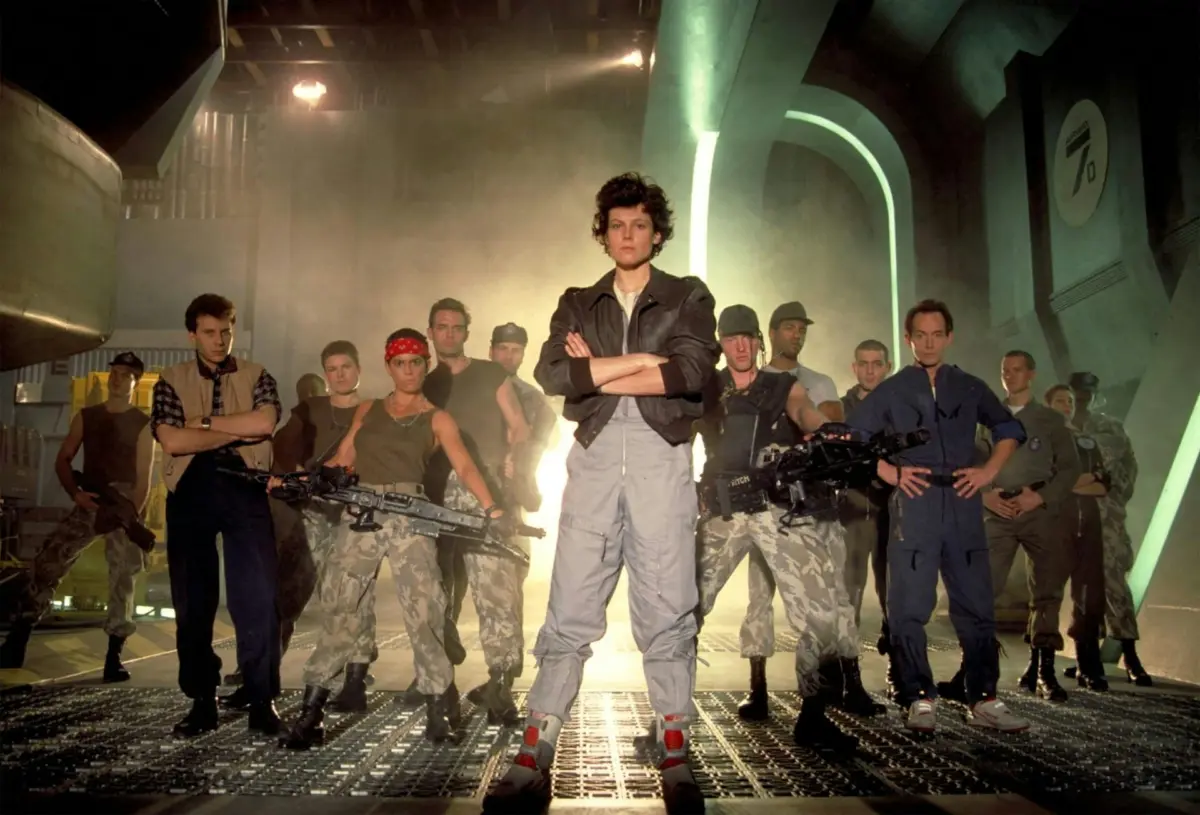
Executive Overview
In the cinematic landscape of science fiction, few sequels have managed to step out of the monumental shadow of their predecessors without being utterly consumed by it. Released in 1986—seven years after Ridley Scott’s atmospheric, groundbreaking masterpiece Alien—director James Cameron’s Aliens did not merely follow up a classic; it redefined the trajectory of an entire franchise. Rather than attempting to recreate Scott’s claustrophobic, drip-torture horror, Cameron bravely pivoted the narrative. He transformed a solitary haunted-house-in-space thriller into a thunderous, high-octane exploration of militarism, corporate greed, and evolutionary terror.
Today, Aliens stands shoulder-to-shoulder with the rarest echelons of cinematic history—sequels that not only match but occasionally eclipse their origins, residing proudly alongside The Godfather Part II, The Empire Strikes Back, and Terminator 2: Judgment Day. By swapping industrial low-fi dread for high-tech military grit, and replacing a single, stealthy Xenomorph with a relentless swarm of terrifying proportions, Cameron crafted a stylistic hybrid that cemented his own legendary status as a blockbuster auteur alongside producer Gale Anne Hurd.
As we reflect on the legacy of this monumental picture, Aliens remains a vital cultural touchstone. Its biting commentary on unrestrained corporate exploitation, its pioneering depiction of gender roles within combat, and its prescient anxieties regarding technology and artificial intelligence continue to resonate with piercing relevance in the modern era.
Detailed Chronology: From Hesitation to Cinematic Triumph
The journey of Aliens from an improbable studio pitch to a definitive sci-fi action blueprint is a masterclass in creative daring.
The Hesitation and the Pitch
Initially, James Cameron was deeply reluctant to touch 20th Century Fox’s intellectual property. To the young director, Ridley Scott’s 1979 original was a "perfect movie"—a pristine, self-contained nightmare that defied easy replication. Trying to out-scare Scott at his own game, Cameron reasoned, was a fool’s errand. How could anyone logically top the visceral shock of the chestburster sequence?
Instead of chasing ghosts, Cameron pitched a radical departure. He proposed creating a stylistic hybrid that fused the terrifying organic menace of Alien with the relentless, mechanised pacing of his own breakout hit, The Terminator. Convinced by his bold vision, the studio handed him the reins, setting the stage for a production that would permanently alter the DNA of action cinema.
Return of the Survivor: 57 Years Later
The narrative picks up more than five decades after the tragic events aboard the Nostromo. Ellen Ripley (Sigourney Weaver), having drifted through deep space in hypersleep, is rescued only to discover that the terrifying world she left behind has not forgotten her. The planet LV-426—where her crew first encountered the alien organism—is now the site of a burgeoning human terraforming colony called Hadley’s Hope.
When contact with the colony is suddenly lost, Ripley is pressed into service as an advisor. No longer simply the resourceful, terrified survivor of the first film, Cameron weaponized Ripley’s trauma and resilience, forging her into a pioneering action hero. Stripped of her authority and plagued by nightmares, she enters the lion’s den once more, embarking on a rescue mission alongside a squad of swaggering, cocky space marines.
Into the Hive: The Escalation of Conflict
The middle act of Aliens shifts the cinematic vocabulary entirely. Dropped onto LV-426, the Colonial Marines quickly learn that arrogance is no match for biological perfection. The tension ratchets upward from eerie silence to frantic, chaotic combat within the labyrinthine, resin-coated walls of the alien hive.
When the military unit is systematically decimated by overwhelming numbers, the film transitions into a desperate survival thriller. Ripley takes charge, bonding with the orphaned young survivor Newt, forging an uneasy alliance with the synthetic android Bishop, and ultimately standing as humanity’s last line of defense against the terrifying, towering Alien Queen. Her cathartic, explosive battle in the cargo bay of the Sulaco—punctuated by the immortal command, "Get away from her, you bitch"—solidified her place in the cinematic pantheon.
Supporting Context & Metrics: Cultural, Political, and Technical Resonance
To truly understand why Aliens endures, one must examine the socio-political climate and the cinematic mechanics that birthed it.
The Political and Cultural Backdrop of the 1980s
The geopolitical landscape shifted dramatically between the release of Alien in 1979 and Aliens in 1986. The Carter administration had given way to the Reagan era—a period defined by free-market capitalism, sweeping deregulation, aggressive military buildup, and the Strategic Defense Initiative ("Star Wars"). America was eager to project power abroad in the wake of the Vietnam War.
Cameron captured this zeitgeist by populating his film with the Colonial Marines: a confident, heavily armed interstellar fighting force imbued with swaggering bravado. Yet, the film’s brilliance lies in its subversion of these very tropes. The muscular, high-tech militarism championed by the Reagan era—mirrored in contemporary icons like Sylvester Stallone’s Rambo—is thoroughly humbled by the bio-horror of the Xenomorphs.
It is not the swaggering male marines who ultimately conquer the threat, but Ripley: a woman fighting not for geopolitical dominance, but out of maternal instinct and pure survival. In doing so, Cameron constructed a profound critique of imperialist hubris and the blind faith placed in institutional might.
The Real Enemy: Corporate Greed
While the Xenomorph provides the visceral, tooth-and-claw terror, Aliens reserves its most chilling condemnation for human institutions. The true villain of the picture is the Weyland-Yutani Corporation ("The Company").
Represented by the smarmy, profit-obsessed bureaucrat Carter Burke, Weyland-Yutani views human lives—and the Colonial Marines themselves—as entirely expendable commodities balanced against corporate ledgers. Burke is willing to sacrifice Ripley, Newt, and the entire colony simply to smuggle a biological weapon back to Earth for profitable exploitation.
Ripley’s scathing rebuke to Burke—"I don’t know which species is worse. You don’t see them fucking each other over for a goddamn percentage"—remains as biting and culturally relevant today as it was in 1986. In an age of unchecked corporate monopolies and billionaire-driven space races, Weyland-Yutani’s callous calculus feels less like science fiction and more like prescient documentary.
Psychoanalytic Terrors and Tech-Noir Aesthetics
Like its predecessor, Aliens is deeply steeped in anxieties surrounding sex, reproduction, motherhood, and bodily autonomy. The creature design, rooted in the surrealist nightmares of H.R. Giger, continues to tap directly into the concept of the vagina dentata—a cross-cultural myth representing male dread of female reproductive power.
Simultaneously, the film firmly inhabits the tech-noir subgenre, interrogating the blurred boundaries between humanity and machine. This tension is embodied not only by the biomechanical aesthetic of the aliens themselves but also by Bishop (Lance Henriksen), the synthetic crewmate whose loyalties and humanity are constantly called into question, subverting the murderous betrayal of Ash from the first film.
Official Statements & Industry Legacy
The production of Aliens was famously fraught with tension, marked by friction between director James Cameron and a British crew skeptical of the young American filmmaker’s methods. Yet, the resulting critical acclaim and box office triumph silenced all doubters.
Reflecting on his approach to the sequel, James Cameron famously noted in historical production interviews:
"I told the studio: don’t try to make ‘Alien 1’ again. You can’t beat Ridley Scott at his own game. The first film is a masterpiece of suspense and claustrophobic horror. If we are going to do this, we have to scale it up, change the genre from horror to action, and make it a stylistic hybrid that reflects my own sensibilities."
Producer Gale Anne Hurd also highlighted the groundbreaking nature of the film’s casting and character development:
"We didn’t set out to make a political statement with Ripley or the female marines like Vasquez. We just wanted compelling, authentic characters who reacted to extreme situations with courage and grit. Sigourney Weaver brought an emotional depth to Ripley that elevated the entire action genre."
Film historians and critics have continually vindicated these sentiments. In retrospective analyses, scholars often cite Aliens as the blueprint for modern franchise expansion—proving that a sequel can successfully pivot genres while respecting the psychological gravity of the original work. The film’s influence stretches across decades, directly inspiring subsequent military-sci-fi milestones such as Paul Verhoeven’s Starship Troopers (1997) and shaping the aesthetic of countless video games, comic books, and novels within the expanded Alien multimedia universe.
Future Outlook: The Enduring Universe of Alien
Four decades after its theatrical debut, the cultural footprint of James Cameron’s Aliens shows no signs of fading. What began as a daring gamble in 1986 successfully birthed a sprawling multimedia empire that now encompasses seven official feature films, numerous literary offshoots, and critically acclaimed interactive media.
As modern cinema continues to grapple with franchise fatigue, Aliens stands as a golden standard for how to expand a fictional universe intelligently. It proved that sequels do not need to be pale imitations or cynical cash grabs; they can be bold, independent works of art that challenge audience expectations, deepen established lore, and push technical boundaries.
Looking forward, the themes pioneered in Aliens—the ethical boundaries of artificial intelligence, the terrifying efficiency of unchecked biotechnology, and the eternal struggle of humanity against corporate exploitation—are more urgent today than ever before. As long as humanity gazes out into the dark expanse of the cosmos with a mixture of ambition and dread, Ellen Ripley’s fiery stand against the swarm will continue to echo through the stars, reminding us precisely what it takes to survive in the dark.