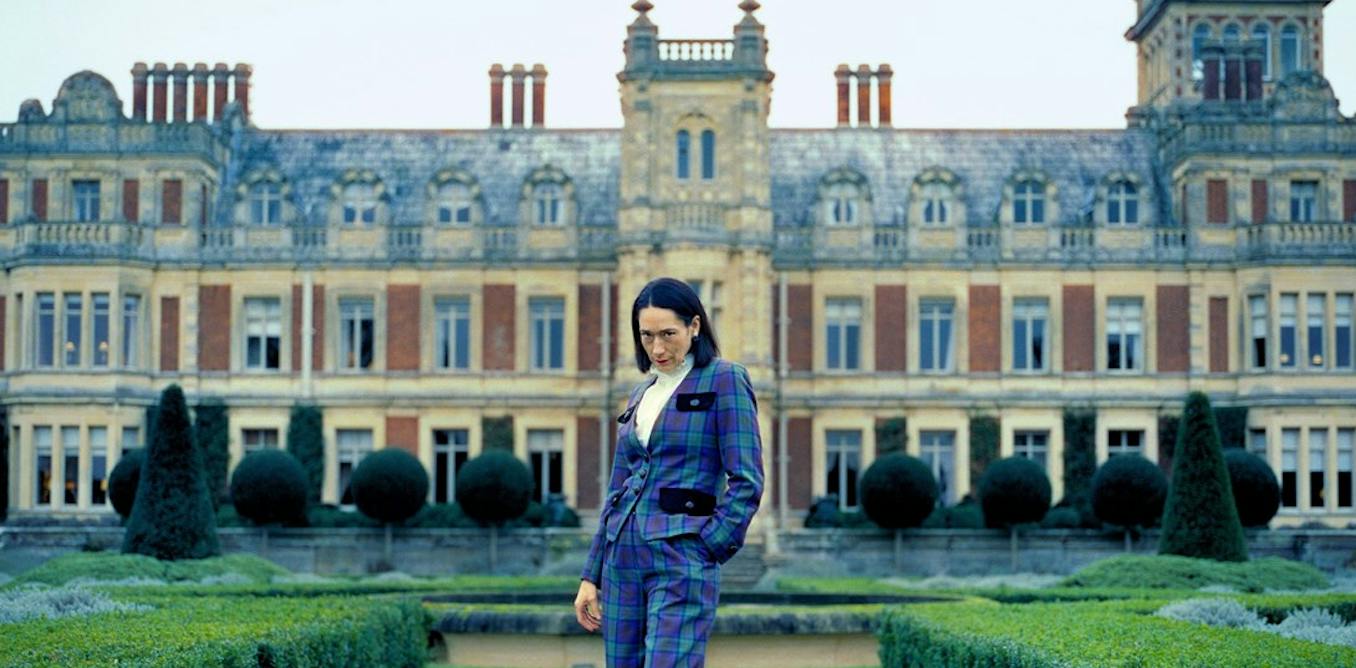
In the contemporary cinematic landscape, the "eat the rich" subgenre has carved out a lucrative, albeit increasingly crowded, niche. Following in the cultural footprint of high-profile satires like Saltburn, Parasite, The Menu, and Triangle of Sadness, director Samuel Abrahams’ surrealist feature Lady initially appears to be yet another familiar takedown of out-of-touch aristocracy and unchecked wealth. Set against the sprawling, melancholic backdrop of Ravenhyde Hall—a grand country estate in Suffolk—the film tracks the eccentric isolation of Lady Isabella, portrayed with sharp vulnerability by Sian Clifford.
At first glance, Isabella is a caricature of aristocratic decadence. In her mid-40s, she fancies herself "aristocracy’s answer to the Kardashians," desperately orchestrating a pivot into the realms of modern internet art and influencer culture. To facilitate this transformation, she enlists Sam (Laurie Kynaston), an ambitious, struggling young filmmaker whose eyes are firmly fixed on securing a BAFTA-winning breakthrough.
However, beneath its bright, satirical surface and moments of high comedy—complete with eccentric costumes and giant inflatable pink flamingos—Lady quickly evolves into something far darker, more melancholic, and psychologically complex. The film uses a striking surrealist conceit: Isabella begins to physically disappear. As her body literally fades from view, the narrative shifts from a straightforward mockery of elite narcissism to an incisive, sobering exploration of aging, grief, commodified identity, and the transactional nature of modern artistic exploitation.
Far from being a simple comedy about an oddball noblewoman, Lady aligns itself more closely with the bleakly absurd, psychological black comedies of Joseph Heller’s Catch-22 or Ottessa Moshfegh’s My Year of Rest and Relaxation. It charts the devastating toll of turning one’s entire existence into a marketable spectacle, ultimately delivering a poignant critique of a digital culture that demands constant self-performance at the expense of authentic human connection.
Detailed Chronology
The Setup: Ravenhyde Hall and the Aristocratic Kardashian
The narrative commences at Ravenhyde Hall, where Lady Isabella lives in an eccentric state of self-imposed isolation. Alienated by the rapid shifts of modern culture yet desperate to remain relevant, Isabella decides to rebrand herself for the digital age. Believing her lineage and estate grant her a unique cultural mandate, she views her social media ambitions not as a desperate plea for attention, but as a groundbreaking artistic endeavor.
To document her grand reinvention, Isabella hires Sam, a young documentary filmmaker desperate for a career-defining project. The initial dynamic of the film is built upon a profound irony: Isabella possesses every traditional marker of visibility—a noble title, immense generational wealth, and a sprawling historical residence—yet she feels utterly invisible to the world. Her decision to hire Sam is an attempt to force the universe to look at her, mirroring the hyper-visible, curated exhibitionism of contemporary influencer culture.
The Surreal Metaphor: Physical Dissolution
As Sam begins filming, the narrative introduces its central, high-concept surrealist twist: Isabella physically starts to vanish. This condition serves as a potent metaphor for the cultural erasure and diminishing visibility experienced by aging women in a society that commodifies female bodies, viewing them through an increasingly narrow lens of youthful aesthetic value.
Intriguingly, this biological and metaphysical crisis is met with denial. When Isabella’s hands begin to turn invisible, she merely covers them with gloves. When subtle hints point toward perimenopause as the biological catalyst for her condition, she dismisses the notion entirely, unwilling to allow bodily reality to interrupt her performance.
For Sam, however, Isabella’s vanishing act transforms her from an eccentric annoyance into a goldmine of compelling content. As more of her physical identity is obliterated, the footage she generates becomes increasingly surreal, edgy, and—crucially—valuable to his ambitions. The filmmaker, who initially fancied himself an objective observer, grows more invested in her decay than her well-being.
Peeling Back the Layers: Grief, Narcissism, and Avoidance
As the plot unfolds, the film complicates its satirical targets. While Isabella’s outlandish behavior invites mockery, the audience learns that her unrelenting narcissism is actually a deeply entrenched psychological defense mechanism. Beneath her performance as a "tortured artist" lies a profound history of unmitigated trauma: a loveless, transactional marriage of convenience and the devastating, unspeakable loss of her only child.
Her insistence on remaining the center of attention is an elaborate psychological shield designed to protect her from confronting her deepest grief. In one of the film’s most telling dialogue exchanges, Sam accuses her of being self-obsessed. With indignant grandiosity, Isabella corrects him, insisting she is "self-centred" rather than "self-obsessed." This absurd distinction captures the tragic core of her character: she has converted her trauma into an artistic project, ensuring that even her pain is mediated through self-expression so she never has to face the outside world unprotected.
The Turning Point: "Stately Stars" and the Climax
The narrative reaches its emotional and thematic zenith at "Stately Stars," an annual talent competition that Isabella sponsors for the local community. In a display of staggering social tone-deafness, Isabella decides to enter the contest herself, determined to make the stage her own.
Her performance is a raucous, hallucinatory spectacle: she appears entirely naked, save for a giant raven’s head that seems to hover eerily above her now fully invisible body. Yet, amid this grotesque display of exhibitionism, a moment of profound psychological shift occurs. Instead of maintaining her obsessive focus on her own performance, Isabella turns her attention outward.
Noticing that Sam is suffering from a crippling bout of public-speaking anxiety, she steps in to assist him, helping him perform one of her poems. By actively engaging with another person’s vulnerability and confronting a reality outside her own ego, Isabella experiences a sudden psychological breakthrough. Paradoxically, this outward act halts her physical disappearance, grounding her back in her own body.
Supporting Context & Metrics
To fully appreciate the thematic weight of Lady, it is helpful to examine the broader cinematic and literary trends from which it draws inspiration.
The "Eat the Rich" Subgenre
In recent years, global cinema has experienced a surge in dark satires targeting the ultra-wealthy. This trend reflects a broader socio-economic anxiety regarding income inequality, systemic corruption, and the absurdity of elite lifestyles. Key milestones in this cinematic movement include:
- Parasite (2019): Bong Joon-ho’s Oscar-winning masterpiece exploring class warfare through the symbiotic relationship between two families.
- The Menu (2022): A culinary thriller that literalizes the "eat the rich" ethos, skewering elite foodie culture and the transactional nature of high-end consumerism.
- Triangle of Sadness (2022): Ruben Östlund’s Palme d’Or-winning satire of the super-rich stranded on a desert island, upending traditional social hierarchies.
- Saltburn (2023): Emerald Fennell’s visually opulent exploration of aristocratic obsession, class intrusion, and gothic excess in an English country estate.
While Lady shares aesthetic DNA with Saltburn—particularly in its use of grand English country houses, eccentric wealth signifiers, and surreal props like giant inflatable pink flamingos—industry analysts note a distinct tonal divergence. Rather than relying solely on visceral shock value or broad genre thrills, Lady operates more akin to the literary traditions of psychological absurdism.
Comparative Literary Frameworks
Critics have drawn direct parallels between Samuel Abrahams’ narrative approach and mid-century or contemporary absurdist fiction:
- Joseph Heller’s Catch-22: Utilizing bureaucratic absurdity to expose deeper, harrowing truths about institutional cruelty and self-preservation.
- Ottessa Moshfegh’s My Year of Rest and Relaxation: Examining female isolation, profound grief, and the psychological mechanisms of withdrawal from an overwhelming, commodified world.
These comparisons highlight how Lady transitions from broad comedy into a stark psychological excavation, utilizing absurdity not merely for laughs, but as a mirror for modern alienation.
Official Statements
While promotional campaigns for indie features often emphasize star power and high-concept premises, the creative team behind Lady has been vocal about the deeper sociological motivations driving the project.
Director Samuel Abrahams has noted in early press materials that the film’s genesis lay in questioning the intersection of modern visibility and internal emptiness. "We live in an era where everyone is desperately trying to broadcast their existence, yet true human presence feels rarer than ever," Abrahams observed during early festival previews. "Isabella’s physical disappearance wasn’t just meant to be a supernatural gag; it is an objective manifestation of how society renders women invisible the moment they stop serving as youthful commodities."
Lead actress Sian Clifford, speaking on her approach to portraying Lady Isabella, emphasized the tragic dimensions of her character’s narcissism:
"Isabella isn’t just a caricature of a silly posh woman. Her entire persona is armor. When you strip away the eccentricities, the giant birds’ heads, and the aristocratic pretensions, you find someone who is utterly terrified of grief. Her narcissism is the only thing keeping her from shattering completely. Playing her required finding the genuine, agonizing vulnerability beneath the ridiculous exterior."
Laurie Kynaston, who plays the ambitious documentarian Sam, reflected on the shifting moral ground of his character:
"Sam starts off thinking he’s the clear-eyed observer, the artist capturing the truth of someone else’s madness. But the script brilliantly turns the camera back on him. He becomes just as monstrous as the system he thinks he’s critiquing, realizing that human suffering makes for fantastic cinematic content."
Future Outlook
As Lady makes its way through the international festival circuit and prepares for broader distribution, its reception offers a fascinating glimpse into the evolving appetite for social satire.
Audiences and critics are increasingly weary of cynical, one-note satires that simply point and laugh at the ultra-wealthy without offering emotional resonance. Films like Lady indicate a shift toward more introspective, psychologically layered tragicomedies that interrogate why people retreat into performance in the first place.
By grounding its surrealist premise in the universal anxieties of aging, grief, and the digital commodification of personal identity, Lady transcends its immediate genre constraints. It poses a vital question for an increasingly online culture: Can we ever truly be seen by others if we refuse to look past ourselves?
As streaming platforms and independent distributors continue to seek out content that balances high-concept visual flair with profound emotional depth, Lady is poised to spark vital industry conversations about the ethics of documentary filmmaking, the societal treatment of aging women, and the urgent necessity of radical, outward-looking empathy in a world obsessed with self-portraiture.
Disclaimer: This article features editorial references to literary works. Links to bookshop.org may generate a small affiliate commission for partner publications, supporting independent cultural journalism.