Executive Overview
In the modern digital audio workstation (DAW) ecosystem, the desk space is arguably a producer’s most fiercely contested real estate. Between towering studio monitors, audio interfaces, control surfaces, external synthesizers, mice, and QWERTY typing keyboards, studio ergonomics have long been a logistical headache. Software solutions like Logic Pro’s "Command + K" musical typing feature offer temporary workarounds, but they lack the tactile feedback required for nuanced musical expression. Conversely, dedicating desk space to a full-size MIDI controller often forces compromises in daily computer typing comfort.
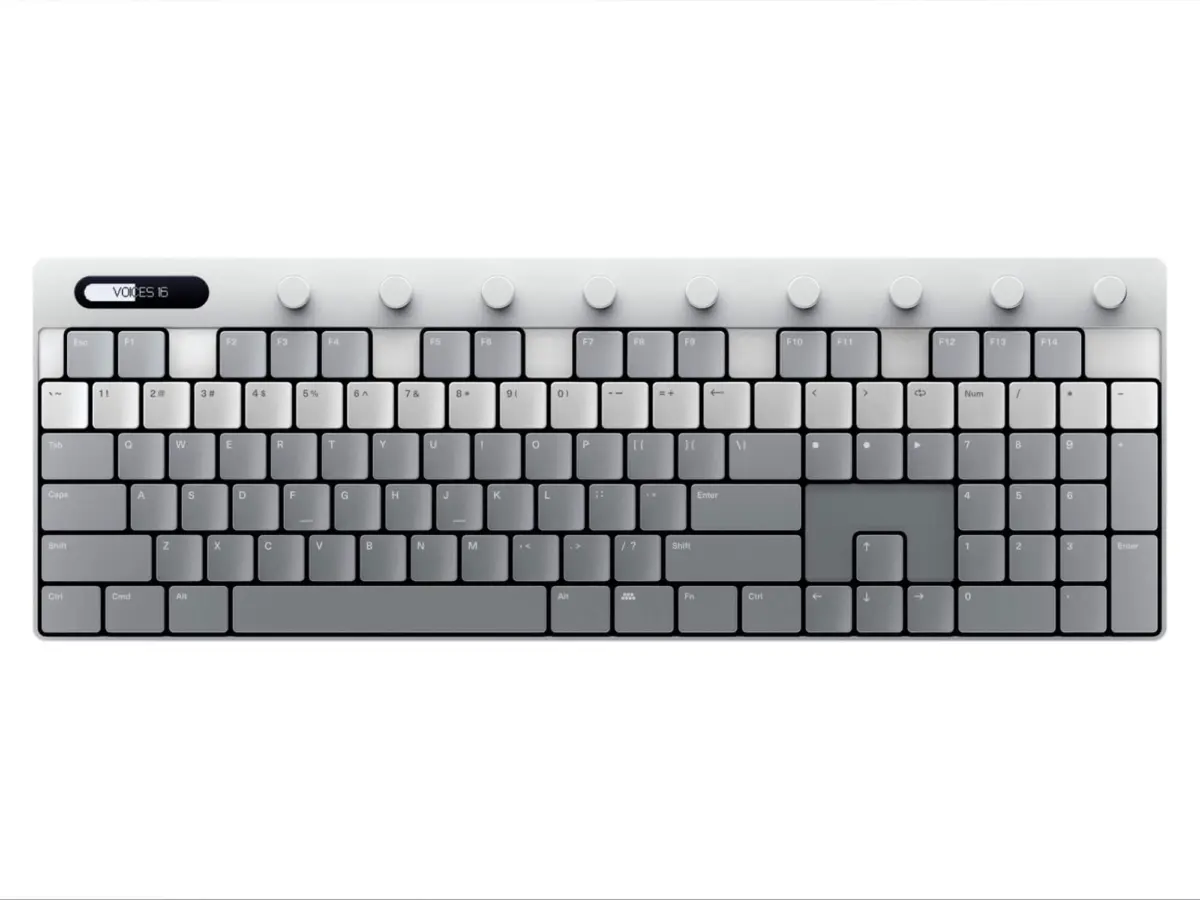
Enter Polyend Keys. Debuting as a bold prototype at Gamescom 2026 in Cologne, Germany, this innovative hardware device bridges a long-standing gap in music production and computing gear. Polyend—a brand celebrated for pushing the boundaries of electronic music instruments with units like the Tracker and Play—has engineered a device that functions simultaneously as a fully operational QWERTY mechanical typing keyboard and a sophisticated three-octave MIDI controller.
Designed specifically for creators who refuse to sacrifice workspace ergonomics for musical playability, Keys eliminates the need for a separate, oversized controller deck cluttering the desk. Built upon a sleek, single-piece aluminum chassis, the unit features hot-swappable, backlit Kailh low-profile switches, nine assignable rotary encoders, an onboard display, and standalone TRS MIDI connectivity. Furthermore, Polyend’s forward-thinking announcement of potential open-source firmware hints at a device whose lifespan and utility could be radically expanded by a vibrant community of developer-musicians.
While currently in its prototype phase—meaning final colors, hardware specifications, and functionalities are subject to refinement—Keys has already captured the imagination of the global production community. This comprehensive report explores the genesis, design architecture, technical specifications, and future implications of Polyend’s most ambitious crossover device to date.
Detailed Chronology: From Concept to Gamescom 2026
The trajectory of Polyend Keys reflects a broader industry movement toward convergence. For years, computer peripherals and music production hardware existed in entirely separate silos. Keyboards were meant for typing emails and documents; MIDI controllers were meant for triggering notes and tweaking software parameters. While enthusiast hobbyists have occasionally attempted DIY modifications to turn mechanical computer keyboards into makeshift MIDI devices using custom QMK or VIA firmware, a polished, professional, out-of-the-box solution remained conspicuously absent from the market.
Polyend identified this vacuum and began conceptualizing a device that could seamlessly marry the daily demands of computing with the spontaneous creative impulses of music production. The core philosophy driving the development of Keys was simple yet challenging: build a deeply playable musical keyboard that requires zero dedicated desk footprint beyond what a standard computer keyboard already occupies.
The Reveal at Gamescom 2026
The prototype made its official public debut at Gamescom 2026, held in Cologne, Germany, running from August 26 to August 30. Rather than choosing a traditional music technology trade show like NAMM or Superbooth, Polyend’s decision to showcase Keys at a massive gaming and tech convention signals the device’s cross-pollinated appeal. Gamers, streamers, video editors, and music producers alike share desk space constraints, making Gamescom an ideal testing ground for a hybrid productivity and performance tool.
Attendees at the Polyend booth were treated to hands-on demonstrations of the prototype unit. Early reactions highlighted the satisfying tactile response of the mechanical switches, the clever integration of rotary controls, and the seamless transition between typing an email and laying down a synth bassline. Following the physical unveiling, Polyend opened up digital discourse through community channels, sharing initial deep dives via their backstage platform to gather early adopter feedback before locking down final production runs.
Technical Specifications, Architecture, and Hardware Design
At first glance, Polyend Keys cuts an imposing yet remarkably streamlined profile. Eschewing the flimsy plastic chassis common in budget controllers, the device is anchored by a single piece of precision-milled aluminum, giving it a rigid, industrial aesthetic that matches the high-end build quality users expect from Polyend.
Keybed and Mechanical Switches
The most critical engineering hurdle for a hybrid keyboard is getting the key travel and response right for both typing and piano performance. Polyend resolved this by partnering with mechanical switch innovator Kailh. Keys utilizes hot-swappable Kailh low-profile switches, a choice that yields multiple distinct advantages:
- Low-Profile Ergonomics: Low-profile switches reduce strain during extended typing and gaming sessions, matching the comfort profile of modern productivity keyboards while still offering satisfying travel distance for musical performance.
- Hot-Swappable Versatility: Because the switches are hot-swappable and solder-free, users can customize the resistance, actuation point, and acoustic feedback of their keys without touching a soldering iron. Whether a producer prefers linear switches for rapid synth runs or tactile/clicky switches for heavy typing, the keys can be swapped out in seconds.
- Backlighting: The keys are fully backlit, ensuring low-light studio sessions or late-night gaming setups remain effortlessly navigable.
Dual-Purpose Functionality and Layout
Spanning roughly three octaves, the key layout is ingeniously balanced. It offers enough physical keys to comfortably play complex chord progressions, basslines, and melodic leads without sprawling across the entire width of a standard studio desk.
Unlike traditional computer keyboards where typing layouts are rigid, Keys leverages its dual-purpose DNA to switch modes seamlessly. When writing documents, chatting on Discord, or coding, it functions as a standard QWERTY layout. The moment inspiration strikes, the user can transition into MIDI controller mode to trigger virtual instruments, hardware synths, or DAW transport controls.

Rotary Encoders and Onboard Display
A keyboard is only as good as its macro-control capabilities. Polyend has equipped Keys with nine freely assignable rotary controls. These encoders offer immense flexibility:
- DAW and Computer Control: They can be mapped to everyday computer functions, including system volume, screen brightness, timeline scrolling, and window management.
- MIDI CC Mapping: When switched to production mode, these encoders can be freely assigned to MIDI Continuous Controller (CC) messages to manipulate software synthesizer cutoffs, filter resonances, effect sends, or hardware parameters on external gear.
- Onboard Visual Feedback: A built-in digital display provides immediate visual feedback whenever a rotary control is adjusted, eliminating guesswork and ensuring precise parameter modulation.
Standalone and Hardware Connectivity
Crucially, Polyend designed Keys to escape the confines of the computer. While USB connectivity for computer integration is standard, the unit also features a TRS MIDI output. This allows musicians to connect Keys directly to external synthesizers, drum machines, grooveboxes, and other hardware MIDI gear without needing a computer running in the background. This standalone capability transforms Keys from a mere computer peripheral into a legitimate, portable performance instrument.
Software Ecosystem and Open-Source Potential
In the contemporary music technology landscape, hardware is only as strong as its software ecosystem. Polyend has consistently championed flexibility and user empowerment, and Keys takes this philosophy a step further by exploring an open-source firmware model.
In official communications regarding the device, Polyend noted that keeping the underlying firmware open source opens up a world of creative possibilities for the user base.
"Alternative layouts, different control modes, custom MIDI tools, sequencers, and other ideas can all be explored through software," the company stated.
What Open-Source Firmware Means for Users:
- Custom Layouts: Programmers and power users can remap the keyboard layout to suit specialized workflows, whether that means alternative typing layouts (like Dvorak or Colemak) or specialized musical microtuning scales.
- Onboard Sequencing: By leveraging open-source capabilities, developers could potentially program standalone step sequencers, arpeggiators, or generative MIDI tools directly onto the device’s chip, bypassing the need for DAW-based plugins.
- Deep Integrations: Community-driven scripts could offer native, zero-configuration integration with niche DAWs, video editing suites, or streaming software like OBS Studio.
This community-centric approach ensures that Polyend Keys will not remain static; rather, it will evolve based on the needs and ingenuity of the musicians and creators who use it every day.
Future Outlook and Industry Impact
As the music technology sector matures, developers are increasingly tasked with solving problems of studio clutter and workflow friction. Producers demand gear that is faster to deploy, more versatile across multiple disciplines, and aesthetically harmonious with modern minimalist workspaces.
Polyend Keys addresses these demands head-on. By converging the two most frequently used devices on a creator’s desk—the computer keyboard and the musical controller—Polyend has laid the groundwork for an entirely new product category.
However, because Keys is still firmly entrenched in its prototype phase, important questions remain unanswered. Polyend has explicitly cautioned that "functionality, colour, or hardware could change" before the final commercial release. Furthermore, pricing, exact regional availability dates, and final specifications are being kept under wraps until the development team completes rigorous testing and community feedback integration.
Despite its prototype status, the industry response has been overwhelmingly positive. If Polyend can successfully deliver on the hardware promise demonstrated at Gamescom 2026—maintaining the robust feel of the aluminum chassis, the reliability of the hot-swappable Kailh switches, and the deep versatility of open-source firmware—Keys could easily become an indispensable centerpiece for the modern bedroom producer, mobile creator, and professional studio engineer alike.
For further updates, technical breakdowns, and future release announcements regarding Polyend Keys, enthusiasts can follow developments directly through the official Polyend Backstage community platform.