The prestigious Salzburg Festival served as the grand stage for one of the opera world’s most polarizing and electrifying events of the season: a high-octane, hyperactive reimagining of Gioachino Rossini’s rare occasional masterpiece, Il viaggio a Reims. Originally composed in 1825 to honor the coronation of Charles X of France, the score contains some of Rossini’s finest, most exuberant writing. However, because it was written exclusively for a singular royal event, the opera languished in obscurity for over a century and a half before its modern revival in the 1980s.
Bringing this demanding work back to the international forefront, visionary director Barrie Kosky partnered with the period instrument ensemble Les Musiciens du Prince-Monaco—an orchestra brought into existence through the artistic inspiration of legendary mezzo-soprano Cecilia Bartoli. Following its initial premiere at the Salzburg Easter Festival, the production transferred to the Haus für Mozart for the summer Salzburg Festival, opening on August 5, 2026.
Conducted with rhythmic precision and stylistic verve by Gianluca Capuano, the production featured an all-star roster of vocal powerhouses, including Bartoli herself as Corinna, alongside Marina Viotti, Mélissa Petit, Tara Erraught, Edgardo Rocha, Dmitry Korchak, Ildebrando D’Arcangelo, Florian Sempey, Misha Kiria, Peter Kellner, and Giovanni Romeo, supported by the Choeur de l’Opéra de Monte-Carlo.
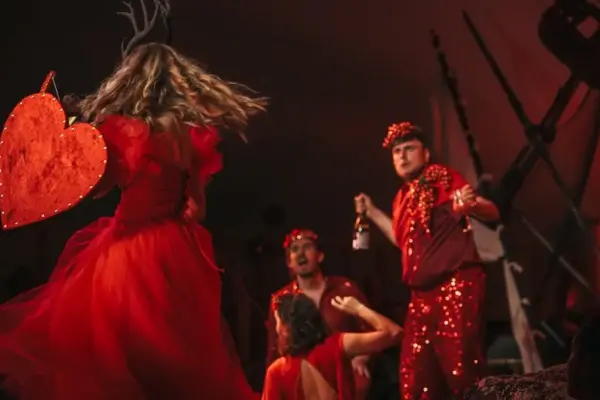
Yet, Kosky’s staging was anything but a standard repertory revival. Transforming the aristocratic spa hotel setting into a whirlwind of theatrical madness, Kosky leaned aggressively into farce. While the musical execution remained a masterclass in Rossini interpretation, the relentless staging sparked intense debate among critics and purists regarding whether visual chaos ultimately overshadowed the sophisticated irony of Rossini’s original composition.
Detailed Chronology
The Genesis and 2026 Festival Run
The journey of Il viaggio a Reims from an archival curiosity to a modern festival centerpiece reached a dramatic apex at the 2026 Salzburg Festival. Originally premiered for the Bourbon restoration court, the opera’s libretto by Luigi Balocchi outlines a gathering of European aristocrats, soldiers, and artists at a spa hotel (The Golden Lily in Plombières), all attempting to travel to Reims for the coronation festivities. When horses and carriages prove unavailable, they turn the setback into a lavish celebration of food, wine, and mock-heroic romance.
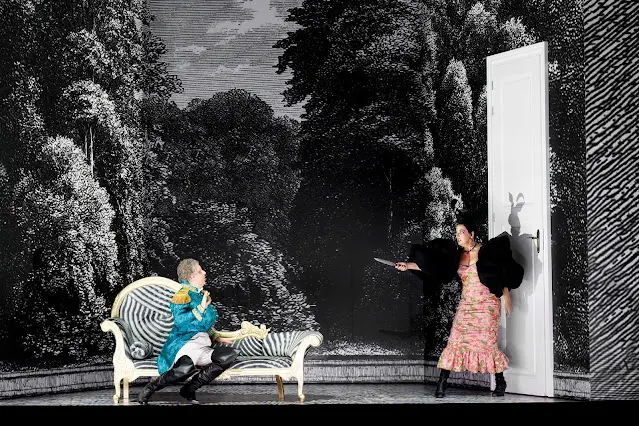
Barrie Kosky’s production, which originated at the Salzburg Easter Festival, transitioned seamlessly into the cavernous spaces of the Haus für Mozart for the summer season. The opening night on August 5, 2026, established an immediate and relentless physical tempo. From the overture onward, the production deployed a staggering array of doors, revolving panels, and slapstick elements that dictated the temporal framework of the entire evening.
Act I: The Pacing of a Farce
As the curtain rose, the stage was immediately flooded with eight energetic dancers dressed as bellhops, signaling a manic kinetic style reminiscent of classic British farce or high-end musical comedy. Kosky’s spatial design utilized five distinct doors in the opening scene alone—including three revolving doors—forcing the singers to execute lightning-fast entrances and exits.
The character interactions were choreographed with surgical, albeit breathless, precision. Individual nationalities and specific psychological profiles, which Rossini subtly encoded into his music, were frequently flattened into broad archetypes. However, standout vocal performances cut through the visual clutter. Tara Erraught delivered a buoyant and dramatically engaged Madame Cortese, while Misha Kiria as the Baron of Trombonok effortlessly commanded both stage and score through sheer vocal authority and charismatic presence.
Act II: The Spiral into Chaos
If Act I established the chaotic premise, Act II accelerated the madness. The number of active doors expanded to thirteen, triggering a flurry of bedroom-hopping, partial disrobing, and prop-heavy gags.
The romantic and political tensions—such as the rivalry between Dmitry Korchak’s intense Conte di Libenskof and Peter Kellner’s Don Alvaro over Marina Viotti’s striking Marchesa Melibea—devolved into hyper-stylized comedic combat. Guns with full sound effects appeared on stage, threatening to swallow the delicate musical dialogue. Even during the emotionally grounded duet of reconciliation between Viotti and Korchak at the beginning of Part Two, the theatrical introduction of a riding whip nearly derailed the tender vocal phrasing, though both artists successfully reeled the audience back into the musical core through sheer technical excellence.
The climax of the production featured Cecilia Bartoli, who transcended her role as the poetess Corinna to appear quite literally out of a massive celebration cake as herself, anchoring the extravagant finale with a brilliant, self-referential flourish.
Supporting Context & Metrics
Historical and Musical Framework
To understand the friction points of Kosky’s production, one must examine the unique genesis of Il viaggio a Reims. Rossini wrote the work as a singular occasional piece, knowing full well it would not enter the standard theatrical rotation. Rather than letting the rich material go to waste, he later recycled substantial portions of the score into his final French opera, Le comte Ory. It took musicological reconstruction in the 1980s to resurrect the original Viaggio, which requires an ensemble of virtuoso singers capable of navigating Rossini’s fiendishly difficult vocal ornamentation.
Crucially, Rossini utilized the structure of grand, "serious" operatic arias and ensembles to gently mock Romantic literary and emotional pretensions. The comedy in Rossini’s day was derived precisely from the delicious cognitive dissonance between high-flown musical solemnity and absurd dramatic subjects. A prime example is the Contessa di Folleville’s soaring, coloratura-heavy scena, which treats the temporary loss of her fashion hats with the gravitas of a tragic heroine facing execution.
Visual Design and Instrumentation
Set Design: Rufus Didwiszus conceived a stark, graphic black-and-white framework that nodded vaguely to the 1820s aesthetic.
Costumes: Victoria Behr subverted the monochrome sets with a riotous, hyper-saturated color palette and exaggerated silhouettes that amplified the cartoonish nature of the staging.
Musical Forces:Les Musiciens du Prince-Monaco offered a revelation in the pit. Founded under the artistic vision of Cecilia Bartoli, the period-instrument ensemble delivered a vibrant spectrum of timbre, articulation, and color. Conductor Gianluca Capuano masterfully balanced period-authentic practices with the relentless physical demands of the stage action.
Cast Metrics and Vocal Highlights
Role
Performer
Vocal/Dramatic Assessment
Corinna
Cecilia Bartoli
Winsome and lively; elegant phrasing with a personalized, fragile delivery and expressive harp accompaniment.
Marchesa Melibea
Marina Viotti
Rich-voiced and commanding presence; anchored emotional moments despite staging distractions.
Contessa di Folleville
Mélissa Petit
A vocal treat in her high-flying arias, leaning heavily into physical comedy.
Madama Cortese
Tara Erraught
Delightful, energetic, and vocally secure, establishing a strong comedic anchor.
Barone di Trombonok
Misha Kiria
Effortlessly stood out with immense vocal projection and striking theatrical presence.
Conte di Libenskof
Dmitry Korchak
Maintained intense vocal line quality amidst heavy slapstick and prop interference.
Lord Sidney
Ildebrando D’Arcangelo
Retained distinct national gravitas, though his lyrical aria was co-opted by physical gags.
Don Profundo
Florian Sempey
Dazzling patter command, delivering a masterclass in rapid-fire vocal articulation.
Official Statements
In the official Salzburg Festival programme book, director Barrie Kosky offered insight into his conceptual approach to the piece:
"The characters are not developed; they have to be fleshed out by the performers… It is an exquisite confection."
Kosky defended his hyper-farce framework as a necessary theatrical equivalent to Rossini’s sparkling, uninterrupted stream of musical inspiration. By treating the opera not as a static museum piece but as a living, breathing mechanism of theatrical acceleration, Kosky sought to bridge the gap between 1820s performance practice and contemporary audiences’ appetite for high-concept staging.
Musical leadership also emphasized the unique collaborative nature of the project. Through Les Musiciens du Prince-Monaco, the production sought to marry historical performance standards with top-tier theatricality, creating an environment where Cecilia Bartoli could act as both a central dramatic anchor and a presiding artistic spirit over the entire enterprise.
Future Outlook
The reception of Barrie Kosky’s Il viaggio a Reims at the Salzburg Festival highlights a persistent tension in contemporary opera production: the line between innovative revitalization and sensory overload.
On one hand, the production achieved its primary commercial and theatrical objective. Opening night audiences and critics alike praised the sheer technical brilliance of the cast, the blistering pace of the comedy, and the world-class musicianship radiating from the pit under Gianluca Capuano. For modern audiences intimidated by the formal conventions of 19th-century bel canto opera, Kosky’s roller-coaster staging ensured that dull moments were entirely nonexistent.
On the other hand, the legacy of this production will likely spark ongoing critical discourse. By converting every musical ensemble into a hyperactive finale and burying Rossini’s subtle musical ironies under layers of doors, props, gunshots, and physical gags, the production occasionally sacrificed the light-and-shade dynamics that make Rossini’s score truly timeless.
As Il viaggio a Reims continues to secure its place in the standard international repertory, Salzburg’s bold experiment proves that Rossini’s occasional masterpiece remains endlessly malleable. Whether future directors will follow Kosky down the rabbit hole of total farce or return to a more nuanced, character-driven equilibrium remains to be seen. What is certain, however, is that the benchmark for vocal pyrotechnics and instrumental brilliance set by Bartoli, Capuano, and this stellar international ensemble will cast a long, influential shadow over future stagings for years to come.