Executive Overview
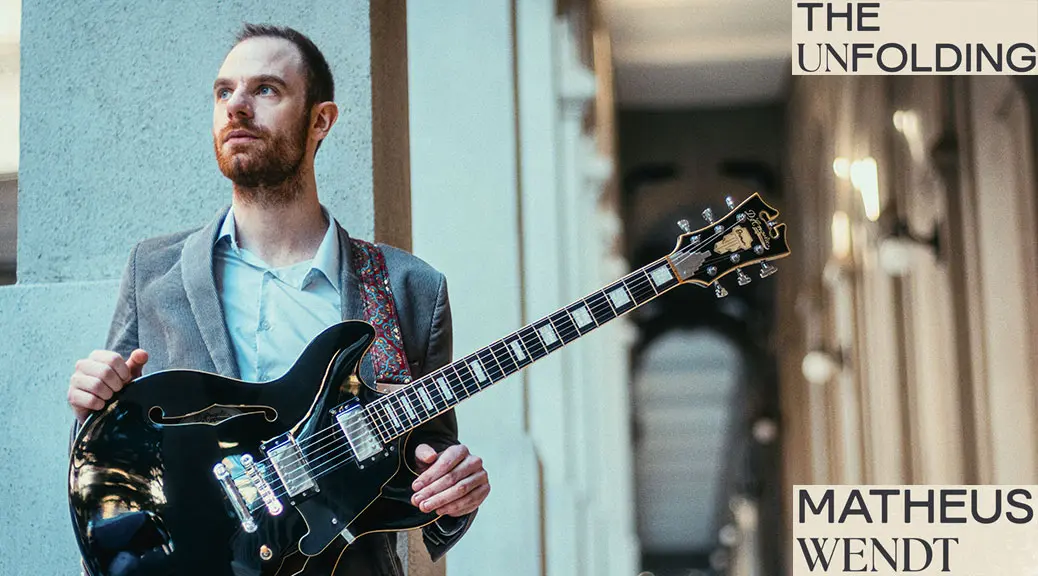
In the contemporary landscape of global instrumental music, where technical prowess frequently overshadows emotional resonance, rare is the artist who can seamlessly bridge the gap between rigorous academic composition and the visceral, life-affirming pulse of modern jazz and Brazilian vernacular. Enter Matheus Wendt. With the release of his sophomore full-length album, The Unfolding, the young Brazilian guitarist and composer has delivered a masterclass in stylistic synthesis. Sparkling with the refreshing clarity of a gentle summer breeze yet anchored by a profound harmonic depth, The Unfolding is an engaging, thoughtfully constructed voyage through modern jazz, impressionistic classical music, and rich Brazilian sensibilities.
Building upon the foundation laid by his 2024 debut album, Long Story Short, Wendt returns alongside his fiercely telepathic core quartet—pianist and Rhodes player Pedro Saul, bassist Felipe Schütz, and drummer João Bauken. Recorded with the seamless interplay of a working band that has lived inside this complex material together, the album captures an artist ascending rapidly through the ranks of the international jazz conversation. Following a breakout year in 2024 that saw him honored at the prestigious Açorianos Music Awards—where he took home accolades including Best Instrumental Music Producer—Wendt’s The Unfolding cements his status not merely as a local talent to watch, but as an essential new voice in contemporary guitar-driven jazz.
Detailed Chronology and Musical Architecture
To fully appreciate the sweeping sonic architecture of The Unfolding, one must trace the trajectory of its creator. Matheus Wendt’s musical journey began early and progressed with fierce dedication. Picking up the acoustic guitar at the age of seven, he transitioned to the electric guitar by eleven, developing a facility on the instrument that allowed him to enter the professional performance sphere by age fifteen. Immersed in the rich tapestry of Brazilian instrumental music and the expanding universe of jazz, Wendt eventually relocated to Porto Alegre to formalize his studies in Popular Music at the Federal University of Rio Grande do Sul (UFRGS).
It was during his undergraduate years that the seeds of his recording career were planted. His debut album, Long Story Short, emerged directly from his academic research, capturing the initial chemistry of the quartet that would ultimately define his signature sound. Graduating from UFRGS in 2024, Wendt transitioned seamlessly from student to innovator, bringing a rigorous conservatory background into active, freewheeling dialogue with the live club and festival circuit.
The Unfolding documents the maturation of this vision across a sequence of carefully sequenced tracks that demand deep, active listening while offering immediate rhythmic and melodic rewards.
The Opening Statements: Impressionism and Momentum
The album opens with striking ambition on "Prólogo: O Labirinto Imaginário." Here, Wendt leans heavily into the fragmented structures and shifting harmonic tensions pioneered by early 20th-century French impressionists like Claude Debussy and Maurice Ravel. The piece acts as a sonic portal, establishing that color, texture, and tonal ambiguity will be just as vital to this recording as swing or groove.
Yet, Wendt is equally at home in the high-octane, muscular language of contemporary electric jazz. This duality is immediately apparent on "Mar Aberto," an explicit and breathless tribute to the late guitar titan Allan Holdsworth. Moving with a restless, churning momentum, the track utilizes displaced accents and complex rhythmic groupings that give the music an expansive, open-ended quality. More than a mere stylistic pastiche, the track honors Holdsworth through the liquid fluidity of Wendt’s phrasing, navigating serpentine chord changes with a pristine legato attack that bends the instrument into entirely new shapes.
Homage and Transformation: From Jarrett to Shorter
Wendt’s compositional lens looks outward to his primary inspirations, yet he consistently avoids derivative mimicry in favor of deep structural synthesis. "Keith," a spacious and contemplative piece, serves as a tip of the hat to piano master Keith Jarrett. Rather than attempting to recreate a straightforward Jarrett-esque lyricism, Wendt and his quartet unpack the piece through shifting timbres, utilizing the interplay between Pedro Saul’s acoustic piano and electric Rhodes to explore the negative space between the notes.
Similarly, "Dança dos Ventos" takes harmonic DNA from Wayne Shorter’s famously labyrinthine composition "Pinocchio" and wraps it around a repetitive, almost ritualistic melody. It stands as one of the album’s most compelling achievements, striking a delicate equilibrium between intellectual complexity and an immediately magnetic forward propulsion.
The mid-album sequence showcases further stylistic versatility. "Can We Stay Together?" operates as a beautifully judged ballad that sits comfortably at a crossroads: touching the timeless elegance of the Great American Songbook, the searching, melancholic grace of Tom Jobim’s bossa nova masterpieces, and the harmonic sophistication of Shorter’s slower, more reflective works.
At the structural center of the project lies the title track, "The Unfolding." Beginning with a dense, churning harmonic vamp, the piece gradually unfurls into cascading impressionistic landscapes before resolving into a remarkably intricate contrapuntal conclusion. It serves as a literal and figurative thesis statement for the entire recording, perfectly embodying the core themes of expansion, development, and organic metamorphosis.

Resolution and Directness
As the album winds toward its conclusion, Wendt demonstrates that he is not bound solely by maximalist complexity. "Street Lights" injects a refreshing, improvisation-friendly energy into the running order, driven by the supple, conversational rhythm section of Schütz and Bauken.
Immediately following is the brief vignette "A Torre do Relógio," a masterclass in concise composition. Dispensing with pyrotechnics, its contemplative directness provides a moment of serene emotional centering. Finally, the closing track, "Espelho Mágico," brings cutting-edge modern jazz harmony into an easy, fluent conversation with traditional jazz phrasing, leaving the listener with a sense of completeness that still vibrates with potential energy.
Supporting Context & Metrics
The Ensemble: A Study in Telepathic Cohesion
Crucial to the success of The Unfolding is the unbreakable continuity of Wendt’s working band. In an era where modern jazz albums are frequently assembled in-studio with pick-up bands of hired-gun session musicians, Wendt’s quartet functions as a single organism.
- Pedro Saul (Piano / Fender Rhodes): Saul’s touch shifts fluidly between the percussive clarity of the acoustic grand piano and the warm, smoky harmonic wash of the Fender Rhodes, providing the harmonic canvas upon which Wendt sketches his melodies.
- Felipe Schütz (Bass): Schütz anchors the bottom end with an elastic, woody tone on the acoustic bass (and electric variants where appropriate), serving as the critical bridge between the rhythmic drive of the drums and the advanced harmony of the keys and guitar.
- João Bauken (Drums): Bauken avoids heavy-handed metronomic timekeeping, opting instead for a conversational, coloristic approach to the drum kit that recalls the masters of ECM-era European jazz while retaining an undeniable South American pulse.
Critical Reception and Accolades
The trajectory of Matheus Wendt’s career has not gone unnoticed by the cultural establishment in Brazil and beyond. The momentum began in earnest with his 2024 sweep at the Açorianos Music Awards—one of the most significant cultural honors in the Brazilian state of Rio Grande do Sul. Securing the award for Best Instrumental Music Producer, Wendt was recognized not just as a wunderkind player, but as a holistic creator capable of shepherding complex sonic visions from conception to final mix.
The Unfolding represents the international maturation of those same production and compositional philosophies, positioning him firmly alongside a new wave of South American instrumentalists who are redefining the boundaries of jazz fusion for the streaming era.
Official Statements and Artistic Philosophy
Reflecting on the creative philosophy underpinning The Unfolding, Wendt has frequently emphasized the importance of organic growth over stylistic forced labor. In recent interviews surrounding the release, the young composer noted that his primary goal was to allow his diverse musical influences—ranging from classical impressionism to high-velocity bebop and native Brazilian rhythms—to collide naturally rather than by academic design.
"When you study music formally, there is always the danger that your brain takes over your hands," Wendt explains. "You start writing equations instead of songs. With this album, my goal with Pedro, Felipe, and João was to take very dense, sophisticated harmonic ideas and run them through the filter of a working band that plays live, breathes together, and understands the groove. If the music doesn’t make you want to move your feet, the complexity isn’t doing its job."
Critics and collaborators have echoed this sentiment, pointing out that Wendt’s work possesses a rare literary quality—each track reads like a distinct chapter in a larger narrative, balancing structural rigor with unbridled improvisational freedom.
Future Outlook
As The Unfolding receives critical acclaim across international jazz publications and digital platforms, Matheus Wendt stands at a pivotal crossroads in his burgeoning career. Having firmly established his voice on two major recorded works and conquered regional accolades in Brazil, the logical next phase for the guitarist involves expanding his touring footprint beyond South America.
Plans are currently underway for international showcase performances and festival appearances throughout Europe and North America, where audiences starved for intelligent, groove-oriented, and compositionally rich guitar jazz are primed for his arrival. Furthermore, Wendt’s insatiable appetite for cross-genre collaboration suggests that his future compositional work may venture even further into orchestral integration and cross-cultural dialogue.
One thing remains unequivocally certain: The Unfolding is not the final destination for Matheus Wendt, but rather the opening chapter of a major career in contemporary music. Intelligent without ever becoming dryly academic, ambitious without feeling overworked, the album proves that Wendt’s musical language is continuing to grow naturally, organically, and brilliantly. For jazz lovers and guitar aficionados alike, his journey is one that must be followed closely.