Executive Overview
For decades, the pantheon of mid-century American rhythm and blues has been dominated by a familiar constellation of names: Aretha Franklin, Etta James, and Gladys Knight. Yet, a glaring omission persists in mainstream music history, particularly outside the United States and apart from the dedicated devotees of the UK Northern Soul circuit. Irma Thomas—affectionately and rightfully crowned the "Soul Queen of New Orleans"—has never quite received the ubiquitous household-name status afforded to her contemporaries.
This oversight is more than a mere footnote in music journalism; it is a critical imbalance in how we chronicle the architects of modern soul. From her breakout regional hits in the late 1950s to her Grammy-winning resurgence and enduring contemporary relevance, Thomas’s journey is a masterclass in resilience, artistic integrity, and vocal majesty. Possessing what critics have memorably described as "the sadly sweet voice of a fallen angel," Thomas has spent over half a century shaping the contours of R&B, soul, and blues.
This article explores the trajectory of her remarkable career, examining her chart successes, the commercial industry’s oversights, her brush with rock royalty, and her enduring legacy as "The Teacher" of American soul music.
Detailed Chronology
Early Beginnings and the New Orleans R&B Explosion
Born in Ponchatoula, Louisiana, in 1941, Irma Thomas displayed an undeniable vocal gift from an early age, quickly becoming a fixture in her local community. By the tender age of 13, she auditioned for Specialty Records—an early indicator of a prodigious talent. However, it was local bandleader Tommy Ridgley who truly catalyzed her professional ascent, securing her a recording contract with Ron Records.
Operated by Joe Ruffino, Ron Records was a vital incubator for New Orleans R&B, dedicated to championing regional artists. Within this vibrant ecosystem, Thomas found herself rubbing shoulders with legendary figures such as Professor Longhair and Mac Rebennack (who would later achieve global fame as Dr. John).
Thomas wasted no time establishing her artistic identity. Her debut single, the fiercely confident (You Can Have My Husband But Please) Don’t Mess With My Man, climbed to No. 22 on the Billboard R&B chart. Even at the start of her recording career, Thomas exhibited an unshakeable poise, delivering performances marked by emotional maturity and definitive style.
The Minit Records Era and Allen Toussaint
Seeking to expand her reach, Thomas transitioned to the Minit label, setting the stage for a legendary creative partnership with producer, songwriter, and arranger Allen Toussaint. Toussaint penned the blues-soaked masterpiece It’s Raining (1962) specifically for her velvety, emotive delivery.
The momentum continued into the following year with Ruler Of My Heart, a composition by Aaron Neville that would subsequently attract covers by heavyweights like Otis Redding and Norah Jones. Thomas was swiftly becoming a songwriter’s dream and a singer’s singer—an artist capable of wringing every ounce of anguish and triumph out of a lyric.
The Turmoil and Triumph of 1964
The year 1964 proved to be a watershed moment in Thomas’s career, yielding four distinct Top 100 R&B hits. It began with the heart-wrenching Wish Someone Would Care on the Imperial label. Written by Thomas during the painful dissolution of her first marriage, the song was a raw emotional excavation.
Ironically, Wish Someone Would Care was paired on release with the uptempo, snare-shuffle drive of Breakaway (penned by Jackie DeShannon and Sharon Sheely), which would later become a major hit for Tracy Ullman.
The hits kept coming. Anyone Who Knows What Love Is (Will Understand)—co-written by Randy Newman—stood as another emotional tour de force. It was backed by the gospel-infused ballad Time Is On My Side.
The Rolling Stones Controversy
Time Is On My Side became the epicenter of one of the most frustrating twists of fate in pop music history. The Rolling Stones closely studied Thomas’s arrangement, copying her version word-for-word—right down to the spoken ad-libs—for their second album, turning it into their first stateside Top 10 hit in 1964.
Because of the Stones’ massive global platform, a widespread misconception took root among casual listeners that Thomas had actually covered the Stones. The indignity of this reversal deeply offended Thomas, to the extent that she adamantly refused to perform the song live for decades.
Rounding out her banner year of 1964 were the poignant Times Have Changed and the stellar He’s My Guy, both released via Imperial. During this period, Thomas functioned as an unofficial R&B ambassador, her flawlessly executed recordings serving as the gold standard for the genre.
Label Hopping and the Swamp Dogg Collaboration
As the 1960s drew to a close, the shifting tides of the music industry brought structural challenges. Her final R&B hit of the decade was a stirring cover of Otis Redding’s Good For Me (1968), recorded at the famed Muscle Shoals studios for the Chess label. Unfortunately, her tenure with Chess was frustratingly brief—a missed opportunity for a major label to truly back and amplify her ambitions globally.
Subsequent brief stints with Canyon, Roker, and Cotillion preceded a creatively fertile alliance with visionary producer Jerry "Swamp Dogg" Williams’ Fungus Records. This partnership yielded the deeply soulful 1973 single and album In Between Tears. An idiosyncratic, deeply immersive record, In Between Tears showcased Thomas’s ability to navigate complex soul arrangements, though it was tragically relegated to relative obscurity for years.
Returning Home: The Soul Queen of New Orleans
Following a period of living in Los Angeles, Thomas returned to her spiritual and physical home: New Orleans. Alongside her husband, Emile Jackson, she opened her own nightclub, The Lion’s Den, where she fronted the house band nightly.
Simultaneously, her appearances at the newly established New Orleans Jazz Fest (inaugurated in 1970) cemented her status as a premier live attraction. The festival circuit introduced her to wider, appreciative audiences, resulting in steadier and more lucrative touring work.
Recording-wise, Thomas continued to adapt. In 1978, she signed with Maison de Soul, releasing Hip Shakin’ Mama as a nod to the booming dancefloor culture, followed by an appropriately titled album, Soul Queen Of New Orleans, which reworked her classic catalog for the disco era.
By 1986, she found a nurturing long-term home with Rounder Records, releasing a string of critically acclaimed albums that restored her to the critical forefront:
- The New Rules (1986)
- The Way I Feel (1988)
- Live: Simply The Best (1991)
- True Believer (1992)
Hurricane Katrina and Grammy Glory
The resilience that defined her vocal delivery was tested to its absolute limits in August 2005, when Hurricane Katrina devastated New Orleans, flooding 80 percent of the city. Among the countless cultural casualties was The Lion’s Den, which was entirely destroyed in the deluge.
Refusing to be broken, Thomas channeled the tragedy into her art. She entered Dockside Studios in Maurice, Louisiana, to record After The Rain (2006). Her 18th studio album was a triumph of the human spirit, earning her a Grammy Award for Best Contemporary Blues Album—making her the first woman to win in that category since Etta James.
Supporting Context & Metrics
Cultural Footprint and Modern Resurgence
Irma Thomas’s influence stretches far beyond traditional R&B charts, echoing across generations of musicians and modern media:
- Collaborations: She has lent her legendary vocals to projects spanning diverse genres, from blues icon B.B. King to the funk-fusion outfit Galactic.
- Cinematic and Television Syncs: Cult television fans know her voice intimately; Anyone Who Knows What Love Is (Will Understand) became a haunting recurring motif, featured across seven episodes of Charlie Brooker’s critically acclaimed Netflix anthology series, Black Mirror.
- Literary & Musical Nods: In 2011, she appeared on actor and musician Hugh Laurie’s blues tribute album, Let Them Talk, delivering a staggering performance of the traditional ballad John Henry.
Comparative Chart & Legacy Metrics
| Metric / Milestone | Irma Thomas | Etta James | Aretha Franklin |
|---|---|---|---|
| Primary Peak Era | 1950s – Present | 1950s – 2000s | 1960s – 2010s |
| UK Mainstream Recognition | Limited (Cult/Northern Soul) | Widespread | Global Icon |
| Grammy Wins | 1 (2007) | 3 | 18 |
| Signature Controversy | "Time Is On My Side" (Stones attribution) | N/A | N/A |
| Regional Title | Soul Queen of New Orleans | Matriarch of R&B | Queen of Soul |
Official Statements and Archival Recognition
The narrative of Irma Thomas’s career reached a poignant, full-circle climax at Jazz Fest 2024. In a gesture of supreme grace and historical correction, The Rolling Stones invited Thomas to share the stage with them to perform Time Is On My Side.
During the performance, Mick Jagger publicly acknowledged the band’s foundational debt to Thomas. More importantly, the moment offered Thomas a long-overdue public platform to reclaim a composition that had belonged to her artistic lineage from the very beginning.
Music historians and fellow legends have long lined up to pay homage. Artists such as Otis Redding, Bonnie Raitt, Boz Scaggs, and Eric Clapton have openly professed their reverence for her vocal mastery. Furthermore, musicologists note striking similarities between her deep-soul interpretation of I Need Your Love So Bad and Peter Green’s definitive recording with Fleetwood Mac for Blue Horizon in 1968.
Future Outlook
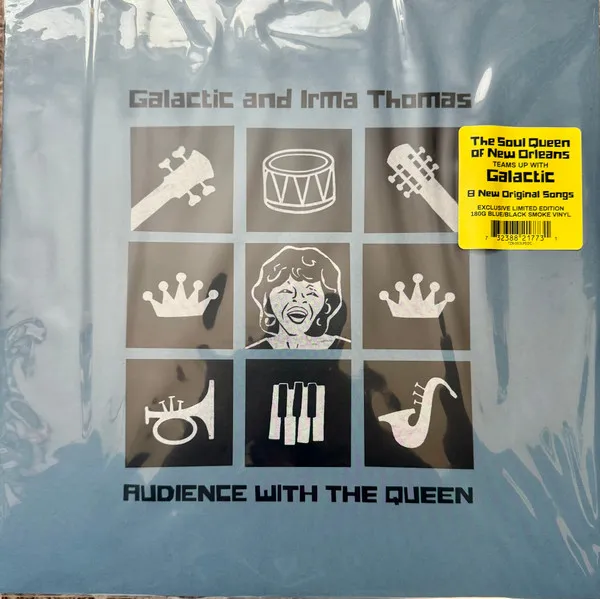
Even well into the 21st century, the tireless artist known to her peers as "The Teacher" shows no signs of slowing down her creative output. Demonstrating her commitment to artistic evolution, Thomas teamed up with New Orleans electro-funk powerhouse Galactic for the 2025 album Audience With The Queen, released via Tchoup-Zilla Records.
This collaboration bridges the gap between classic New Orleans R&B and contemporary soundscapes, proving that her voice remains as vital, adaptable, and commanding as it was when she first stepped into a recording booth in the 1950s.
For listeners, historians, and collectors seeking an unadulterated masterclass in how to command rhythm and blues royalty, the discography of Irma Thomas remains an essential pilgrimage. Her majesty has weathered storms, industry oversights, and historic indignities, emerging triumphant as the undisputed, eternal Soul Queen of New Orleans.
Words: Lin Bensley