By Lily Mercer Special Feature / Long-Form Culture Series
Executive Overview
Decades into a career that fundamentally re-engineered the soundscapes of reggae and dancehall, the unyielding energy of "The Fireman"—Capleton—remains entirely untouched by time, institutional friction, or geographic boundaries. As the legendary Jamaican artist prepares to touch down in the United Kingdom this September for his first full headline tour in over 13 years, the global music community is witnessing the long-awaited homecoming of one of Jamaica’s most vital cultural architects.
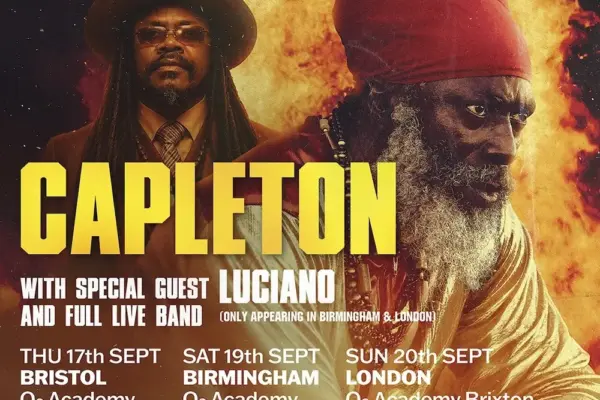
For more than a decade, British fans have been starved of the visceral, high-intensity communion that only a full-scale Capleton headline tour can provide. While festival appearances like City Splash offered brief, tantalizing glimpses of the fire, the administrative hurdles and an effective 13-year tour ban kept the dancehall icon at arm’s length from one of his most passionate international fanbases. Now, backed by the unshakeable pillars of his Rastafarian faith and a catalog of timeless anthems, Capleton is returning to the UK for a series of intimate, up-close-and-personal dates—including a monumental co-headlining performance alongside fellow roots icon Luciano in London on September 20th.
In this exclusive interview, we delve deep into the spiritual discipline that fuels his legendary live performances, reflect on the mystical weight of his historic 1990s and 2000s UK appearances, explore the deep sociopolitical ties between Jamaican sound system culture and the British working-class diaspora, and examine why real energy can never be faked in an era of manufactured streaming hits.
Detailed Chronology: From the Stratford Rex to a 13-Year Hiatus
To understand the magnitude of Capleton’s upcoming September tour, one must contextualize the historical weight of his departure from the British touring circuit. During the 1990s and 2000s, Capleton—born Clifton George Bailey III—was an omnipresent force across UK sound systems, pirate radio stations, and concert halls. His transition from raw, slackness-adjacent dancehall deejay to the spiritually charged "Prophet" of "King Shango" coincided with a golden era of Jamaican music crossing over into British mainstream consciousness.
Among the myriad memories etched into the minds of UK reggae historians, his performances at legendary venues like the Stratford Rex—often sharing bills with titans such as Buju Banton and Tarrus Riley—stand out as masterclasses in crowd control and sonic magnitude. These were not merely concerts; they were spiritual uprisings.
Reflecting on those golden-era shows, Capleton recalls a particularly otherworldly moment from an outdoor park concert that featured fellow roots luminary Cocoa Tea:
"There was an outdoor show—Cocoa Tea was at that show. When I was on stage, the sky was really dark. Then out of the blue, the sun just burst out of the sky. It was so mystic, people couldn’t believe it. It didn’t come out for long, it’s like the clouds just opened, the sun came out, and the whole place was brightened up for a couple of seconds, then it shut back up. People were talking about that for months. Even to this day, people still remind me about it. For real, it was a crazy show, very nice show. A lot of people, an outdoor show like a park."
Such phenomena, whether viewed through a lens of divine intervention or mere meteorological coincidence, underscore the mythological status Capleton holds among British fans. Shortly after these peak years, however, bureaucratic roadblocks, shifting immigration and performance visa landscapes, and targeted activist pressures created an effective blockade on his ability to mount comprehensive UK tours.
Despite playing isolated festival stages in recent years, the absence of a dedicated, multi-city headline run created a generational gap in live experiences. The September tour effectively bridges that 13-year chasm, allowing a new generation of music lovers to witness firsthand the raw combustion of a Capleton set, while giving older adherents a long-overdue reunion with the Fireman.
Supporting Context & Metrics: The Symbiosis of UK Culture and Jamaican Roots
The enduring bond between Capleton and the United Kingdom is far from accidental; it is rooted in decades of shared history, migration, and systemic struggle. When asked why the UK remains one of his strongest, most fiercely loyal international fanbases, Capleton points directly to the socio-cultural alignment between Jamaican immigrants and the British working class.
"Yeah, and I guess the culture, too. England people like positive music, you know, for over the years. They love Dancehall and everything, but the roots and culture—England thing that. People have been through struggles, the oppression systematically, and the music is the voice of the people. It speaks for the less fortunate, it speaks for the people that are oppressed systematically. It gives them soul, direction, and a sense of hope. Whenever there is despair, the music brings hope. Whenever there is sadness, music brings happiness. Wherever there is sorrow, the music will always bring joy. I guess it’s the music, the culture, the message, and everything."
Quantitative Impact: Festivals vs. Intimate Venues
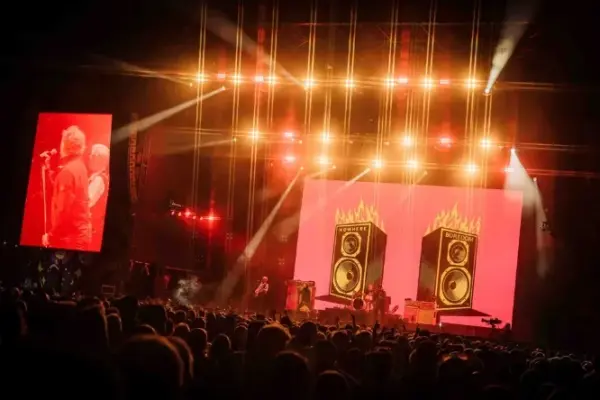
While massive European and British summer festivals—such as London’s City Splash—draw crowds numbering between 50,000 and 75,000 attendees, Capleton’s upcoming headline tour represents a distinct artistic shift.
Tour Parameter
Mega-Festivals (e.g., City Splash)
Upcoming UK Headline Tour (September)
Audience Scale
50,000 – 75,000+ attendees
Intimate, up-close-and-personal venues
Set Duration
Compressed (30 – 45 minutes)
Extended, comprehensive catalog exploration
Atmosphere
High-capacity, wide-scale festival energy
Immersive, high-density communal vibration
Connection
Distant, macro-level crowd engagement
Direct eye-contact, visceral fan interaction
As the artist himself notes, the mechanics of a headline tour demand a different psychological and physical preparation than a festival slot:
"I’m all over the world, you know what I mean? So, I’m looking forward to this stop in England. It’s somewhere up close and personal. It’s not like a City Splash or a festival with 75,000 or 50,000–60,000. It’s a different kind of energy, a different kind of vibe—more intimate."
This intimacy is crucial for an artist whose performances rely heavily on spiritual transference. Without the barrier of vast festival barricades, Capleton’s chants of "More fire!" and calls for righteousness become direct dialogues with the individual listener.
Official Statements & Philosophy: The Spirit of Rastafari and True Music
At the core of Capleton’s longevity is an unyielding commitment to Rastafari and a refusal to compromise his lyrical message for commercial expediency. In an industry where trends shift by the quarter, Capleton’s uncompromising stance on conscious lyricism, black liberation, and spiritual upliftment has anchored his relevance across multiple musical eras—from 90s hardcore dancehall to the digital streaming age.
When discussing the current state of the music industry, the Fireman remains philosophical. True music, he argues, possesses an innate spiritual DNA that cannot be manufactured by algorithms or trend-chasers:
"It’s a great joy, a good feeling, a great drive reconnecting with the fans, you know? Yeah, man, it’s a blessing. The time is now, so we just have to manifest and do what we’ve got to do to keep the people happy. It’s all about the fans, all about the culture and the music."
This manifesto of manifestation underpins his daily discipline. Maintaining the blistering physical energy required for a two-hour stage show—running across stages, gesticulating wildly, and projecting a voice that cuts through heavy bassbins—requires rigorous mental and physical conditioning rooted in Ital living and spiritual devotion. For Capleton, the fire he invokes on stage is not a mere stage gimmick; it is a cleansing, transformative force meant to burn away corruption, negativity, and spiritual lethargy.
Future Outlook: Carrying the Torch for the Next Generation
As the calendar ticks closer to September, anticipation for the UK tour has reached fever pitch. The September 20th London date, pairing Capleton with fellow roots heavyweight Luciano, serves as a monumental statement of intent for conscious Jamaican music in Europe. It highlights a growing hunger among modern audiences for authenticity—a tangible pushback against the disposable nature of modern pop-dancehall crossovers.
For Capleton, this tour is not merely a retrospective victory lap, but a vital link in the chain of cultural transmission. By returning to the UK to share his message with both veteran supporters and a younger demographic discovering roots and culture for the first time, he continues to carry the torch for future generations of artists.
The Fireman’s message remains as urgent as it was three decades ago: in times of systemic oppression, economic uncertainty, and global anxiety, music remains the ultimate sanctuary.
"Whenever there is despair, the music brings hope. Whenever there is sadness, music brings happiness. Wherever there is sorrow, the music will always bring joy."
The flames are set to rise across Britain once more. For the UK fanbase that waited thirteen long years, the wait is almost over.
To read the full, unabridged conversation with Capleton and explore deep-dive archival features on the architects of global culture, visit the Viper Magazine Substack.


![CAPLETON INTERVIEW: “MUSIC ALONE SHALL LIVE" - FAITH AND 40 YEARS OF FIRE [VP.2026 / 012] - Viper Mag](https://www.vipermag.com/wp-content/uploads/2026/08/Capleton-Picture-02-e1787851466100.jpg)
![CAPLETON INTERVIEW: “MUSIC ALONE SHALL LIVE" - FAITH AND 40 YEARS OF FIRE [VP.2026 / 012] - Viper Mag](https://www.vipermag.com/wp-content/uploads/2026/08/Capleton-Picture-05.jpg)
![CAPLETON INTERVIEW: “MUSIC ALONE SHALL LIVE" - FAITH AND 40 YEARS OF FIRE [VP.2026 / 012] - Viper Mag](https://www.vipermag.com/wp-content/uploads/2026/08/Capleton-2023-1.jpg)
![CAPLETON INTERVIEW: “MUSIC ALONE SHALL LIVE" - FAITH AND 40 YEARS OF FIRE [VP.2026 / 012] - Viper Mag](https://www.vipermag.com/wp-content/uploads/2026/08/Capleton-006-scaled.jpg)