
Executive Overview
“It seems like all I ever do is change,” Taylor Swift writes in the prologue to the bestselling album 1989 (Taylor’s Version). In many ways, perpetual transformation is the beating heart of the meticulously engineered Taylor Swift marketing machine, a cultural enterprise that revolves entirely around the theatrical evolution of her signature “eras.”
Since the release of her self-titled country debut in 2006, Swift has undergone a series of dramatic metamorphosis: from a curly-haired, acoustic-wielding country ingenue to a sleek, neon-lit pop city dweller, and more recently, to a sequin-clad, arena-commanding showgirl. That continuous cycle has just been expanded with the arrival of The Life of a Showgirl: The Encore, a surprise extension featuring four new bonus tracks, led by the single “Patient Zero.”
Yet, a closer examination of the lyrics across these new additions reveals a fascinating paradox: beneath the shifting aesthetic surface, Swift’s songwriting is anchored by profound structural and thematic continuity. To investigate this linguistic DNA, researchers created a bespoke digital corpus encompassing every publicly available track by the artist—a database appropriately dubbed the Taylor Lyric Corpus, or TaLyCo.
Comprising 247 songs spread across 12 studio albums, extended play releases, charity singles, film contributions, and unreleased demos written since her Sony/ATV publishing deal at age 14, TaLyCo maps out 123,553 words of meticulously tracked data. This comprehensive linguistic archive allows scholars to pinpoint recurring patterns over a 20-plus-year career. In the upcoming book The Lyrics of Taylor Swift, co-authorship analyses highlight Swift’s enduring lyrical fascinations: colour, counterfactuality, embodiment, opposition, and time. Far from marking a departure, her newest tracks prove that while her outfits may change, her linguistic fingerprint remains remarkably steadfast.
Detailed Chronology: From Nashville Beginnings to the Showgirl Era
To truly understand the lyrical mechanisms operating inside The Life of a Showgirl: The Encore, one must trace the historical trajectory of Swift’s songwriting from its adolescent roots to its current hyper-analyzed maturity.
Phase I: The Acoustic and Country Foundations (2006–2012)
When a 14-year-old Swift signed her early development deal, her writing was characterized by a direct, diary-entry style. Songs like "Tim McGraw" and "Teardrops on My Guitar" established an immediate, conversational intimacy. As she transitioned through Fearless and Speak Now, her vocabulary expanded, yet the core thematic elements—romantic idealism, small-town imagery, and a keen eye for physical detail (sundresses, cowboy boots)—remained fixed.
Phase II: The Pop Crossover and Cosmopolitan Shift (2012–2017)
With Red, Swift began experimenting heavily with the symbolic weight of colour, famously declaring red to be a “really powerful” hue signaling everything from intense passion to destructive jealousy. The subsequent eras of 1989 and Reputation shifted the lyrical geography from porch swings and high school bleachers to cityscapes, night-time traffic, and neon-lit avenues. During this phase, her absorption of public perception—the meta-perspective of viewing herself through the eyes of her critics—became a central lyrical device, epitomized by anthems like "Shake It Off."
Phase III: The Folklorian and Theatrical Expansions (2020–Present)
The pandemic-era acoustic projects folklore and evermore marked a return to narrative storytelling and tactile, rustic imagery (cardigans, faded blue jeans, gray overpasses). This paved the way for her bombastic return to pop spectacle with The Life of a Showgirl. The newly released Encore phase synthesizes these disparate historical threads, blending the rustic introspection of her folk era with the sharp, self-referential pop commentary of her modern phase.
Supporting Context & Metrics: Inside TaLyCo
The creation of the Taylor Lyric Corpus (TaLyCo) shifts the discourse surrounding Swift’s music from subjective fan culture to objective data science. By feeding 247 songs across her 12 studio albums into a linguistic database, researchers can quantify what literary critics have long suspected: Swift’s lexicon is governed by strict, recurring habits.
The Dominance of Grey
While critics have noted Swift’s “obsession” with the color red—dedicating an entire album cycle to its fiery emotional dichotomy—corpus data reveals a surprising statistical reality: grey is her most over-represented colour.
In her new Encore track “Pink Clouding,” Swift continues her long-standing habit of placing this inherently neutral, colourless hue alongside vibrant shades for stark contrast, singing "gray (gray) rocking where the arrow hit". This echoes past masterpieces of juxtaposition, such as "Did I paint your bluest skies the darkest gray?" from 2020’s "coney island," or "Gray overpass full of neon names" from "Ruin the Friendship" on the original The Life of a Showgirl album. The syllabic and semantic echoes in the Encore track make this dynamic contrast more pronounced than ever.
The Grammar of Counterfactuality
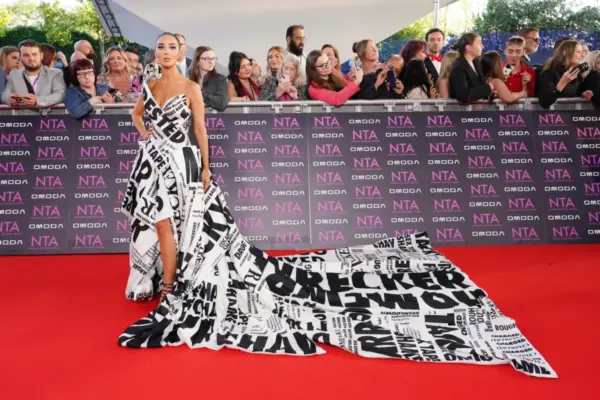
Swift has frequently been described by critics as hyper-aware of how others perceive her—a psychological state where she absorbs external judgment and repackages it into her art. Nowhere is this more vividly displayed than in the opening verse of the new Encore track "Cleveland!", where she delivers a sardonic self-assessment lifted directly from tabloid headlines:
“And with all of that money, why’s she dressed like trash? / When she smiles, it’s annoying.”
This meta-perspective—my view of another’s view of me—recurs across her discography, from 2014’s "Shake It Off" (“That’s what people say”) to 2024’s "Who’s Afraid of Little Old Me?" (“Isn’t that what they all said?”). Furthermore, on "Cleveland!", an amorphous "they" speculates that the track’s romantic lead "could find someone younger." This lyrical choice compounds Swift’s fixation on unrealized scenarios, matching her statistical overuse of modal auxiliary verbs—would, should, and could—which populate the remainder of her discography.
Embodiment and the Lyrical Wardrobe
Swift’s microscopic focus on specific body parts is another verified metric within TaLyCo. The Encore additions are no exception, ticking off a literal anatomical bingo card that includes arms, elbows, faces, hearts, lips, and shoulders.
Accompanying these physical forms is an abundance of clothing. Cardigans, Eagles T-shirts, lilac skirts, little black dresses, and faded blue jeans have long functioned as narrative anchors. With the release of The Encore, her lyrical wardrobe expands to include the "church dress" and "hand-me-down sweater" in the track "Babylon"—a clear sonic and thematic callback to the knitwear left under a bed in folklore’s lead single, "cardigan" (2020).
Literary scholar Claire Hurley notes that these items are rarely neutral set-dressing; instead, they act as metonyms deeply entwined with identity formation. Swift utilizes clothing to locate "embodied female knowledge," grounding her emotional narratives in tangible, wearable reality.
Official Statements and Critical Reception
The release of The Life of a Showgirl: The Encore has sparked intense debate across music journalism and fandom forums alike. Met with a deeply polarized response, some fans and digital critics have negatively compared the new bonus tracks to the intricate narrative structures of her celebrated mid-career albums.
However, corpus-based linguistic studies offer a compelling counter-narrative to these snap judgments. According to data derived from TaLyCo, Swift is not suffering a creative decline; rather, she is writing precisely as she has always done. Her lyrical output remains highly detailed, heavily suffused with counterfactual speculation, and visually vibrant.
In The Lyrics of Taylor Swift, authors note that the artist’s reliance on specific motifs—such as color contrasts, modal uncertainty, and somatic imagery—is evidence of a cohesive, lifelong poetic project. While public perception swings wildly between adulation and fatigue, Swift’s internal artistic architecture remains remarkably consistent.
Future Outlook: The Endless Cycle of Reinvention and Continuity
As Taylor Swift continues to break records, fill stadiums, and redefine the modern music industry, the trajectory of her career points toward an increasingly sophisticated synthesis of her past and present.
The success of data-driven literary analyses like TaLyCo suggests that popular music scholarship is entering a new era. By treating contemporary song lyrics with the same rigorous close-reading and corpus linguistics traditionally reserved for canonical literature, researchers are proving that modern pop albums are complex tapestries worthy of academic inquiry.
Looking forward, the tension between Swift’s relentless aesthetic reinvention (her "eras") and her steadfast linguistic continuity will likely remain the defining characteristic of her catalog. Whether she steps onto the stage as a sequin-clad showgirl, a rustic folk poet, or a neon-pop icon, the underlying grammar of her heartbreak, speculation, and self-awareness ensures that she is always, undeniably, writing her own story.