Executive Overview
The contemporary landscape of global club music is undergoing a profound decentralization. For decades, the axis of innovative electronic production and cultural export was anchored firmly in Western capitals like London, Berlin, and New York. Today, however, the most vibrant pulse of dance music emerges from the Global South—forged in the sun-baked sertão of Paraíba, the bustling coastal alleys of Salvador da Bahia, the windswept expanses of the Colombian Guajira desert, and the sun-drenched Atlantic port of Lisbon.
This sonic migration forms the foundation of this week’s global audio journey, tracing a transnational network of artists who are weaponizing their local folklore, ancestral percussion, and regional protest traditions. By fusing these deep-rooted elements with futuristic sound design, heavy sub-bass, and club-ready electronics, these musicians are not merely modernizing tradition; they are actively rewriting the rules of contemporary dance music.
At the heart of this movement is an intentional reclamation of identity. Artists are bypassing traditional colonial distribution channels, utilizing digital platforms, independent labels, and localized collectives to broadcast their realities to an international audience. This dispatch explores four key cultural flashpoints defining this wave:
- Luana Flores’s futuristic reimagining of Northeastern Brazilian Nordeste traditions.
- The global reinterpretation of BaianaSystem’s repertoire by international producers.
- Ghetto Kumbé’s revolutionary fusion of Afro-Colombian rhythms and deep-bass electronics.
- Enchufada’s two-decade milestone compilation, A Lisbon Club Story, celebrating the architects of global club culture like Buraka Som Sistema.
Through these case studies, we examine how regional resistance, sonic innovation, and transnational collaboration are reshaping the future of global club culture.
Detailed Chronology & Regional Analysis
Stop 1: Paraíba, Northeast Brazil – Luana Flores and the Futurist Nordeste
Our journey begins in Paraíba, nestled in the vibrant and culturally rich Nordeste (Northeast) of Brazil. Historically, this region has been an endless wellspring of musical innovation, giving birth to rhythms like forró, coco, maracatu, and embolada. Yet, for generations, these traditional sounds have been exoticized or relegated to nostalgic folklore by the country’s more industrialized, economically dominant South and Southeast.
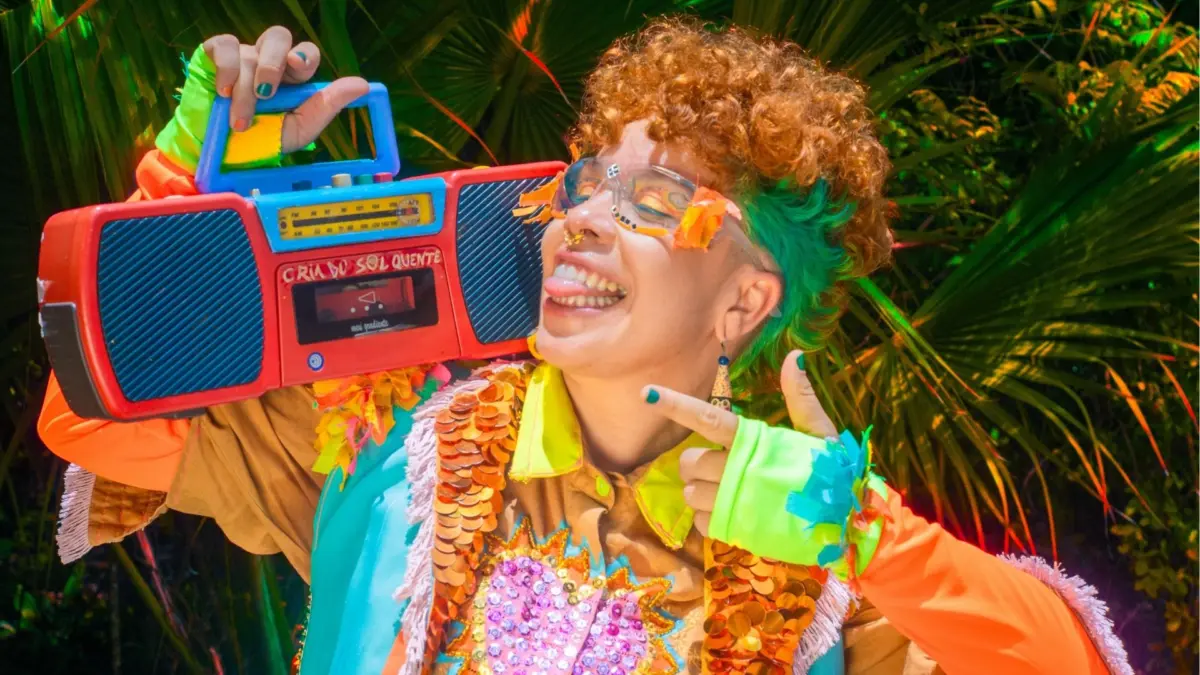
Enter Luana Flores, a multidisciplinary artist, percussionist, and producer whose work serves as a direct intervention in this cultural hierarchy. On her acclaimed release Cria do Sol Quente (Child of the Hot Sun), Flores takes the raw, acoustic urgency of Northeastern traditions and thrusts them violently into the 21st century.
Deconstructing Cria do Sol Quente
Flores does not sample tradition from a position of detached reverence; she embodies it as an active participant in regional survival. Cria do Sol Quente merges the heavy, hypnotic thud of traditional frame drums and zabumbas with jagged synthesizer lines, industrial noise, and cybernetic vocal processing. The result is a sound that feels both ancient and apocalyptic—a reflection of the socioeconomic hardships, climatic shifts, and sociopolitical tensions currently gripping the Brazilian Northeast.
Lyrically and sonically, Flores addresses the intersection of gender, geography, and resilience. By centering the female perspective within the traditionally male-dominated percussion spaces of the Nordeste, she reclaims the narrative of regional identity. The track acts as a sonic manifesto: the heat of the sun is no longer just a climatic descriptor, but a metaphor for the burning pressure of systemic inequality and the explosive energy of regional self-determination.
Stop 2: Salvador da Bahia – The Global Reimagining of BaianaSystem
Moving further down the Brazilian coastline, our second stop brings us to Salvador da Bahia—the beating heart of Afro-Brazilian culture. Here, music is rarely just entertainment; it is an act of spiritual communion, political resistance, and communal joy. At the vanguard of Salvador’s modern renaissance is BaianaSystem, a band that has spent over a decade redefining the parameters of Brazilian guitar music (guitarra baiana), dub, sound system culture, and tropicalia.
The group’s footprint extends far beyond the borders of Bahia, inspiring a global network of producers who see in BaianaSystem’s catalogue a blueprint for transnational club music. This phenomenon is vividly captured in the collaborative project O Mundo Dá Voltas Dando Voltas Pelo Mundo (The World Turns and Turns Around the World).
A Kaleidoscope of International Interpretations
O Mundo Dá Voltas Dando Voltas Pelo Mundo is a radical exercise in deconstruction and cross-cultural dialogue. International producers from diverse electronic music undergrounds were invited to take the sprawling, guitar-driven, percussion-heavy opuses of BaianaSystem and reshape them through their own localized lenses.
The resulting tracks function as a sonic dialogue across continents. Elements of UK bass, footwork, dembow, and techno are seamlessly grafted onto the syncopated swing of Bahia’s axé and samba-reggae. By opening their repertoire to global remixers, BaianaSystem reinforces a core tenet of sound system culture: music is an open-source technology meant to be shared, mutated, and amplified by the community. The project transforms Salvador da Bahia from a localized cultural hub into the epicenter of a planetary network of bass music practitioners.
Stop 3: The Guajiro Desert, Northern Colombia – Ghetto Kumbé’s Rebel Chants
Crossing the Atlantic’s watery bridge to the Caribbean, our third stop takes us inland to the arid, windswept expanses of the Guajiro desert in northern Colombia. This is the ancestral homeland of the Wayuu people, a landscape of stark beauty and fierce independence. It is also the spiritual staging ground for Ghetto Kumbé, a trio that stands at the bleeding edge of Colombia’s contemporary afro-futurist movement.
Ghetto Kumbé—comprising seasoned percussionists and producers—operates with a singular, unyielding mission: to channel the ancestral power of West African and indigenous Colombian rhythms through the raw, physical force of modern club sound systems.
Ritual, Resistance, and Sub-Bass
On their standout release Cardones, the group leans heavily into the hypnotic, galloping rhythms of the tambor alegre and traditional gaita flutes, pairing these acoustic instruments with analog synthesizers and devastating sub-bass frequencies. The atmosphere evoked in Cardones is one of nocturnal ritual—a gathering around a fire where ancient spirits are summoned not by silence, but by the relentless, hypnotic thump of 808 kicks.
Ghetto Kumbé’s music is inherently political. Their rebel chants carry the weight of historical resistance against colonialism, displacement, and environmental degradation in rural Colombia. Yet, rather than wallowing in the trauma of the past, the trio converts this history into fuel for the dancefloor. The message is clear: bodily liberation and political consciousness are inseparable. When the sub-bass rattles the chest in a dark club, it carries the same kinetic energy as the drum circles of maroons fighting for freedom in the colonial era.
Stop 4: Lisbon, Portugal – Enchufada and A Lisbon Club Story
Our final stop lands in the Atlantic-facing port city of Lisbon, Portugal, for a milestone celebration: A Lisbon Club Story, a landmark compilation marking the 20th anniversary of the pioneering independent record label Enchufada.
For two decades, Enchufada has acted as a vital cultural bridge connecting Lisbon with its former colonies in lusophone Africa (Angola, Cape Verde, Mozambique, São Tomé and Príncipe) and the broader European underground. Long before the term "global club" became a marketing buzzword in Western music boardrooms, Enchufada was actively forging a new vocabulary out of the collision between Lisbon’s immigrant communities and local electronic youth culture.
Two Decades of Sonic Architecture
At the center of this movement are foundational acts like Buraka Som Sistema, whose pioneering hybridization of Angolan kuduro and European techno effectively birthed a new genre and paved the way for the global acceptance of fast-paced, diaspora-driven club music.
A Lisbon Club Story is not merely a retrospective; it is a living archive of a city’s transformation. Lisbon has long been a place of arrivals and departures, and Enchufada captured the kinetic, melancholic, and wildly euphoric energy of this migratory crossroads. The tracks featured on the compilation showcase how the heavy, rapid-fire percussion of kuduro and tarraxo bled into global bass, grime, and house music. It stands as a testament to the power of independent label infrastructure in nurturing localized scenes until they command international attention.
Supporting Context & Metrics
To fully understand the weight of these sonic movements, one must examine the socio-economic and technological shifts currently transforming the global music industry. The rise of these regional scenes is not accidental; it is driven by several key factors:
- Democratization of Production Technology: The prohibitive cost of high-end recording studios has been largely neutralized by affordable software, laptop production, and mobile recording interfaces. Artists in the Guajiro desert, Salvador da Bahia, or rural Paraíba can now produce club-ready masters from their bedrooms that rival the fidelity of legacy studios in London or Los Angeles.
- Decentralized Distribution Networks: Platforms like Bandcamp, SoundCloud, and specialized independent digital distributors have allowed artists to bypass traditional gatekeepers. Labels like Enchufada operate as micro-multinationals, connecting niche regional scenes directly to hyper-targeted global audiences via algorithmic discovery and dedicated fan communities.
- The Global Shift in Club Culture: Post-pandemic European and North American club scenes have experienced a fatigue with sanitized, homogenous techno and tech-house. There is a palpable hunger for polyrhythmic complexity, unfamiliar scales, and narratives rooted in genuine cultural struggle and celebration. This has created a massive appetite for the exports of artists like Luana Flores, Ghetto Kumbé, and BaianaSystem.
| Region / Artist | Core Musical Influence | Primary Electronic Fusion | Cultural / Political Focus |
|---|---|---|---|
| Luana Flores (Paraíba, Brazil) | Forró, Coco, Maracatu | Industrial synths, electronic noise | Gender equity, regional pride, socioeconomic hardship |
| BaianaSystem (Salvador, Brazil) | Guitarra Baiana, Axé, Reggae | Dub, UK Bass, Global Club | Afro-Brazilian resistance, community, public space |
| Ghetto Kumbé (Colombia) | Afro-Colombian percussion, Gaita | Analog synth, heavy sub-bass | Decolonization, environmental justice, ancestral memory |
| Enchufada / Buraka (Lisbon) | Kuduro, Lusophone African folk | Global Bass, Techno, Grime | Migrant identity, urban transformation, diaspora unity |
Official Statements & Cultural Impact
While these artists operate across different continents and distinct musical traditions, their overarching philosophies share a striking alignment. Speaking on the necessity of fusing traditional percussion with electronic production, members of Ghetto Kumbé have frequently emphasized the continuity of the drum:
"The drum was never just an instrument of folklore to be kept behind glass in a museum. It is a technology for communication, for entering altered states of consciousness, and for mobilizing communities. When we plug our drums into amplifiers and layer them with sub-bass, we are simply updating that technology for the realities of the modern world. The struggle for dignity and the need to dance are eternal; the tools just evolve."
Similarly, representatives from the Enchufada camp have reflected on the label’s twenty-year journey of navigating Lisbon’s changing cultural topography:
"When we started Enchufada, Lisbon’s peripheral neighborhoods were heavily stigmatized, and the incredible music being made by the kids of the African diaspora was treated as invisible by the cultural establishment. We didn’t set out to invent a new genre; we just wanted to document the soundtrack of the city as we lived it—messy, hybrid, migrant, and relentlessly energetic. Looking back over twenty years, seeing how these sounds have infiltrated global club culture proves that the periphery has always been the true center of innovation."
These statements underline a broader paradigm shift: the relationship between the "center" and the "periphery" of global music is collapsing. The cultural peripheries are now setting the terms of engagement for modern electronic music.
Future Outlook
As we look toward the horizon of global club culture, the trajectories mapped out by Luana Flores, BaianaSystem, Ghetto Kumbé, and Enchufada point toward a future defined by radical hybridity and hyper-local autonomy.
1. The Death of Geographic Monopolies
The era wherein a producer had to relocate to London, Berlin, or New York to achieve international relevance is officially over. High-speed internet access, decentralized digital distribution, and global touring circuits allow artists to remain rooted in their home communities—drawing strength from local soil—while maintaining a planetary footprint. We can expect to see an explosion of localized micro-genres emerging from secondary and tertiary cities across the Global South.
2. Archival Sampling and Ancestral Futurism
The fusion of traditional, acoustic folklore with futuristic electronic production is not a fleeting trend; it is a sustainable methodology for cultural preservation. By embedding ancestral chants, indigenous instrumentation, and regional protest music into high-energy club frameworks, artists are ensuring that younger generations engage with their heritage on the dancefloor rather than through static textbooks. This "ancestral futurism" will likely expand into virtual reality spaces, immersive installations, and cross-continental digital collaborations.
3. Sustainable Independent Ecosystems
As major streaming conglomerates consolidate power, the real resilience of these scenes will rely on independent label ecosystems—much like Enchufada’s twenty-year milestone demonstrates. Band-owned publishing, direct-to-fan platforms, and artist-run collectives will become increasingly crucial in ensuring that the economic rewards of this global exchange flow back into the communities where the music originates.
Ultimately, the global bassline is no longer a linear export from North to South or West to East. It is a sprawling, interconnected web of sub-bass frequencies, rebel chants, and ancestral rhythms echoing from the sertão of Paraíba to the asphalt of Lisbon, proving that the future of club music belongs to those who honor their past while refusing to stand still.