Opera North has struck gold once again with the revival of Femi Elufowoju jr.’s critically acclaimed 2022 production of Giuseppe Verdi’s masterpiece, Rigoletto. Staged at the Leeds Grand Theatre on October 23, 2026, this landmark production proves as visually arresting, emotionally charged, and intellectually stimulating as its debut. Originally conceived under the working title La maledizione (The Curse), Verdi’s tragic opera hinges entirely on the inescapable, crushing weight of Monterone’s curse. In Elufowoju’s visionary hands, this central theme undergoes a powerful modern reframing.
By deliberately casting key figures—including Rigoletto, Gilda, Monterone, Marullo, and Countess Ceprano—with performers of color, the British-Nigerian director draws a direct parallel between the systemic marginalization of the court jester and the lived experiences of Black individuals navigating predominantly white societies. Supported by a stellar principal trio new to the production—Blake Denson, Raven McMillon, and Leonardo Sánchez—and expertly anchored by incoming Music Director Patrick Lange, this iteration of Rigoletto transcends standard operatic revivals. It delivers a masterclass in psychological depth, razor-sharp vocal artistry, and seamless theatrical cohesion.
Detailed Chronology: A Night of Dramatic Intensity at Leeds Grand Theatre
Act I: Establishing the Poisoned Environment
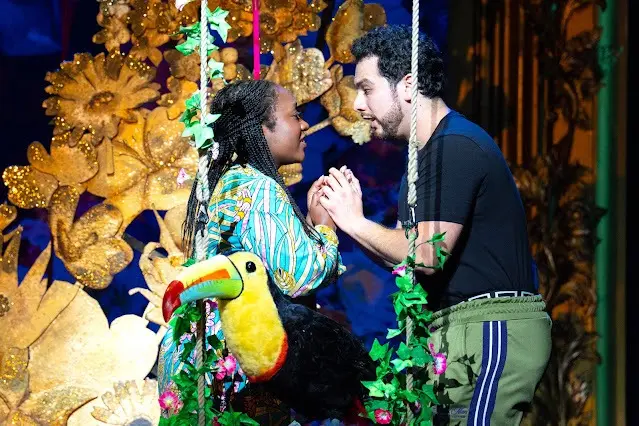
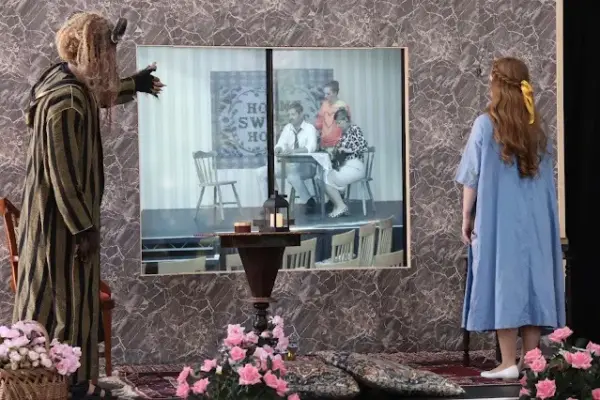
The evening commenced with an electric undercurrent, courtesy of conductor Patrick Lange. Setting a brisk, purposeful tempo from the opening bars, Lange established an atmosphere of impending doom. Rae Smith’s set designs, drawing heavy visual inspiration from contemporary artists Kehinde Wiley and Yinka Shonibare, immediately established a vibrant yet claustrophobic court.
Within this opulent, pattern-drenched space, Mexican tenor Leonardo Sánchez introduced the Duke of Mantua with irresistible, chameleon-like charm. Sánchez navigated his opening aria with effortless elan, projecting an agile, physically active persona that seamlessly shifted from predatory charm to superficial courtliness. Crucially, Elufowoju’s meticulous staging brought on characters like the chilling assassin Sparafucile (portrayed with steely menace by Callum Thorpe) and his seductive sister Maddalena (Alyona Abramova) early during the Act I festivities. This masterstroke integrated the seedier elements of the underworld into the gleaming facade of the court, ensuring the audience’s attention remained locked onto the tightening narrative web.
Act II: Psychological Unraveling and Familial Bonds
As the drama escalated into Act II, the emotional core of the production crystallized around American baritone Blake Denson’s towering interpretation of the title character. Denson’s Rigoletto was a masterclass in vocal and physical duality: physically imposing yet inwardly fractured, possessing a dark, velvety instrument capable of unleashing ferocious fury during the iconic “Cortigiani, vil razza damnata.”
Yet, it was Denson’s tenderness in his interactions with his on-screen daughter, Gilda—portrayed with radiant warmth by American soprano Raven McMillon—that anchored the tragedy. McMillon infused Gilda’s unworldliness with genuine empathy rather than simple naivety. Her rendition of “Caro nome” combined crystalline vocal agility with deeply felt phrasing. The subsequent father-daughter confrontation at the close of Act II resonated with palpable intimacy, establishing a fierce familial bond that made the subsequent tragedy all the more devastating.
Act III: The Convergence of Fate and Absolution
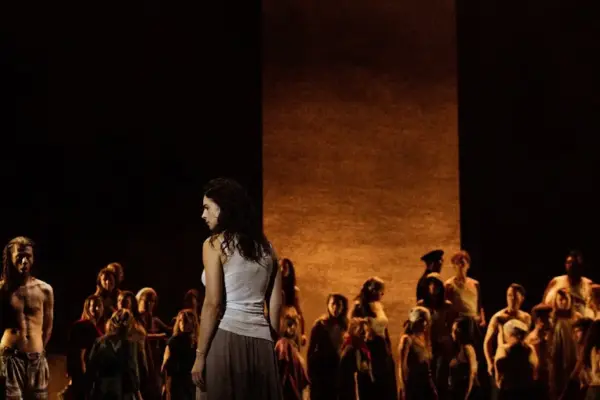
The final act brought the narrative’s moral decay into sharp relief. Sánchez’s Duke returned with a swaggering aura of invincibility, perfectly juxtaposed against Thorpe’s chillingly casual Sparafucile peeling an apple while the Duke wooed Maddalena in the shadows. Despite minor spatial incongruities in Act III’s depiction of a down-and-out haven—a rare visual stumble in an otherwise immaculate design—the dramatic tension never faltered.
The culminating tragedy unfolded with agonizing precision. McMillon’s Gilda, sacrificing herself for a man incapable of true redemption, brought a heartbreaking purity to the opera’s closing moments. Denson and McMillon executed the final tableau with devastating emotional restraint, avoiding mawkish sentimentality in favor of raw, unvarnished human grief. Lange and the Opera North orchestra drove the finale with inexorable momentum, sealing a triumphant night of lyric theater.
Supporting Context & Metrics: Production Scale and Tour Logistics
To fully appreciate the magnitude of this revival, one must examine the operational and artistic scope underpinning Opera North’s current autumn season:
Total Performances: Thirteen fully staged performances scheduled across the initial run.
Touring Schedule: Opening at the Leeds Grand Theatre before embarking on a major regional tour encompassing Newcastle, Salford Quays, and Nottingham.
Creative Team Lineup:
Director: Femi Elufowoju jr.
Conductor: Patrick Lange (Music Director designate, taking the helm fully in 2028).
Designer: Rae Smith.
Lighting Designer: Howard Hudson.
Principal Casting Highlights:
Rigoletto: Blake Denson (Houston Grand Opera Studio alumnus, role debut in this production).
Gilda: Raven McMillon (Role debut).
Duke of Mantua: Leonardo Sánchez (Role debut).
Monterone: Sir Willard White (Veteran bass in a commanding, recurring cameo).
Sparafucile / Maddalena: Callum Thorpe and Alyona Abramova.
The production also heavily spotlighted members of Opera North’s resident chorus and smaller supporting roles—such as Thomas Elwin (Borsa), Themba Mvula (Marullo), and Ross McInroy (Count Ceprano)—whose sharply etched performances successfully transformed the court into a believable, complicit community.
Official Statements and Artistic Vision
The conceptual backbone of the production remains rooted in Femi Elufowoju jr.’s deliberate interrogation of institutional power, race, and ostracization. Speaking on the enduring relevance of his concept, Elufowoju has consistently emphasized that Rigoletto is fundamentally an opera about societal cruelty and institutionalized bullying.
"The curse is not merely a supernatural threat; it is the inevitable blowback of a society that devalues the marginalized," notes the production’s underlying philosophy. By casting Black artists in roles historically subjected to systemic humiliation at court, the staging forces viewers to confront how generational trauma and racial isolation warp a father’s protective instincts into toxic obsession.
Meanwhile, Patrick Lange’s musical leadership marked a triumphant pre-curser to his upcoming tenure as Music Director in 2028. Reflecting on his approach to Verdi’s score, Lange prioritized rhythmic urgency without sacrificing bel canto lyricism:
"Verdi demands absolute orchestral discipline, but he also writes pockets of sublime vulnerability for the human voice. Our goal was to drive the dramatic impetus forward during the ensemble climaxes while granting the singers the necessary acoustic space to breathe, shape, and emote."
Future Outlook: A Landmark Legacy for Opera North
Opera North’s 2026 revival of Rigoletto serves as a crucial milestone for the company as it looks toward the future. By pairing Elufowoju’s uncompromising directorial vision with Patrick Lange’s electrifying musical direction, the company has set a gold standard for contemporary opera revivals in the UK.
For first-time operagoers, the production offers an accessible, visually striking entry point free of dusty traditionalism. For seasoned aficionados, the nuanced vocal performances—particularly Blake Denson’s towering role debut as the tragic jester and Raven McMillon’s luminous Gilda—offer profound new layers of psychological interpretation.
As the production wraps its Leeds run and prepares for its regional transfer across Newcastle, Salford Quays, and Nottingham, it cements its status as a defining cultural highlight of the 2026 theatrical calendar. Audiences across the United Kingdom are strongly advised to secure tickets for what is indisputably one of the most vital operatic stagings of the decade.