In the shadowy, candle-lit vaults of the Battersea Arts Centre, Gothic Opera has achieved a minor miracle of resurrection. For its chilling annual Halloween production, the adventurous small-scale company has unearthed Fromental Halévy’s La Dame de Pique (The Queen of Spades), an operatic rarity that has languished in near-total obscurity for over a century and a half.
Set against the decadent, blood-soaked twilight of the Ancien régime, this reimagined Gothic thriller plumbs the psychological depths of human greed, demonic pacts, and ancient curses. It is a tale centered around a legendary magic ring and the three secret cards that promise infallible fortune at the gambling tables.
Musically and visually, the production is an astonishing triumph—a testament to what an ambitious independent ensemble can achieve when punching far above its weight class. While occasional dramatic stumbles, heavy-handed dialogue adaptations, and uneven pacing hinder its narrative cohesion, the sheer audacity of the venture, paired with standout vocal performances, makes it an unforgettable theatrical event. As opera companies continually search for innovative ways to captivate modern, genre-fluid audiences, Gothic Opera’s calculated dive into the macabre suggests that a spooky night at the lyric theatre may well be the industry’s next winning proposition.
Detailed Chronology and Production Analysis
Setting the Scene: The Twilight of the Ancien Régime
The narrative framework drops audiences directly into the volatile final days of the Ancien régime, a period ripe for societal decay and supernatural unease. Director Jonny Danciger frames the dark fable with atmospheric precision, introducing us to the subterranean gloom of a French mining community juxtaposed against the aristocratic splendor of Princess Polowska’s chateau.

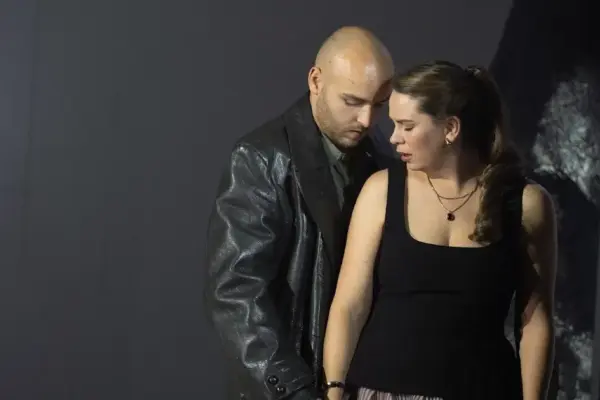
The production opens with André Roskaw, the earnest foreman of the local miners, played with earthy authenticity by baritone Charlie Epps. Epps possesses a light, youthful voice with a gentle, honest timbre that immediately grounds his character. He aspires to marry Lisanka, the governor’s haughty daughter, portrayed by Alice Usher. Usher commands the stage with a formidable, dramatic voice, using her vocal heft to lay out the chilling details of the Polowska family legend. However, while her musical delivery remains unassailable, her spoken interactions occasionally falter due to stilted delivery—a symptom of an English dialogue adaptation that struggles with naturalistic flow.
As the darkness within the narrative takes hold, Epps pivots effectively into full-throated melodrama. Driven mad by an ancient curse, his descent into obsession feels entirely earned; after all, if an artist cannot pull out all the stops when tormented by a pact with the devil in a Halloween opera, then when can one?
Chivalry, Caricature, and Vocal Standouts
The arrival of Lieutenant Constantin injects the requisite chivalric romanticism into the gothic yarn. Tenor James Hutchings handles the role with supreme vocal ease, exhibiting a deep, caressing tone that can swell with white-hot passion. His spinning high notes—specifically a breathtaking top C—display an effortless security that hints at even greater stratospheric heights in his future.
In sharp contrast stands Prince Zizianow, a delightfully ludicrous comedy villain brought to life by Sam Utley. Remminiscent of an aristocratic emigré straight out of Blackadder the Third, Utley’s Zizianow provides much-needed comic relief and vocal weight. His hearty, booming baritone creates a stark contrast to the lighter male leads, though vocal stamina proved to be a minor hurdle, culminating in some noticeable huskiness by the third act.

Yet, the undisputed vocal and dramatic anchor of the evening is Grace O’Malley as Princess Polowska, the imperious owner of the chateau and keeper of the secret cards. O’Malley’s portrayal is a masterclass in vocal discipline and characterization. Her top notes possess an icy, crystalline brilliance, and her coloratura is breathtakingly clean, agile, and sparkling. Rather than treating these florid passages as mere vocal gymnastics, O’Malley meticulously preserves the weight and meaning of the text. Her aristocratic gravitas is palpable, and her dialogue carries the crisp, tinkling intonation of a dark fairy tale. Crucially, a deeply vulnerable aria performed within the dark confines of the mine injects profound emotional depth into an otherwise proud and formidable character.
Dramatic Friction and Visual Splendor
Despite these towering individual performances, the production occasionally struggles to weave its elements into a cohesive dramatic whole. Much of this friction stems from Jonny Danciger’s English dialogue adaptation, which leans heavily into an unsubtle, on-the-nose vernacular. Described by critics as reading occasionally like a child’s guide to the French Revolution, the text drops modern colloquialisms—such as a jarring reference to “Christ on a chaise longue”—that fracture the historical illusion.
This crude material appears to hamper the cast during spoken exchanges, leading to stiff interactions. The central romance between Constantin and the Princess, brilliantly established in the opening act, loses its momentum as it approaches its dramatic climax, resulting in a distinct lack of theatrical sparks. Similarly, moments of dark comedy miss their timing by a frustratingly narrow margin.
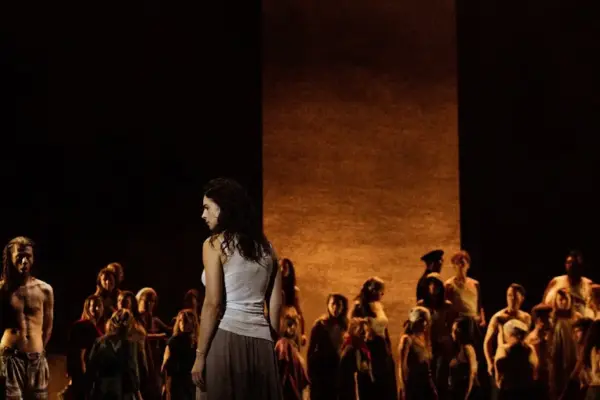
Visually, however, designer Céleste Langrée achieves absolute perfection. The utilization of the Battersea Arts Centre’s architecture is inspired. The opening scenes at the Princess’s Chateau are economically yet effectively evoked through stark portraits and minimalist drawing-room framing. The stage’s deep, tiered design creates an intimate acting space down front, while endowing the upper platforms with a chilling, supernatural aura.

Transitioning to the mines, the production relies on thick shadows, atmospheric smoke, and flickering mining lanterns to craft a brilliantly spooky environment. The multi-leveled set provides ideal architecture for skulking characters and winding psychological corridors. Danciger’s blocking capitalizes on these spaces, generating grand, arresting tableaus. Enhanced by luxurious French Revolution-era costumes—featuring powdered wigs, rich satins, tricolor rosettes, and sans-culottes attire—the production achieves a high-end cinematic aesthetic that defies the limitations of a small independent company.
Supporting Context & Metrics
The 150-Year Silence of Halévy’s Masterpiece
To understand the significance of Gothic Opera’s undertaking, one must look closely at the provenance of the work itself. Fromental Halévy, best known for his monumental 1835 grand opera La Juive, was a towering figure in 19th-century French music. Yet La Dame de Pique—featuring a libretto by Eugène Scribe based on Alexander Pushkin’s seminal short story—has sat largely unperformed for a century and a half.
Key Production Metrics:
---------------------------------------------------------
Composer:            Fromental Halévy (1799–1862)
Original Libretto:   Eugène Scribe (after Alexander Pushkin)
English Adaptation:  Jonny Danciger
Chamber Arranger:    Leon Haxby
Cast Size:           6 Principal Soloists + 7-Member Chorus
Instrumentalists:    Chamber Ensemble (Exact tally proprietary)
Venue:               Battersea Arts Centre, Main Hall
Review Date:         29 October 2026
Musically, the score occupies a fascinating historical bridge. While it lacks the ironclad structural consistency of 19th-century masterworks, its best movements approach that upper echelon. The jaunty, infectious rhythms of the ensemble numbers instantly recall the lighter, perkier sections of Bizet’s Carmen (a direct stylistic lineage, given that Bizet studied under Halévy), while its lusher, romantic swells bear the emotional DNA of Puccini.
Vocal Ensemble and Instrumental Reduction
The success of the evening relies heavily on the ensemble work. Leon Haxby’s chamber arrangement of the orchestral score strips away the safety net of a large pit, leaving every instrumentalist dangerously exposed. The small-scale ensemble rises magnificently to the challenge, executing lyrical solos with crisp articulation. Conductor Hannah von Wiehler leads with steady, unyielding precision while successfully carving out structural space for wild, unbridled passion during the score’s most turbulent demonic climaxes.

Furthermore, the seven-member chorus functions as an organic theatrical engine. Delivering a remarkably rich, full-bodied sound that belies their small headcount, their diction remains crystal clear throughout. Each chorister acts as an accomplished soloist, injecting vital momentum and character into the unfolding tragedy.
Official Statements & Creative Vision
The conceptual ethos of Gothic Opera relies on rescuing forgotten 19th-century works from the dustbin of history and contextualizing them within a modern, visceral theatrical framework.
-
On the Rediscovery of the Score: Critical consensus from the opening night points to a resounding vindication of Halévy’s forgotten score. As reviewer Saskia Bibb noted, "The proposition at the heart of the production is that Halévy’s opera deserves some love, and they have a point… It is strange that it has been quite so neglected, and one can only hope it doesn’t have to wait another 150 years for its next outing."
-
On Production Values: The collaborative synergy between director Jonny Danciger, conductor Hannah von Wiehler, and designer Céleste Langrée has consistently defined Gothic Opera’s trajectory. By transforming a chamber adaptation into a grand, immersive visual feast—complete with moving surtitles, complex lighting design by Eli Hunt, and meticulously tailored period garments—the creative team has established a new benchmark for independent opera production in the United Kingdom.

Future Outlook
Gothic Opera’s mounting of La Dame de Pique offers profound strategic implications for the broader classical music landscape. For decades, major European and North American opera houses have wrestled with declining, aging demographics and the ongoing challenge of attracting younger, culturally adventurous demographics.
By strategically leaning into seasonal hooks—specifically the cultural appetite for horror, gothic aesthetics, and immersive Halloween entertainment—companies can unlock new pathways for audience acquisition. The opening night of Halévy’s masterpiece drew an impressively large, enthusiastic crowd that responded with warm, sustained applause.
The success of this production proves that contemporary audiences do not necessarily require dumbed-down programming; rather, they respond to high artistic ambition, strong vocal talent, and atmospheric storytelling delivered with unmitigated commitment. If major institutions are looking for a blueprint to revitalize neglected repertoire and capture the public imagination outside of traditional subscriber bases, they would do well to follow Gothic Opera’s lead into the dark, shadowed corners of the operatic canon.