Executive Overview
Two decades after its initial theatrical release, Guillermo del Toro’s Pan’s Labyrinth (El laberinto del fauno) returns to cinemas worldwide, re-emerging not merely as a nostalgic retrospective, but as a searing, perennially relevant masterclass in cinematic resistance. Set against the harsh backdrop of rural Spain in 1944—half a decade after the official conclusion of the Spanish Civil War—the film weaves a dark, sorrowful tapestry balancing historical atrocity with mythic wonder.
At its core, the narrative tracks young Ofelia (Ivana Baquero) as she navigates a fractured reality. Above ground lies the cold, grey, militaristic tyranny of her stepfather, the Falangist Captain Vidal (Sergi López). Below ground lies an ancient, subterranean fantasy realm where mysterious entities recognize her as a long-lost royal heir.
Widely celebrated upon its 2006 debut, the film’s critical and cultural stature has only multiplied over the last twenty years. It frequently occupies prominent positions on prestigious international polls cataloging the greatest films of the 21st century, and many contemporary critics and scholars regard it as the absolute pinnacle of del Toro’s career. As this landmark anniversary brings the film back to the big screen, it offers an ideal vantage point to explore how Pan’s Labyrinth uses dense visual language, fairy-tale mythos, and the historical legacy of artistic censorship under Franco’s regime to affirm the unyielding resilience of the human imagination.
Detailed Chronology: The Historical and Cinematic Roots of a Modern Fable
To fully understand the weight of Pan’s Labyrinth, one must trace the historical lineage of Spanish oppression and the cinematic responses it inadvertently birthed. The film exists not in a vacuum, but as a deliberate dialogue with Spain’s totalitarian past and the brilliant, subversive ways filmmakers historically bypassed state controls.
Censorship and the Birth of Subversive Cinema
The mechanisms of state suppression in Spanish cinema date back decades. In 1938, amidst the chaos of the civil war, the Comisión Nacional de Cinematografía was established, formally integrating fiction films into an already brutal apparatus of legislative censorship. Alongside newsreels and documentaries, cinematic narratives were singled out for rigid state oversight—a tacit acknowledgment by authorities that fiction possessed a potent, volatile capacity to sway public consciousness and challenge authority.
Confronted with this suffocating environment, Spanish filmmakers became masters of suggestion. Deeply embedded in Hispanic heritage, folklore, religious iconography, and pictorial art was a rich tradition of symbolism. Artists quickly learned to weaponize this visual language to address national trauma without drawing the immediate ire of state censors.
A prime historical example of this coded resistance is Carlos Saura’s 1966 masterpiece, The Hunt. The film follows three middle-aged civil war veterans who reunite for a seemingly innocent rabbit-hunting trip in the exact terrain where they once trapped and executed loyalists. As the day wears on, nostalgic reminiscences curdle into bitterness, ultimately culminating in fatal violence among the men. Saura bypassed explicit political commentary, choosing instead to let implicit symbolism convey how the inescapable horrors of the past inevitably devour those who perpetrated them.
Echoes of The Spirit of the Beehive
Pan’s Labyrinth directly inherits this magical-realist tradition, owing a profound debt to Víctor Erice’s 1973 landmark film, The Spirit of the Beehive. Set in an isolated Castilian village in 1940, Erice’s film follows a young girl named Ana (Ana Torrent) whose worldview is entirely upended when a mobile cinema brings James Whale’s 1931 adaptation of Frankenstein to town.
Captivated by the monster’s tragic isolation, Ana’s reality shifts; she soon encounters and aids a wounded Republican soldier, viewing his desperate plight through the lens of Whale’s misunderstood creature. This profound exploration of cinema’s transformative power left an indelible mark on Guillermo del Toro. It laid the psychological and stylistic groundwork that eventually materialized in Pan’s Labyrinth—and directly fueled del Toro’s lifelong fascination with the Frankenstein mythos, culminating in his own upcoming cinematic adaptation.
Supporting Context & Metrics: Decoding the Visual Language
One of the primary reasons Pan’s Labyrinth continues to captivate audiences and academics alike is its dense, uncompromising visual architecture. Del Toro possesses a rare capacity to fuse grandiose mythic signs with pop-cultural emblems, creating an iconography that feels simultaneously ancient and startlingly modern.
The Duality of Ofelia’s World
Ofelia’s liminal existence is articulated entirely through stark visual contrasts. Placed under the care of Captain Vidal—whose character is draped in the monochromatic, soul-crushing greyness of rigid militarism—she finds herself retreating into a universe dictated by imagination.
Notably, Ofelia speaks very little throughout the film. Her silence acts as an implicit, stubborn defiance against the verbose, overbearing demands of absolute subservience enforced by Vidal. Rather than engaging in political debate, Ofelia reads, interprets, and reacts to her environment through visual symbols. These symbols help her process the brutal, ongoing violence of Franco’s regime on the surface, as well as the tempting yet perilous trials of the underworld below.
Early in her journey, the mysterious Faun (also played by Doug Jones) presents Ofelia with a blank, leather-bound book. As her quests unfold, the pages magically fill with text and illustrations. Within the film’s internal logic, this alchemy of image-making and artistic creation grants Ofelia a vital sense of identity, personal direction, and moral agency within a labyrinthine world designed to crush her spirit.
Monsters Real and Imagined
Del Toro famously stated that the most horrific atrocities in the film do not transpire in the fantastical underworld—a realm brimming with monsters, ancient trials, and terrifying entities—but rather in the sunlit, waking world overseen by Captain Vidal. Vidal personifies the chilling synthesis of maniacal violence and bureaucratic control that forms the rot at the heart of fascism.
This thematic truth is driven home in one of the film’s most harrowing sequences. A local father and his son are interrogated after being detained with a firearm; they desperately swear the father was merely hunting rabbits to feed his starving family. Without a hint of hesitation or mercy, Vidal brutally beats the son to death with a glass bottle and shoots the father in the throat. Afterward, he casually rifles through the dead man’s satchel, only to discover the dead rabbits—a revelation that leaves him entirely indifferent, exposing the hollow, bloodthirsty nature of his authority.
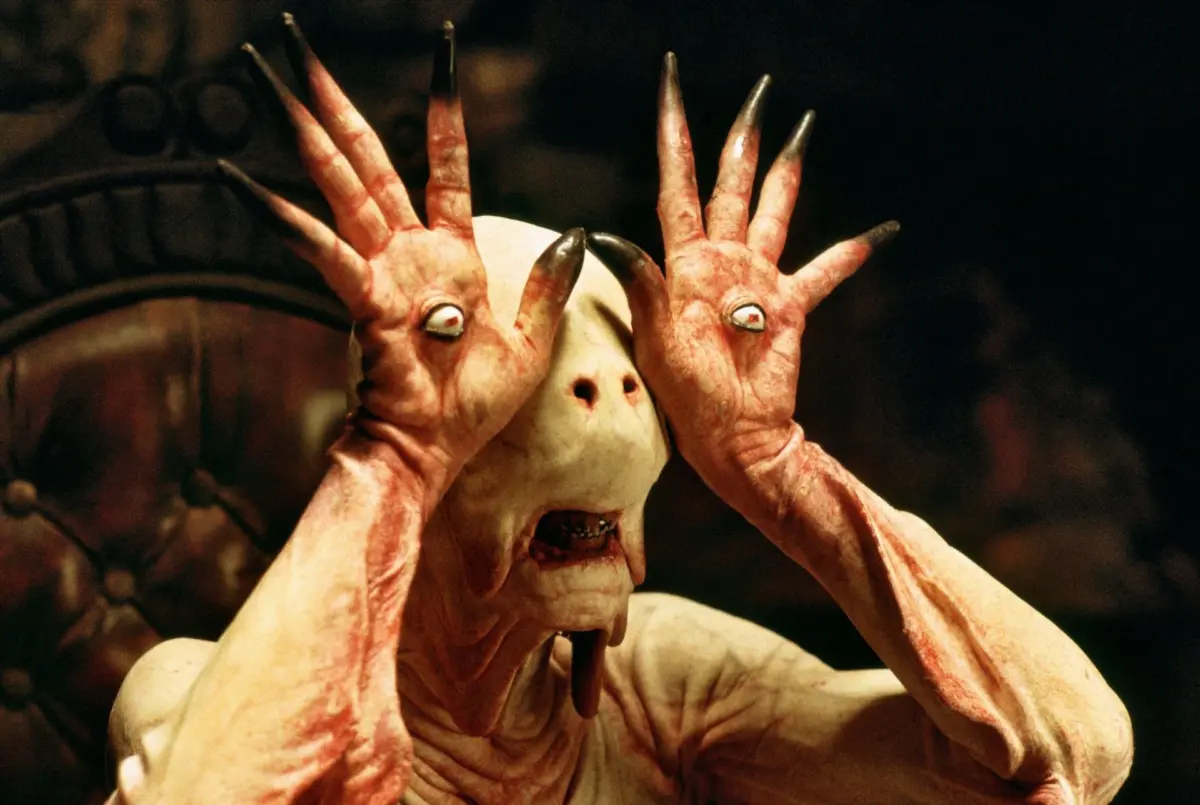
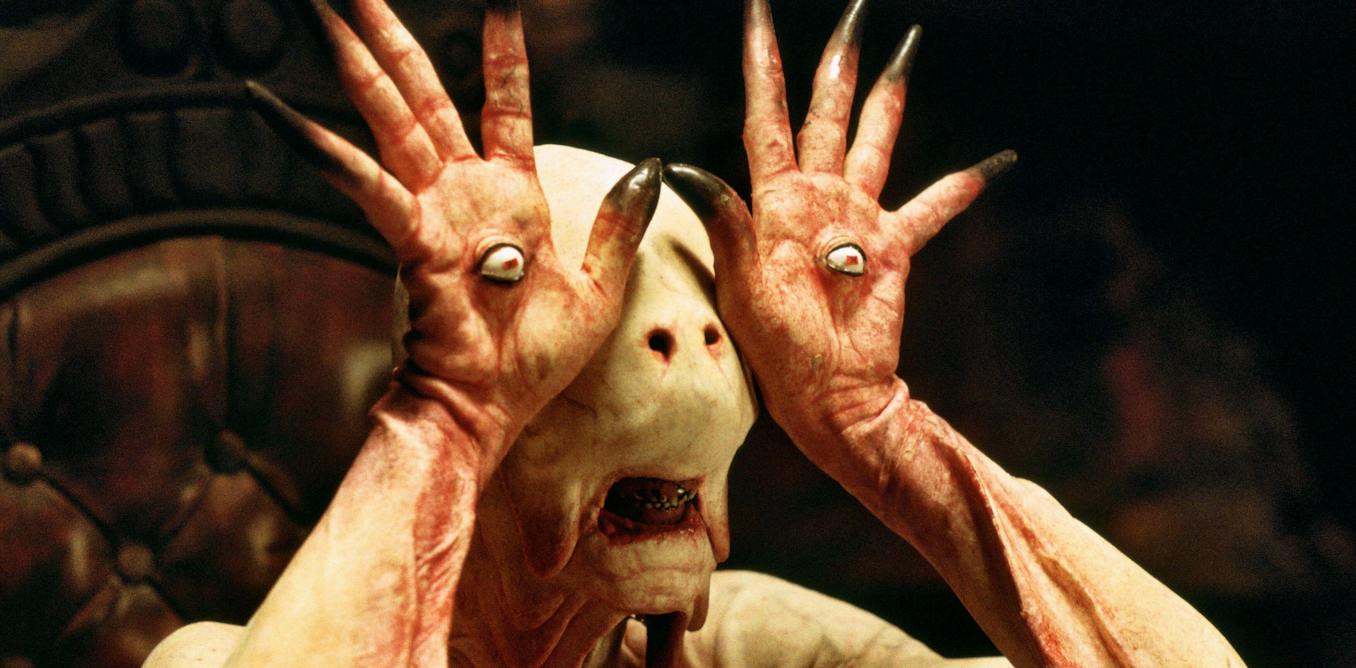
This terror is mirrored in the film’s iconic creatures, which serve as physical manifestations of historical trauma. The Pale Man—masterfully brought to life by Doug Jones—is a terrifying amalgam of Francisco Goya’s harrowing painting Saturn Devouring His Son and a promotional poster for Don Coscarelli’s 1979 horror classic, Phantasm. Through these deliberate artistic linkages, del Toro anchors his dark fairy tale in a rich lineage of horror and socio-political critique.
Official Statements & Creative Philosophy
Guillermo del Toro has been remarkably candid about his artistic process, repeatedly emphasizing that his political convictions cannot be separated from his love of myth and fable.
In past interviews, the Academy Award-winning director articulated his foundational ethos:
"I’m not a filmmaker who can speak directly about politics without addressing it through fable or parable. It’s just not in my make-up."
By filtering the generational trauma of the Spanish Civil War through the lens of dark fantasy, del Toro bypasses the dry didacticism that often plagues historical dramas. Instead, he taps into universal emotional truths. Speaking on the enduring appeal of Pan’s Labyrinth on its 20th anniversary, industry analysts and retrospective curators have highlighted how the film functions on a dual track: as an intimate coming-of-age tragedy and as a monumental testament to the endurance of creative expression under duress.
Film historians note that the picture honors the resilience of artists who labored under heavy censorship throughout the 20th century. By equating Ofelia’s magical book with the subversive artistry of Spanish directors like Saura and Erice, Pan’s Labyrinth asserts that while authoritarian regimes can ban books, burn films, and silence dissidents, they can never fully extinguish the imaginative capacity of the human spirit.
Future Outlook: Legacy, Influence, and the 20th-Anniversary Re-release
As Pan’s Labyrinth returns to theaters for its milestone 20th anniversary, its cultural footprint continues to expand. No longer viewed merely as a breakout international fantasy hit, it is securely canonized as a cornerstone of modern cinematic art.
The film’s impact reverberates strongly across contemporary filmmaking. Its seamless blending of practical creature effects, historical tragedy, and magical realism has inspired a new generation of genre directors who refuse to treat fantasy as mere escapism, but rather as a vital tool for confronting real-world tyranny. Furthermore, del Toro’s ongoing career trajectory—including his long-awaited, deeply personal adaptation of Frankenstein—traces a direct line back to the thematic seeds planted in The Spirit of the Beehive and brought to magnificent fruition in Pan’s Labyrinth.
Ultimately, the 20th-anniversary re-release offers modern audiences an essential reminder of cinema’s capacity to bear witness. In an era marked by rising authoritarianism, political polarization, and renewed threats to artistic freedom, Ofelia’s journey into the labyrinth remains an urgent call to action. It reminds us that even when confronted with insurmountable darkness, the stories we tell, the symbols we create, and our refusal to submit to tyranny remain our most powerful weapons.