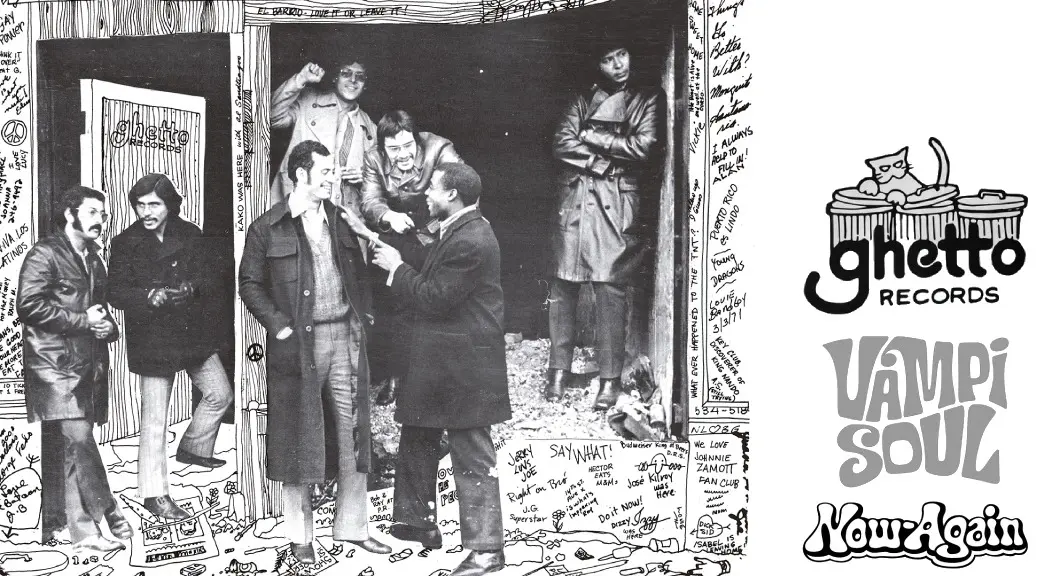
In the volatile landscape of New York City’s late-1960s and early-1970s independent music scene, few ventures burned as brightly or vanished as completely as Ghetto Records. Founded in 1970 by boogaloo icon Joe Bataan—while he was still contractually bound to Fania Records—the label operated out of 2078 Second Avenue in East Harlem. Funded by George Febo, a street-level backer whose presence cemented the label’s gritty, authentic urban ethos, Ghetto Records was designed to capture the transitional friction of a musical ecosystem pivoting away from Latin soul and boogaloo toward the harder, brass-heavy architectures of salsa.
Between 1970 and 1972, the label managed to issue just six long-playing records before folding under the financial and infrastructural pressures of the era. When the enterprise collapsed, its master tapes vanished with it, casting its catalog into the realm of elusive crate-digger myth.
Now, through meticulous archival restoration work by Now-Again and a subsequent collaborative release by Vampisoul, the foundational jewel of that catalog—Ghetto Records Presents… Eddie Lebrón and His Orchestra Suave—has been resurrected. Featuring painstaking audio restoration from rare surviving original LPs, the reissue brings back into the daylight a brilliant anomaly: the sole recorded output of a transient super-sideman leading his own visionary orchestra, bolstered by rare 1971 45s. This release is not merely a historical reissue; it is an archeological recovery of a missing link in the evolution of New York Latin music, offering a masterclass in rhythm, cultural synthesis, and the unyielding hustle of the East Harlem independent music trade.
Detailed Chronology
1968–1970: The Death of Boogaloo and the Birth of Ghetto Records
By the close of the 1960s, the boogaloo—that vibrant, street-level collision of Afro-Cuban rhythms and American R&B—had begun to exhaust its commercial momentum. Pioneers of the sound were forced to adapt. Ray Barretto transitioned from the definitive boogaloo statement Acid (1968) to the expansive, jazz-inflected terrain of Together (1969). Bandleaders like Eddie Palmieri and trombonist Willie Colón (alongside singer Héctor Lavoe) systematically replaced traditional violin sections with menacing, aggressive walls of trombones, heralding the dawn of salsa.
It was within this cultural crossroads that Joe Bataan made a calculated pivot. Already a titan of the boogaloo era on Fania Records, Bataan sought total creative and infrastructural control. Partnering with George Febo, Bataan established Ghetto Records in East Harlem. The label’s debut release in 1970 functioned less like a traditional corporate product and more like an open invitation taped to a bodega window—even featuring a direct telephone number for aspiring talent to test their fortunes.
The Inception of Orchestra Suave
The label’s flagship signing was Eddie Lebrón, a Puerto Rican-born, New York-raised multi-instrumentalist, vocalist, and bandleader who had arrived in the city at the age of five. Lebrón assembled the exceptional Orchestra Suave, an ensemble distinguished by its unique front line. While contemporaries favored the dominant trombone-heavy configurations, Lebrón opted for a saxophone-weighted attack featuring Ibes Gonzalez on alto and Gabi Ignetti on tenor, counterbalanced by Rolando Lopez’s trumpet and Leopoldo Pineda’s lone trombone.
The rhythm section was equally formidable, anchored by George Rivera on bass, Joe “Papo” Boine on timbales, Mike Medina on congas, and David Cilva on bongos. Vocal duties were shared among Alfonso “Cachito” Tirado, Conchi Soto, and Lebrón himself. Despite high expectations, the orchestra’s trajectory was short-lived; Lebrón soon returned to the New York circuit, carving out a prolific career as a reliable sideman and master arranger.
The 1970 Release: Anatomy of a Masterpiece
Ghetto Records Presents… opened a window into the dizzying rhythmic shifts of 1970 New York. Side A of the original LP showcased stylistic versatility, opening with the breezy cha-cha-chá of "Fui Sincero," transitioning into the deep, syncopated urgency of the guaguancó "Yo Te Lo Dedico," and returning to the cha-cha-chá with "Si Quieres."
The record’s most striking stylistic bridge, however, was its English-language track. Joe Bataan’s distinct imprint is evident in the inclusion of "For Sentimental Reasons," a 1945 ballad made famous by Nat King Cole. Rather than framing it through the lens of traditional Latin arrangements or doo-wop vocal harmonies, Ghetto Records enlisted singer Abdul O’Dool—credited simply with "English vocals"—to deliver the song entirely unaccompanied by backing harmonies. The result transformed a mid-century standard into a haunting, raw soul ballad.
Side B was an uncompromising masterclass in the guaguancó. Tracks like "Eddie’s Guaguanco" and "Pena" set a relentless rhythmic pace, while "Rico Son" leaned into the burgeoning son format while retaining the underlying rhythmic gravity of the rumba. Mike Medina’s conga work anchored the mix, propelled by fluctuating patterns of chekerés and bells that transformed the entire recording into an uncompromising vehicle for the dancefloor.
1971–1972: The Final Years and Master Tape Disappearance
Following the debut release, Ghetto Records issued a handful of additional records—bringing its total output to six albums between 1970 and 1972—before quietly folding. The collapse was typical of the era’s undercapitalized indie labels: distribution hurdles, shifting urban demographics, and predatory business practices took their toll. Most devastatingly, when the label closed its doors, its master tapes vanished, leaving behind only scattered, crackling vinyl pressings to preserve its legacy.
Supporting Context & Metrics
The Rhythmic Taxonomy: Cha-Cha-Chá and Guaguancó
To fully appreciate the structural brilliance of Ghetto Records Presents…, one must understand the foundational Cuban forms that dictate its sequencing:

- Cha-Cha-Chá: Born in Havana in the early 1950s, this rhythm was pioneered by violinist Enrique Jorrín of Orquesta América when he adapted the traditional danzón to accommodate dancers struggling with complex syncopations. Marked by the landmark 1953 recording "La Engañadora," its breezy, accessible tempo became a global phenomenon.
- Guaguancó: Tracing its lineage much deeper into the nineteenth-century tenement yards and dockside neighborhoods of Havana and Matanzas, the guaguancó is one of the three principal branches of Cuban rumba (alongside the slow yambú and the rapid columbia). Built upon the interplay of drums, improvised vocal calls, and a theatrical dance of sexual pursuit, it operates entirely within the strict architecture of the rumba clave. In 1970s New York, this intricate percussion blueprint became the foundational floor upon which hard salsa built its aggressive brass arrangements.
Archival Reconstruction & The Vampisoul / Now-Again Partnership
Because the original master tapes were lost to history, the modern resurrection of Ghetto Records Presents… required meticulous forensic audio engineering. Now-Again spearheaded the initial rescue operation, sourcing pristine copies of exceedingly rare original LPs to rebuild the master tracks through digital restoration.
The resulting archive was first deployed in a limited-edition 2022 box set, followed by a standalone LP release in 2023. The subsequent Vampisoul partnership refined this recovery effort. Crucially, the Vampisoul edition integrates both sides of an exceptionally scarce 1971 Ghetto 45:
- "My Vows To You": A Latin-soul reimagining of the 1959 doo-wop tune originally cut by Cincinnati group The Students. Featuring lead vocals by Little David supported by rich group harmonies, this track bridges East Coast Latin music and classic American vocal group R&B.
- "Sigue Tu Vida": Composed by Eddie Lebrón, this track delivers a quintessential, driving guaguancó.
By appending these 45 tracks to the sequencing—placing one at the conclusion of each album side—Vampisoul solved a logistical hurdle. The original LP sides were short enough to absorb the extra running time without compromising audio fidelity or cutting depths. While this alters the original closing tracks ("Si Quieres" and "Rico Son"), it structurally reinforces the thematic unity of each side: Side A now houses both English-language crossover soul ballads, while Side B anchors an uninterrupted sequence of four heavy guaguancós.
Official Statements
Reflecting on the legacy of Ghetto Records and the tireless archival efforts required to bring these lost sounds back into circulation, independent musicologists and reissue architects have emphasized the cultural weight of the project.
"Ghetto Records was an exercise in pure survival and raw artistic ambition. Joe Bataan wasn’t just chasing a trend; he was building a sanctuary for musicians who didn’t fit neatly into the corporate machinery of Fania. When those master tapes disappeared, a vital chapter of East Harlem’s musical history went dark. Restoring this record from surviving vinyl isn’t just about preservation—it’s about giving back a stolen voice to the streets that birthed it."
— Archival Project Notes, Now-Again Records
"The marriage of structural Cuban rumba with the gritty reality of early-70s New York urban life defined the Ghetto catalog. Eddie Lebrón and his Orchestra Suave managed to create a sound that looked unflinchingly toward the future of salsa while honoring the deep roots of the guaguancó and the cha-cha-chá. Vampisoul’s collaboration ensures that this fleeting, brilliant lightning-in-a-bottle moment is never lost again."
— Liner Notes Commentary, Vampisoul Reissues
Future Outlook
The resurrection of Ghetto Records Presents… Eddie Lebrón and His Orchestra Suave is part of a broader, vital re-evaluation of early-1970s independent Latin music. As labels like Vampisoul and Now-Again continue their systematic excavation of the era—having successfully brought back gems like Joe Acosta’s The Power of Love and La Fantástica’s From Ear To Ear—the map of New York’s golden age of salsa and boogaloo is being dramatically redrawn.
Looking ahead, archivists and music historians anticipate increased academic and collector interest in the minor labels that operated in the shadow of major conglomerates during the Nixon-era urban crisis. While Ghetto Records itself was short-lived—issuing merely six albums before closing its doors permanently in 1972—its ideological blueprint prefigured the DIY ethos of modern independent music production.
Plans for future archival box sets aim to track down the remaining scattered 45s and test pressings from the Ghetto vaults, offering hope that other lost artifacts from 2078 Second Avenue might yet be recovered. For now, the definitive restoration of Lebrón’s masterpiece stands as a monument to a fleeting crossroads in musical history—proving that true groove, preserved in the grooves of rare wax, can outlast even the loss of its master tapes.