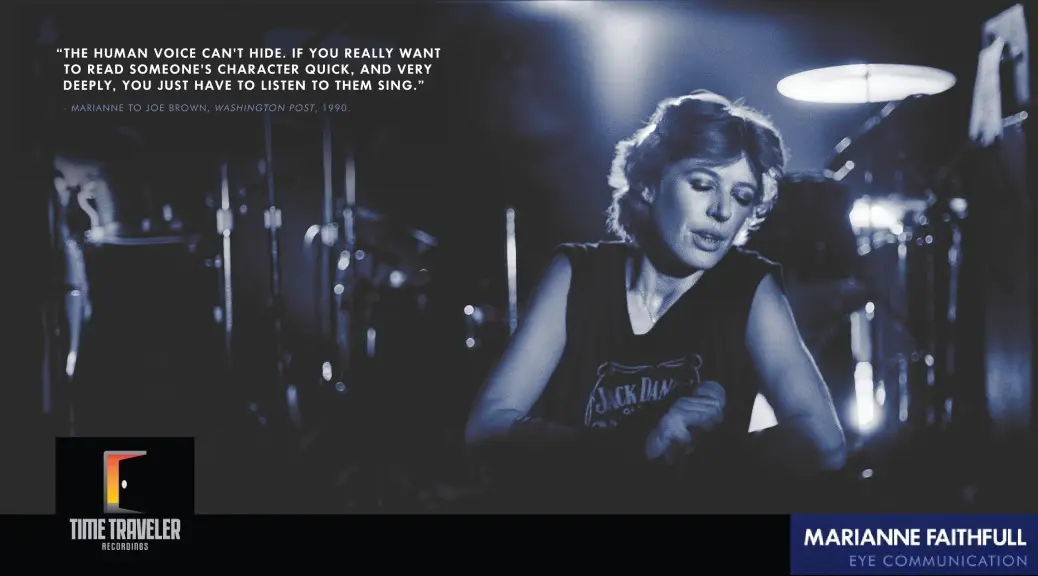
For Black Friday, Zev Feldman’s genre-agnostic archival imprint, Time Traveler Recordings—which launched last autumn with the Muse Master Edition series—is turning its lens toward a pivotal moment in rock history. Following its Record Store Day releases earlier this year, which included Terry Callier’s sublime 1967 Chicago solo set At The Earl Of Old Town, the label is unearthing a remarkable live artifact: Marianne Faithfull performing at the Wax Museum in Washington, D.C., on October 2, 1983.
Titled Eye Communication and pressed as a limited-edition 180-gram double LP, this release arrives perfectly timed to honor what would have been Faithfull’s 80th birthday on December 29, following her passing in January 2025. Capturing the artist at a volatile, intensely creative crossroads in her career, the double-album package also features a poignant aesthetic touch on Side D: an etching of William Blake’s final stanza from "The Tyger" rendered in Faithfull’
s own handwriting.
While Faithfull’s stark, post-punk art-rock and cabaret-noir leanings stretch far beyond traditional jazz and soul territory, this unreleased 1983 broadcast-tape rescue offers an essential, harrowing snapshot of a survivor at the peak of her theatrical powers.
Detailed Chronology: The Road to the "Crisis Cabaret"
The Island Trilogy and the 1983 North American Trek
By the summer of 1983, Marianne Faithfull had successfully completed what critics and fans alike retrospectively refer to as her definitive "Island trilogy." Comprising 1979’s groundbreaking, career-resurrecting Broken English, 1981’s Dangerous Acquaintances, and March 1983’s A Child’s Adventure, this trio of albums established Faithfull not merely as a 1960s pop icon or a tabloid fixture, but as a commanding, gravel-voiced auteur of modern alienation.
The subsequent concert tour was her very first headlining venture across the United States and Canada. Commencing at Fryfogle’s in London, Ontario, on August 15, 1983, and concluding at the Kabuki Nightclub in San Francisco on November 10, the grueling itinerary tested her physical and psychological endurance. At 36 years old, Faithfull herself aptly characterized the production as her "crisis cabaret."
The demons of chemical dependency that course through the lyricism and delivery of this setlist still maintained a fierce, unyielding grip on her life; true recovery and rehabilitation remained two years away. Every single song on the tour was given a radical, newly synthesized arrangement, stripping away standard rock tropes in favor of icy atmosphere, driving dub-inflected basslines, and stark emotional exposure.
The Washington, D.C., Wax Museum Resonance
The venue for this October performance—the Wax Museum—was a unique landmark in the nation’s capital. Located at 4th and E Streets SW, the site had previously housed a traditional waxworks museum before being converted into a modern, 1,000-capacity live music venue that operated briefly from March 1981 to November 1984.
The club possessed a distinct technological novelty that ultimately sealed its place in musical history: a ten-foot video screen suspended directly behind the stage, which relayed live, real-time close-ups of the performers to the audience.
Without this idiosyncratic video feed and its accompanying audio routing, this historic concert would have been lost entirely to time. Master tape supplier Eric Kulberg preserved the raw source material, which audio restoration specialist Andrew Batt meticulously cleaned and transferred. To the listener’s ear, the recording retains a distinct, atmospheric VHS/Betamax spatial warmth—a testament to its unorthodox origins, yet structurally balanced and arresting from the first track to the last.

Supporting Context & Metrics: The Band, the Setlist, and the Repertoire
An Enigmatic Touring Ensemble
The caliber of musicianship backing Faithfull on the 1983 tour elevated her material from bleak confessions into masterclasses of dark, avant-garde pop.
- Joe Mavety (Guitar): Having previously co-written and arranged the title track of Broken English, Mavety’s jagged, economic guitar lines formed the structural spine of Faithfull’s modern sound.
- Fernando Saunders (Bass): Already a heavyweight who made his name alongside the Jeff Beck/Jan Hammer group and Lou Reed, Saunders laid down the hypnotic, subterranean bass grooves that defined A Child’s Adventure. (Saunders and drummer J.T. Lewis would reconvene with Faithfull four years later for Hal Willner’s acclaimed 1987 production, Strange Weather).
- Godfrey Wang (Keyboards & Synthesizers): Wang injected freezing electronic textures and eerie synth pads, perfectly complementing the political and psychological paranoia of the set.
- J.T. Lewis (Drums): Equally comfortable in uncompromising jazz and driving pop, Lewis provided a versatile rhythmic framework before joining an early iteration of Vernon Reid’s trailblazing band, Living Colour.
- Carol Steele (Percussion): Recruited directly from Steve Winwood’s touring band after Faithfull caught his performance at Frankfurt’s Alte Oper that June, Steele added deep polyrhythmic layers.
Deconstructing the Double-LP Tracklist
The sequencing of Eye Communication unfolds like a dramatic three-act stage play, mapping out Faithfull’s psychological topography across the four sides of the vinyl release.
-
Side A: The performance opens identically to A Child’s Adventure with "Times Square," a composition by Barry Reynolds dealing unflinchingly with addiction. Faithfull famously described the song as a meditation on "loneliness and emptiness and a sort of futility"—emotions she was actively embodying at the time. This flows into "Tenderness" (from Dangerous Acquaintances), an unvarnished attempt at writing an archetypal pop-rock song on the concept of human vulnerability. Ben Brierley’s "Brain Drain" (originally from Broken English) showcases a paranoid intensity that remained a live staple in her repertoire for three decades. Side A concludes with "The Blue Millionaire," co-written with Reynolds and Wally Badarou (a legendary figure known to jazz-funk and soul aficionados through his work with Compass Point Studios). Faithfull visibly revels in the theatricality, ad-libbing a biting "total bullshit!" right after singing the line, "There’s no such thing as the wrong man."
-
Side B: Opening with Reynolds’s "Guilt"—another Broken English cut born from the shared Catholic upbringing and substance struggles he and Faithfull navigated—the track builds to a chilling, hypnotic crescendo where Faithfull and percussionist Carol Steele chant the song’s title in unison. This is followed by "Falling From Grace," co-written with Brierley, which stands as one of the exceedingly rare tracks where Faithfull wrote unreservedly about her own life, specifically detailing the infamous 1967 Redlands drug bust and the media firestorm that followed. The side closes with "Eye Communication," which originated from an impromptu backstage band jam written and recorded in under half an hour. Its bridge features a haunting recitation of the final stanza of William Blake’s "The Tyger"—a poem imprinted on her consciousness from a childhood copy gifted by her father. Notably, Faithfull never performed this song live again after the 1983 tour.
-
Side C: Side C kicks off with a bold choice: John Lennon’s "Working Class Hero." Music critics were initially baffled when the daughter of an Austro-Hungarian baroness covered the anti-establishment anthem on Broken English, prompting Faithfull to remind interviewers that her mother had raised her on a meager nine pounds a week. The crowning jewel of the release follows: "Rising," an unrecorded composition co-written with Fernando Saunders that summer. Because it was never committed to a studio album, its inclusion here marks a major historical discovery for collectors. The main concert audio concludes with a blistering, synth-driven rendition of "Broken English"—inspired by the ideological fervor of the Baader-Meinhof group—where Wang’s keyboards underscore Faithfull’s desperate, repeated interrogation: "What are we fighting for?" (Note: While D.C. audience recordings and contemporaneous setlists indicate the crowd later heard renditions of "Sweetheart," "Running For Our Lives," "The Ballad Of Lucy Jordan," "Why D’ya Do It?", and "Sister Morphine" as encores, the source tape cuts off before these performances can materialize.)
Official Statements and Archival Vision
Zev Feldman, the mastermind behind Time Traveler Recordings and the broader archival movement celebrating lost performances, has consistently maintained that the label operates free from commercial genre classifications. By expanding from jazz icons like Terry Callier into the shadowy realms of 1980s post-punk art-rock, Feldman is redefining what archival audio discovery can encompass.
In production notes accompanying the release, audio engineer Andrew Batt details the meticulous efforts required to rescue the performance from the deteriorated analog video feed. Despite the inherent limitations of early-1980s VHS audio-tracking technology, Batt’s restoration highlights the dynamic interplay between Saunders’ muscular bass and Faithfull’s weathered, commanding vocal delivery.
For the dedicated cohort of Marianne Faithfull devotees worldwide, the release of an officially sanctioned 1983 live document—featuring a lost original composition and a definitive, never-to-be-repeated live arrangement of "Eye Communication"—elevates this Record Store Day Black Friday drop into an essential cultural event.
Future Outlook
The release of Eye Communication via Time Traveler Recordings signals a broader, highly encouraging trend in modern music preservation: the blurring of lines between jazz, rock, cabaret, and spoken-word performance. As labels increasingly dig into obscure broadcast archives, private cassette collections, and archival television feeds, historically complex artists like Marianne Faithfull are finally receiving the meticulous curation long reserved for legacy jazz and classic rock icons.
With Faithfull’s passing in January 2025 casting a reflective light over her immense artistic legacy, projects like this double LP ensure that her fierce, uncompromising vulnerability remains vividly alive. For collectors, audiophiles, and disciples of dark, poetic alternative music, Eye Communication is not merely a nostalgic artifact, but a masterclass in survival art—cementing October 2, 1983, at the Washington D.C. Wax Museum as one of the most compellingly dangerous nights in modern rock history.