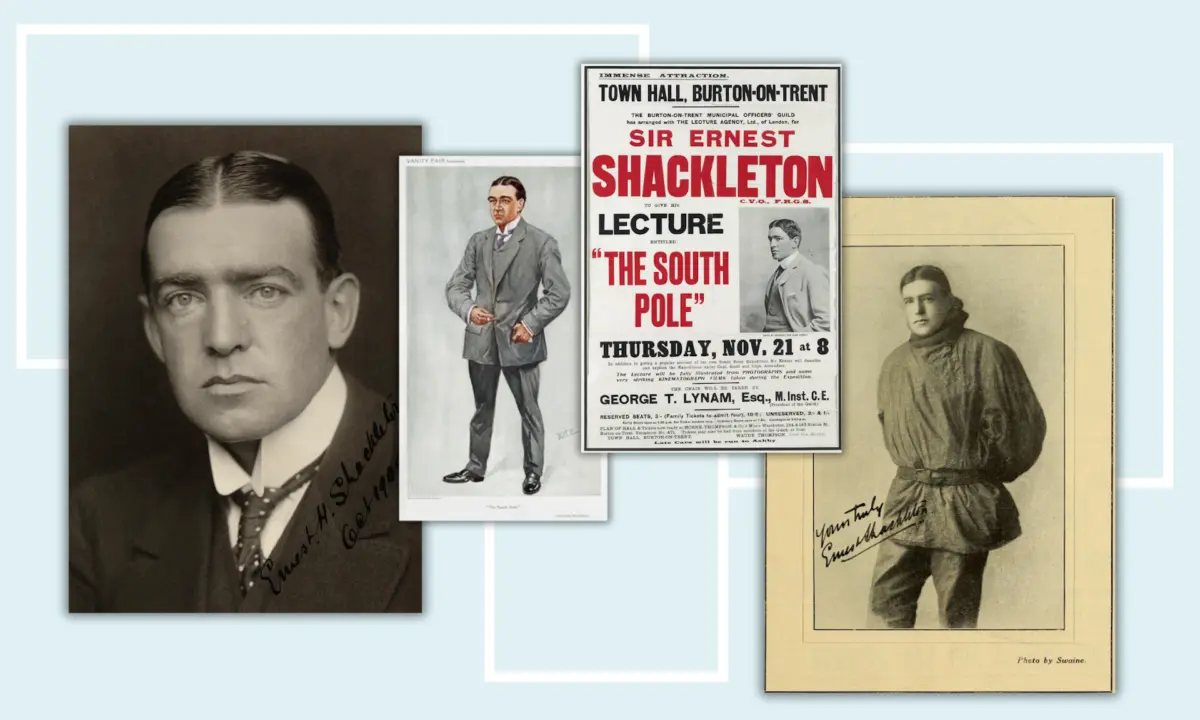
To the modern historical imagination, Sir Ernest Shackleton is immortalized as the titan of resilience—the unflinching leader who kept twenty-seven men alive for nearly two years after his ship, the Endurance, was crushed by pack ice in the Weddell Sea in November 1915. He is the archetypal master of crisis management, a polar folk hero whose legend rests entirely on endurance, ice, and supreme leadership under catastrophic conditions.
Yet, rewind the historical clock to 1995—or rather, 1895—and the future trajectory of this towering figure was completely invisible. At twenty-one years old, Shackleton was merely a nameless, junior officer in the British Merchant Navy, possessing zero connection to polar exploration, no scientific pedigree, and having never even strapped on a pair of skis.
How did an unremarkable, land-locked merchant seaman transform into one of the most famous polar explorers in human history?
The answer, as explored in the new book The Grip of the Ice, is both surprising and counterintuitive. Shackleton’s eventual legendary status was forged not solely by his exploits upon the frozen wastes of the Antarctic continent, but by what he engineered back home on the mainland. His transformation from an obscure junior officer into a national celebrity was an early masterclass in media manipulation, public relations, and opportunistic networking. It proves that long before he ever faced the crushing pack ice of the Weddell Sea, Shackleton understood how to turn a catastrophic professional setback into a triumphant public platform.
Detailed Chronology: From Merchant Navy to the Edge of the Unknown
1. The Accidental Explorer: Securing a Berth on the Discovery
Shackleton’s entrance into the elite world of polar exploration was hardly the result of a lifelong, singular ambition. In March 1901, the British National Antarctic Expedition—better known as the Discovery Expedition, jointly organized by the Royal Geographical Society and the Royal Society—was rapidly taking shape under the command of Captain Robert Falcon Scott.
The venture was heavily subsidized by the British government and wealthy donors. Shackleton, blessed with an intensely gregarious and charismatic personality, engineered his way into the expedition not through peerless scientific qualifications, but through social maneuvering. He befriended Cedric Longstaff, the son of one of the expedition’s principal financial backers.
That single connection yielded an invitation. On March 15, 1901, Shackleton was ordered to report to Robert Falcon Scott at the expedition’s headquarters in Mayfair, London. He was appointed as the ship’s third lieutenant, tasked with helping navigate the Discovery toward the bottom of the world.
2. The Antarctic Winter and the Birth of The South Polar Times
In January 1902, the Discovery arrived off the coast of Antarctica, initiating a grueling phase of coastline mapping and geological reconnaissance. As winter approached, the expedition locked the ship safely into the sea ice of McMurdo Sound.
Trapped for months in pitch-black polar darkness with temperatures plummeting far below freezing, morale among the crew quickly became a critical hazard. It was during this claustrophobic confinement that Shackleton proved his indispensable value to the team. Highly sociable and quick-witted, he took charge of crew morale, editing and curating The South Polar Times—notably recognized as the first magazine ever published on the Antarctic continent.
3. The Fateful Dash South: Pushing Toward the Pole
Recognizing Shackleton’s drive and interpersonal capability, Captain Scott selected him—alongside expedition zoologist and junior medical officer Dr. Edward Wilson—for the expedition’s flagship mission: a grueling overland sledge journey aiming directly for the South Pole.
On November 2, 1902, the trio departed the Discovery, accompanied by Siberian huskies intended to haul their heavy sledges. Initially, progress was rapid. Pushing across the vast, featureless expanse of the Great Ice Barrier, the men successfully broke records, traveling further south than any human beings in history.
However, the endeavor rapidly degraded into a logistical and biological nightmare:
The Canine Crisis: The expedition’s nutrition strategy for the Siberian huskies failed disastrously. The dogs rapidly weakened, starving on inadequate rations.
The Weight Burden: Due to the failing dogs, the men were forced to double-back, hauling loads in relay increments. This drastically slashed their daily distance gains.
Tensions in the Ranks: According to later correspondence from Albert Borlase Armitage, the expedition’s second-in-command, tensions between Scott and Shackleton reached a boiling point on the trail, with Scott reportedly branding Shackleton a "bloody fool" during a heated argument.
The Scurvy Scourge: By Christmas 1902, Dr. Edward Wilson identified ominous, bleeding gums among the party—classic signs of scurvy, a disease born of severe vitamin C deficiency.
Realizing catastrophe loomed, the trio turned back on December 31, 1902, having attained a "Furthest South" record of approximately 480 miles short of the geographical South Pole.
4. The Agonizing Retreat and Early Evacuation
The return journey to McMurdo Sound proved to be a physical trial of Dante-esque proportions. Shackleton’s health utterly collapsed. Wracked by scurvy, he was reduced to coughing up blood on the trail. With all of the sledge dogs dead, Scott and Wilson were forced to haul the sledges themselves, while Shackleton made agonizing progress on skis alongside them.
They finally stumbled back to the Discovery on February 3, 1903. To their surprise, a relief vessel named the Morning had arrived.
With the Discovery still inextricably locked in sea ice and another brutal winter fast approaching, Captain Scott made an executive decision: Shackleton was medically unfit to remain and must return to New Zealand aboard the Morning when it sailed north on March 2, 1903.
While Scott’s official references praised Shackleton’s work ethic, the decision ignited decades of historical debate. Polar historians have long argued over whether Scott viewed the ambitious, popular Shackleton as an incipient professional rival, though concrete evidence for malicious intent remains thin. Regardless of motivation, Shackleton was being sent home in disgrace, branded as medically broken.
Supporting Context & Metrics: The Anatomy of a Public Relations Triumph
The Psychology of Disappointment
Shackleton’s private diaries upon his return reveal an internal storm of frustration, acute embarrassment, and bitter disappointment. He had desperately wanted to endure a second winter on the ice and see the mission through to its ultimate geographical conclusion. To be cast aside as an invalid wounded his pride deeply.
Yet, upon arriving in New Zealand—and subsequently reaching London—observers noted that Shackleton appeared remarkably robust. Gerald S. Doorly, a junior officer on the relief ship Morning, noted that Shackleton appeared "practically well" by the time he hit port, and positively thriving by the time he docked in England.
The London Media Blitz
Rather than slinking into professional obscurity, Shackleton executed a masterclass in opportunistic public relations. Leveraging his unique status as the sole returning officer from the heart of the Antarctic interior, he held a monopoly on the narrative of the Discovery expedition.
Print Journalism: He immediately penned exclusive, widely syndicated features for high-profile publications including The Illustrated London News and Pearson’s Magazine.
The Lecture Circuit: He commanded packed auditoriums across Great Britain, captivating audiences eager for firsthand tales of frostbite, huskies, and the blinding white abyss of the South.
Logistical Influence: He directly involved himself in outfitting the subsequent relief whaling vessel, the Terra Nova, embedding himself deeper into the inner circles of British polar geography.
Institutional Advancement: By early 1904, his relentless networking secured him the prestigious post of secretary of the Royal Scottish Geographical Society.
In less than two years, the Discovery expedition had catapulted Shackleton from an anonymous merchant navy sailor into a darling of British society. More importantly, he had amassed an invaluable network of elite patrons, wealthy investors, and media contacts—laying the groundwork to launch his own independent expedition in 1907, much to the chagrin of Robert Falcon Scott.
Official Statements & Historical Perspectives
Reflecting on this foundational period in polar history, maritime historians emphasize that Shackleton’s greatest early skill was not navigation, but resilience in the public eye.
"Shackleton possessed an uncanny, almost preternatural ability to weaponize misfortune," notes polar historian and author Dr. Robert Henderson. "While lesser men would have accepted a medical discharge as a career-ending humiliation, Shackleton recognized that Victorian Britain hungered for imperial heroes. He packaged his suffering into a marketable commodity, transforming a personal medical disaster into a masterclass in personal branding."
In his seminal biographical work on early Antarctic exploration, historian Roland Huntford observed that the friction between Scott and Shackleton catalyzed a permanent shift in British exploration culture:
"The early return was the crucible of Shackleton’s ambition. Stripped of his role as a subordinate officer, he discovered his true calling: not as a follower of Scott’s rigid naval hierarchy, but as an independent commander who understood that public adoration was just as vital as rations and compasses."
Future Outlook: The Legacy of a Master Spin Doctor
Ernest Shackleton’s transformation from an uninitiated merchant seaman into a celebrated polar authority set a new standard for how scientific expeditions were funded, publicized, and consumed by the global public.
The lessons Shackleton learned in the drawing rooms of Mayfair, the editorial offices of The Illustrated London News, and the lecture halls of Victorian Britain informed every subsequent chapter of his career. When his own ship, the Nimrod, sailed south in 1907, and later when the Endurance met its icy doom in 1915, Shackleton was not merely an explorer navigating by sextant; he was a master storyteller acutely aware of his audience back home.
As modern historians continue to unearth the complex political and social underpinnings of the Heroic Age of Antarctic Exploration, Shackleton’s early years stand as proof of a singular truth: polar survival required more than physical endurance against the ice. It demanded an ironclad resilience against professional failure, and the vision to turn a disaster on the southern ice cap into a triumph on the mainland stage.