For over two decades, Native Instruments’ Absynth has occupied a legendary, if somewhat esoteric, corner of electronic music production. Revered by cinematic sound designers, ambient composers, and experimental electronic artists, the semi-modular software synthesizer was universally celebrated for its sprawling, evolving pads, otherworldly timbres, and a capacity for complex, long-form sound design that few instruments could match. However, its reputation was historically tethered to the ethereal and the abstract. Techno producers, seeking punchy transients, tight rhythmic modulation, and aggressive low-end crunch, traditionally bypassed Absynth in favor of workhorses like Serum, Massive, or dedicated acid emulators.
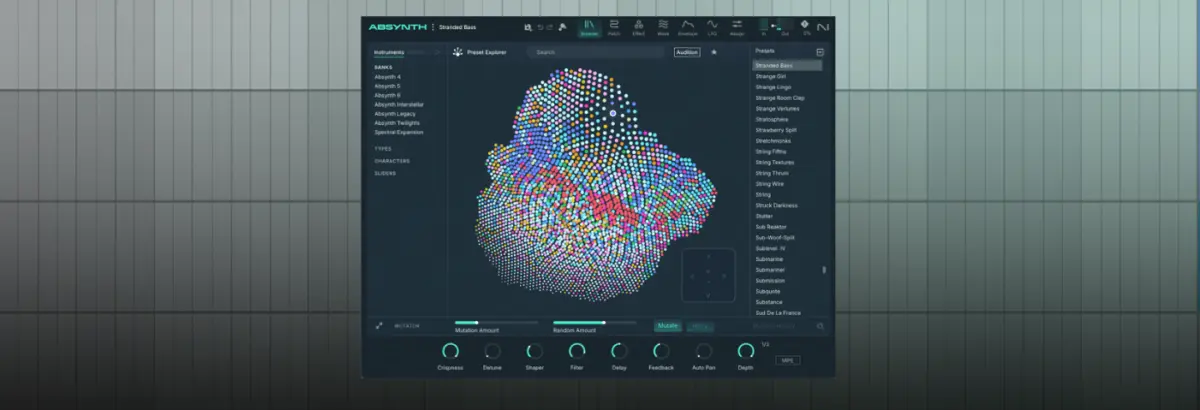
That paradigm has shifted dramatically with the arrival of Absynth 6, featured prominently within Native Instruments’ sweeping Komplete 26 bundle. This latest iteration represents the most powerful and structurally overhauled version of the synth in its history. While retaining its foundational DNA—the multi-stage envelopes and deep modulation matrices that made early iterations famous—Absynth 6 has been aggressively modernized. It now boasts a overhauled Granular Engine with a maximum density of 32, a suite of Moog-modeled Ladder filters, the lush, cavernous Aetherizer effect, and a revamped Loop section.

Rather than positioning Absynth 6 merely as an ambient soundscape generator, this technical deep dive explores its newfound versatility. By taking a single, unassuming audio source—a one-shot sample of a Peking Opera Gong—we unpack a step-by-step masterclass in how to weaponize Absynth 6’s architecture. Over ten meticulous stages, an expansive, cinematic noise texture is systematically fractured, rhythmically locked, detuned, and filtered into a complete, hard-hitting, performance-ready techno groovebox patch capable of anchoring a contemporary club track.
Detailed Chronology: From Single Gong Sample to Peak-Time Acid Riff
Transforming an organic, unpitched percussion hit into a driving, multi-layered techno sequence requires a systematic approach to sound design. By leveraging Absynth 6’s multi-engine architecture, producers can split a single sample across multiple channels, treating each with distinct synthesis parameters, rhythmic envelopes, and filtering techniques.

Step 1: Initialization and the Granular Foundation
The process begins inside your DAW at a driving 129 BPM. After instantiating Absynth 6 and programming a tight, hypnotic MIDI pattern, auditioning the default patch yields a sterile, uninspired sine wave. To break away from conventional synthesis, navigate to the Patch tab, jettison the default oscillator, and load up the Granular Engine, supplying a single, raw Peking Opera Gong one-shot as the foundational sample source. While the initial result lacks punch, it establishes the harmonic raw material required for subsequent degradation.
Step 2: Pitch Transposition and Granular Density
A raw gong hit sounds spacious and ambient, but it is a far cry from club-ready techno "filth." To remedy this, transpose the sound down by 12 semitones (one full octave) to anchor it in a heavier register. Next, dive into the Grain tab and compress the grain size down to an aggressive 3ms.

This is where Absynth 6’s overhauled Granular Engine truly flexes its muscles. By pushing the maximum density parameter all the way up to its new ceiling of 32, the individual grains overlap into a dense, buzzing wall of sound. To understand the magnitude of this upgrade, dropping the density parameter back down to 4 reveals a thin, limp, and disjointed texture—highlighting how crucial the new engine’s processing headroom is for modern bass design.
Step 3: Pumping Envelopes and Acid LFO Modulation
Absynth has always derived its secret sauce from its advanced envelope architecture. Envelopes in Absynth are not confined to simple amplitude shaping; they can dynamically govern pitch, filter cutoffs, effects sends, and modulation depths across multiple custom stages.

To introduce rhythm, click Osc A Amp, access the Transform menu, select Expand to Rhythm, and engage BPM Sync. Next, generate a new envelope assigned to Osc A Main Pitch, activate the LFO button, and drag the first envelope breakpoint all the way down. Instantly, an internal ducking pump interacts with volatile pitch modulation, transforming the static gong texture into a pulsing, unmistakable acid bassline.
Step 4: Fine-Tuning the Acid Line
With the core rhythm established, navigate to the LFO page. To isolate the pitch modulation solely to Channel A, deselect channels B and C from the LFO’s modulation routing.

Next, dial in precise numerical values: raise the Pitch slider to 25, the time parameter to 1.6919, and the phase to 32.063. These micro-adjustments introduce unstable, wobbly pitch fluctuations punctuated by sharp, acidic transient spikes. The resulting output bridges the gap between classic analog squelch and modern digital sound design.
Step 5: Sculpting with Moog-Modelling Ladder Filters
No acid-leaning patch is complete without aggressive filtering. Absynth 6 introduces a stellar suite of Moog-modeled Ladder filters that bring authentic analog warmth and self-oscillation characteristics to the digital domain.

Layer two distinct filters onto the signal chain:
- Ladder Band-Pass (BP): Set to a cutoff of 542.92, which aggressively isolates and highlights the boxy, nasal acid mid-range.
- Ladder Low-Pass (LP): Set to 500.56, with the resonance cranked up to 43.875.
This dual-filter configuration clamps down on unruly high frequencies while injecting a wet, self-oscillating squeal into the resonant peaks.

Step 6: Layering and Rhythmic Retriggering (Channel B)
A truly compelling techno riff requires internal counterpoint and rhythmic interplay. Open Channel 2, load another Sample Engine powered by the same Peking Opera Gong sample, and transpose this second layer down a full two octaves (24 semitones) to occupy the sub-bass frequencies. Temporarily mute Channel A to audition Channel B in isolation.
Navigate to the Envelope section for Osc B Amp, apply the Expand to Rhythm function once more, and switch the envelope mode to Retrigger.

Step 7: Syncopation and Groove
To inject bounce, pull the beat length/timing down to 0.250, creating a rapid, syncopated, delay-like stutter. Next, grab the lower of the two pink breakpoint circles within the envelope display and drag it leftward to align with the start of the second envelope spike.
This instructs Absynth to rhythmically retrigger the amplitude envelope in rapid succession until the second and third MIDI notes trigger, at which point the retriggering halts, allowing the full envelope cycle to play out. The result is an infectious, driving groove that breathes life into the sequencer.

Step 8: Spatially Enriching with the Aetherizer
Absynth 6 features an upgraded iteration of its legendary Aetherizer effect—a granular delay and spectral resonator capable of turning audio into shimmering clouds of sound. Rather than feeding the Master signal into the effect, isolate the input so it feeds exclusively from Channel B.
Push the Feedback parameter up to 75 and set the Wet/Dry mix to approximately 0.562. Assigning this wet parameter to a hardware macro allows for real-time sweeps during a live performance. With the Aetherizer processing Channel B independently, bring Channel A back into the mix to hear how the pristine, aggressive low-end coexists with the upper-frequency spectral haze.

Step 9: The Third Layer and Advanced Looping
For the final sonic layer, instantiate a third Sample Engine on Channel C, once again utilizing the Peking Opera Gong sample. Mute Channels A and B momentarily to evaluate Channel C alongside an external tech-house drum loop.
Access Absynth 6’s newly overhauled Loop section, establishing a loop start point of 5600 and an end point of 12644. This slices the sample into a frantic, syncopated stutter loop that maintains the fundamental pitch of the main riff while injecting rolling, microscopic micro-repeats. Unmuting the preceding layers yields a massive, wall-of-sound patch defined by interlocking polyrhythms and evolving timbres.

Step 10: Performance Balance and Live Jamming
The final step is purely artistic: balancing the relative volumes of Channels A, B, and C. Because each layer has been designed to function both independently and cohesively, mapping macro controls to individual channel levels and the Aetherizer wet amount turns Absynth 6 into an elite, standalone live-jamming groovebox. A single percussion sample has officially been evolved into a self-contained techno performance system.
Supporting Context & Metrics: The Architectural Evolution of Absynth 6
To fully appreciate the scope of this sound design exercise, one must examine the technological leaps embedded within Komplete 26. Absynth was originally conceived by Wolfgang Schneider in the early 2000s and acquired by Native Instruments in 2004. For years, it maintained a cult following due to its unique semi-modular architecture, which combined wave terrain synthesis, granular processing, and exceptionally deep envelope generators. However, as DAW standards shifted toward multi-core optimization, high-definition graphical interfaces, and low-latency performance, legacy versions of Absynth languished, eventually being retired from the active Native Instruments catalog.
The resurrection of the platform in Absynth 6 marks a watershed moment for software instrument design. Key structural metrics and enhancements include:
- Granular Engine Density: Expanded from a historic maximum of 4 voices/grains to an industry-leading 32-voice density, allowing for ultra-smooth time-stretching, cloud generation, and aggressive harmonic smearing without digital artifacts.
- Filter Architecture: Integration of zero-delay feedback (ZDF) ladder filters modeled directly on classic analog hardware topologies, providing nonlinear saturation and self-oscillation characteristics previously unattainable in native software.
- Envelope Resolution: Continued refinement of Absynth’s iconic breakpoint envelopes, supporting up to 68 segments per envelope with freely drawable curves, tempo-sync capabilities, and multi-destination modulation mapping.
- Spectral Processing: Upgrades to the proprietary Aetherizer and Mutator effects blocks, optimized for modern CPU architectures to handle high-feedback granular delay networks without performance choking.
Official Statements and Industry Reception
The inclusion of Absynth 6 in Komplete 26 has generated significant discussion across music technology circles. Speaking on the design philosophy behind the revival, Native Instruments’ lead software architect noted:

"When we evaluated the legacy of Absynth, we recognized that producers weren’t just looking for nostalgia—they were looking for tools that defy predictable synthesis models. Modern techno and electronic music production demands sound design that is simultaneously aggressive and organic. By rebuilding Absynth’s granular engines and filter pathways from the ground up, we didn’t just preserve a classic synthesizer; we gave modern producers an unpredictable, high-performance rhythm engine disguised as an ambient machine."
Industry sound designers and modular synth specialists have similarly praised the update. Early adopters emphasize that Absynth 6 bridges the gap between the chaotic, happy-accident workflow of modular hardware and the recallable precision of software plugins. By demonstrating that a single acoustic percussion sample can be morphed into an acid-tinged, multi-layered techno sequence, tutorials like this challenge the industry-wide reliance on standard wavetable and subtractive synthesis presets.

Future Outlook: The Resurgence of Deep-Architecture Sound Design
As electronic music production trends cycle away from static, highly processed sample packs toward bespoke, generative sound design, instruments with deep modulation matrices are experiencing a profound renaissance. Absynth 6 arrives at a critical juncture where producers are actively seeking antidote solutions to cookie-cutter virtual instruments.
The ability to treat a software synthesizer as an interactive laboratory—where a single sound source can be split across three independent granular channels, processed through analog-modeled filters, and fractured via complex multi-stage envelopes—cements Absynth 6’s place at the bleeding edge of modern production. Whether utilized for film scoring, heavy industrial soundscapes, or peak-time warehouse techno, Absynth 6 proves that deep-architecture synthesis is more relevant than ever. For producers looking to elevate their sonic palette, diving into the granular depths of Komplete 26 is no longer optional—it is an essential masterclass in electronic composition.