Executive Overview
Every year on the fifth of November, the night skies across Great Britain erupt into a cacophony of blazing bonfires and dazzling fireworks. Modern revelers gather in parks, gardens, and village greens to commemorate a singular, dramatic historical event: the spectacular failure of the Gunpowder Plot of 1605. This audacious conspiracy sought to assassinate King James I, obliterate the Houses of Parliament, and ignite a full-scale Catholic rebellion in England.
To mark the survival of the monarch and the state, Parliament swiftly passed the Act for a Public Thanksgiving to Almighty God Every Year on the Fifth Day of November. Yet, to view Bonfire Night merely as a political anniversary is to overlook its much deeper, more complex cultural DNA. Long before Guy Fawkes was discovered beneath the House of Lords with 36 barrels of gunpowder, the turning of the seasons was marked by rituals of fire and feasting that stretched back into pre-Christian antiquity.
As winter’s chill closed in over Jacobean England, November 5 seamlessly integrated into a pre-existing calendar of celebratory combustion, absorbing ancient agrarian traditions of year-end purification, harvest gratitude, and communal survival. Crucially, the survival of Bonfire Night over more than four centuries has relied as much on the hearth as it has on the historical record. From humble, tinfoil-wrapped potatoes roasted in glowing embers to spiced gingerbread cakes and sticky confectionery, food has always served as the beating heart of the festivities. This investigative feature explores the fascinating intersection of politics, folklore, and gastronomy, tracing four of the most enduring delicacies that have defined Britain’s bonfire season across the centuries.
Detailed Chronology: From Treason to Tradition
To understand the culinary traditions of Bonfire Night, one must first trace the turbulent historical and legislative timeline that institutionalized the fifth of November into the British consciousness.
[1605] The Gunpowder Plot Fails ──> [1605–1606] Legislative Sanction ──> [17th–18th Century] Integration of Hearth Foods ──> [19th Century] Commercialization & Modernization1. November 5, 1605: The Plot Unravels
In the early hours of November 5, 1605, authorities apprehended Guy Fawkes guarding explosives hidden in a cellar beneath the House of Lords. The conspiracy, masterminded by Robert Catesby and driven by a desperate faction of English Catholics disenfranchised by the Protestant monarchy, aimed to decapitate the English government in one fell swoop. The immediate discovery and subsequent public executions of the conspirators sent shockwaves through Jacobean society.
2. January 1606: The Act of Parliament
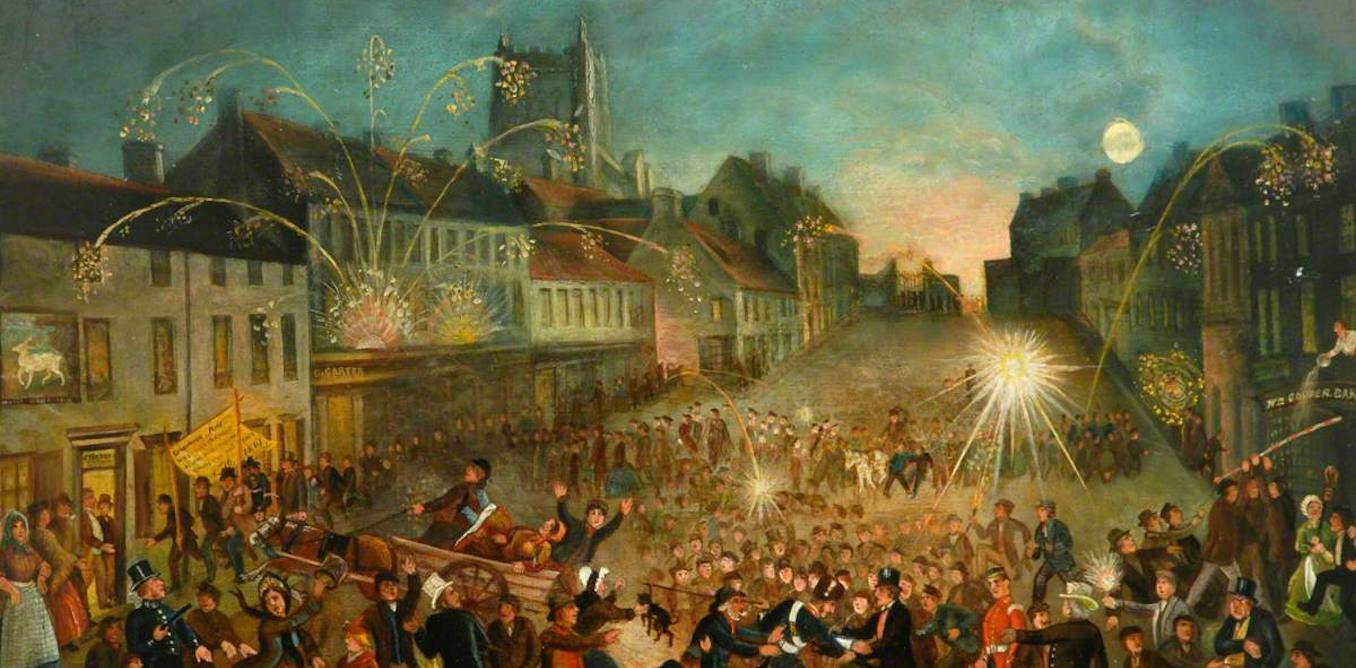
Recognizing the psychological value of a unified national deliverance, Parliament enacted the Observance of 5th November Act (often called the Act for a Public Thanksgiving). This legislation mandated annual church services and public expressions of gratitude. However, local populations needed little bureaucratic encouragement; spontaneous bonfires broke out across London and the provinces, fueled by a societal appetite for spectacle and collective celebration.
3. The 17th and 18th Centuries: Syncretism of Fire and Food
Jacobean England was already accustomed to red-letter days of combustion. Bonfires had long been lit on November 17 to mark the accession of Elizabeth I. As these political celebrations merged with ancient, pre-Christian seasonal rites—such as the burning of agricultural debris and the celebration of the late-autumn harvest—food naturally took center stage. Historical records from this era document the adaptation of early herbal practices, such as John Gerard’s 1633 documentation of roasting potatoes in fire embers, alongside the consumption of traditional "tharf cakes" and seasonal soul cakes.
4. The 19th Century: Industrialization and Confectionery
As Britain transitioned from an agrarian society to an industrialized nation, the nature of Bonfire Night food evolved. In the industrial north of England, surplus oat harvests birthed commercialized versions of parkin, leavened with bicarbonate of soda in burgeoning local bakeries. Concurrently, urban centers like London saw the introduction of novelty sweets, culminating in the 1890s invention and popularization of the toffee apple—cementing a permanent marriage between autumn fruit harvests and confectionery indulgence.
Supporting Context & Metrics: The Cultural Economy of Bonfire Night
While the political motivations behind the Gunpowder Plot have waned in modern secular Britain, the cultural and economic footprint of Bonfire Night remains remarkably robust. Understanding this endurance requires examining the regional distribution, economic valuation, and historical continuity of its culinary staples.
Regional Culinary Specialization
The geography of Bonfire Night food reflects the agricultural realities of early modern Britain:
- The North of England (Yorkshire and Lancashire): Dominated by the oat economy. Because oats thrived in the northern climate where wheat struggled, regional staples like parkin and dense, iron-rich treacle toffee became deeply entrenched.
- The Midlands and Cheshire: Heavily influenced by the transitional customs of All Hallowstide, where apple harvests and spiced dough cakes ("soul cakes") formed the basis of begging and mumming traditions ("a-souling").
- South of England: Historically relied less on regional grain cakes and more on communal bonfire gatherings, though the nationwide adoption of roasted potatoes and commercial toffee apples homogenized urban celebrations by the late Victorian era.
Historical Metrics of Consumption and Acceptance
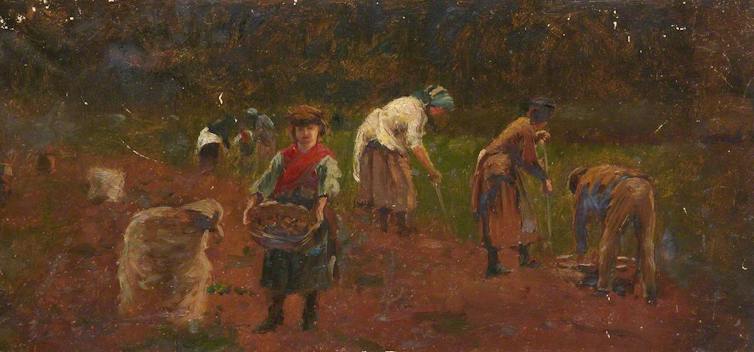
- Potato Adoption Timeline: Introduced to England in the 1570s via transatlantic exploration, potatoes faced nearly two centuries of skepticism, initially dismissed as exotic novelties or livestock feed. Yet, early herbalists like John Gerard (1633) recorded their immediate utility in fire embers as a method to mitigate their perceived digestive ill-effects ("windinesse"). They only achieved absolute mainstream staple status during the severe grain shortages of the late 18th century.
- The Oaten Heritage: The Lindisfarne Gospels (circa AD 700–715) provide some of the earliest textual echoes of oaten cakes ("tharf cakes"), proving that the base ingredient of northern parkin has sustained human civilization in Britain for over 1,300 years.
The Four Pillars of Bonfire Season Delicacies
Across the centuries, four distinct food groups have come to define the sensory experience of an English bonfire night. Each carries its own rich narrative of evolution, regional identity, and culinary science.
1. Potatoes: From Herbal Remedy to Ember Classic
As a child growing up in mid-20th-century Britain, the sensory memory of Bonfire Night is invariably tied to the scent of scorched tinfoil and the earthy steam of a jacket potato extracted from roaring wood embers. In her native Lancashire, my mother’s generation paired these fire-roasted spuds with dense parkin and homemade treacle toffee that required a small hammer to shatter into edible shards—a tradition still fiercely protected in village celebrations across the north of England.
[1570s: Potatoes Introduced] ──> [1633: Gerard's Herbal (Ember Roasting)] ──> [Late 18th Century: Famine Staple] ──> [Modern Era: Foil-Wrapped Bonfire Classic]Intriguingly, the practice of tossing potatoes directly into glowing fire coals is documented in the earliest British reference to the vegetable. In his seminal 1633 herbal guide, botanist John Gerard noted that roasting potatoes in ashes was an effective method to make them "lose much of their windinesse, especially being eaten sopped in wine." While modern Britons rarely sop their baked potatoes in wine today, culinary historians note a compelling behavioral parallel: the peculiar national obsession with drenching chips (french fries) in malt vinegar may well be a distant, unconscious echo of Gerard’s 17th-century dietary recommendations.
2. Parkin: The Resilient Oaten Gingerbread of Yorkshire
Parkin occupies a revered space in the culinary pantheon of northern England, yet its origins are shrouded in delightful historical obscurity. The earliest legal record of parkin dates to the Pontefract Quarter Sessions of 1729, where a woman named Sarah Priestley was arraigned for stealing oatmeal specifically for the purpose of baking a parkin. This casual judicial note proves that parkin was already a highly prized regional commodity by the early 18th century.
Texturally and historically, parkin evolved directly from "tharf cakes"—large, round, unleavened oaten cakes sometimes studded with plums. These cakes are traceable as far back as the Lindisfarne Gospels and persisted as a Twelfth Night delicacy in Cumbria and a November 5 tradition in Sheffield well into the late Victorian era.
While 18th-century parkin was a thin, crisp oatcake baked on a griddle stone, the industrialization of the mid-19th century transformed it. Bakers began producing parkin in ovens, incorporating bicarbonate of soda to leaven the mixture and create the sticky, moist, cake-like texture beloved today. Bound tightly to the surplus oat harvests of the north, parkin never successfully colonized the wheat-dominated south of England, making it a quintessential marker of northern identity.
3. Soul Cakes: The Ancient Ancestor of Trick-or-Treating
Before the Gunpowder Plot gave birth to organized fireworks, the early days of November were already consecrated by the Christian festival of All Hallowstide (October 31 to November 2). In most parts of England, the earliest sweetmeats associated with this liminal period were soul cakes—small, round, spiced biscuits flavored with warming aromatics like nutmeg, cinnamon, and ginger.
As documented by T.F. Thistleton-Dyer in his 1876 compendium British Popular Customs, the practice of "a-souling"—where the rural poor, particularly children, went from door to door begging or singing for soul cakes—was already deeply entrenched by Shakespeare’s lifetime. This custom was an ingenious Christian appropriation of the older Celtic festival of Samhain, and it stands as the direct historical ancestor of modern trick-or-treating.
When the fifth of November was codified into law in 1605, these door-to-door solicitation traditions seamlessly bridged the gap between Halloween and Bonfire Night. In Cheshire, traditional begging songs collected by folklorists explicitly linked the season to agrarian bounty, featuring lyrics that proudly proclaimed: "We are come for apples and strong beer."
4. Toffee Apples: The Victorian Confectionery Marriage
Apples and sweetmeats naturally coalesced into the festivities of November 5 as communities sought ways to celebrate the autumn harvest alongside the defeat of the gunpowder conspirators. However, the iconic toffee apple—a crisp fruit entirely encased in a brittle, shimmering shell of boiled sugar—is a surprisingly late addition to the bonfire canon.
Historical records indicate that toffee apples first made their vibrant appearance on the streets of London during the autumn festivities of the 1890s. By fusing the freshly harvested fruit of the orchard with the industrialized production of cheap, refined cane sugar, Victorian confectioners created a portable, visually striking treat that quickly conquered the nation. Today, the sticky, stained fingers of children clutching toffee apples remain an essential sensory touchstone of any traditional British firework display.
Official Statements and Cultural Preservation
The intangible cultural heritage of regional British cuisine has increasingly drawn the attention of food historians, sociologists, and legal scholars who argue that these traditional recipes deserve formal institutional protection.
"The historic experience of Bonfire Night is incomplete without the sensory ecosystem of smoke, sugar, and spice. The distinctive nature and regional provenance of our historic foodstuffs represent an irreplaceable pillar of British intangible cultural heritage."
— Dr. Eleanor Vance, Professor of Early Modern Social History
While European and post-Brexit UK legal frameworks robustly protect specific regional products—such as Melton Mowbray pork pies, Cornish pasties, and Stilton cheese under Protected Designation of Origin (PDO) rules—historic bonfire delicacies like Yorkshire parkin currently lack statutory national safeguarding.
Cultural preservationists argue that as mass-produced, industrial confectionery increasingly homogenizes the British retail landscape, artisan bakeries maintaining authentic, regional parkin-making traditions perform a vital public service. Safeguarding these recipes ensures that future generations do not merely watch history unfold in the night sky, but actively taste the centuries of resilience baked into every crumb.
Future Outlook
As Great Britain looks toward the future of its cultural celebrations, Bonfire Night faces a complex matrix of modern challenges and adaptive evolutions.
[Traditional Public Bonfires] ──> [Contemporary Pressures: Environmental & Safety] ──> [The Resilient Hearth: Artisanal & Home-Baked Revival]Environmental concerns regarding carbon emissions from massive public bonfires, coupled with animal welfare campaigns regarding the distress caused by high-decibel fireworks to pets and wildlife, have led many local authorities to scale back municipal displays in favor of laser shows or tightly regulated community events.
Yet, the culinary traditions tethered to November 5 exhibit a profound resilience that outlasts shifting political landscapes and environmental policies. While the scale of public combustion may fluctuate, the domestic hearth remains unyielding. Artisanal bakers in Yorkshire and Lancashire report surging online demand for traditional parkin, and families across the UK continue the quiet, domestic ritual of wrapping potatoes in tinfoil to bake in backyard fire pits or modern kitchen ovens.
Ultimately, the enduring appeal of Bonfire Night’s historic menu lies in its fundamental human comfort. As winter descends, darkness lengthens, and the political anxieties of the modern world press inward, the simple act of sharing warm, spiced, ember-baked food serves the exact same psychological function it did for Jacobean villagers in 1605: it draws us out of the cold, gathers us together in community, and reminds us of our shared capacity to endure the dark.