In a landmark cultural event for the United Kingdom, the Dulwich Picture Gallery in London has opened its doors to a monumental exhibition that brings together, for the first time in British history, the complete Thirty-six Views of Mount Fuji by the legendary Japanese ukiyo-e artist Katsushika Hokusai. Created during the artist’s seventies in the early 1830s—a period of astonishing late-career productivity—the series originally comprised thirty-six prints, to which ten more were later added due to overwhelming commercial success.
Hokusai conceived these works not as elite fine art, but as inexpensive, mass-produced woodblock prints intended for ordinary citizens in Edo, modern-day Tokyo. Today, this rare assembly from the esteemed Iuchi Collection offers contemporary audiences a profound meditation on perspective, scale, and human psychology.
Beyond celebrating a pinnacle of Japanese printmaking, the exhibition invites a deeper psychological inquiry. Through the lens of art psychotherapy, the series serves as a powerful mirror reflecting how human beings construct meaning, project assumptions onto others, and grapple with the concept of scale in an overwhelming universe. As visitors navigate the dusky blue galleries—experiencing everything from the world-famous The Great Wave off Kanagawa to intimate depictions of travellers, pilgrims, and towering landscapes—they are challenged to look past singular icons and appreciate the interconnected nature of both art and human experience.
Detailed Chronology & Exhibition Journey
The Genesis of a Masterpiece (1830–1833)
Between 1830 and 1833, Katsushika Hokusai, then well into his seventies, embarked on what would become his defining masterwork. At an age when many contemporaries had retired, Hokusai revolutionized landscape printmaking by shifting the focus from traditional courtly or mythical subjects to the everyday lives of Japanese people, all anchored by the towering, immutable presence of Mount Fuji.
Printed using cheap, accessible woodblock techniques, these sheets were distributed widely across Edo. They captured the imagination of travellers, merchants, and labourers alike. The current exhibition at the Dulwich Picture Gallery traces this historical sequence, allowing modern viewers to traverse the Japanese landscape precisely as Hokusai intended it to be experienced: cumulatively, contextually, and dynamically.
Room One: Establishing Form and Variation
The journey begins in the opening gallery, where curators have boldly grouped three distinct variations of Mount Fuji side by side. This curatorial choice immediately deconstructs the singularity of the icon.
- Red Fuji (Clear Day with a Southern Breeze): Here, the mountain is rendered as an almost pure, lustrous red form resonating powerfully against a receding blue sky. Subtle clouds align in an almost humorous formation, while near the peak, delicate creases of snow catch the eye. At the foot of the mountain, a multitude of tiny trees mass together in a visual chorus. These minute details transform the picture: the great mountain becomes fully realized only in relation to its surrounding ecosystem.
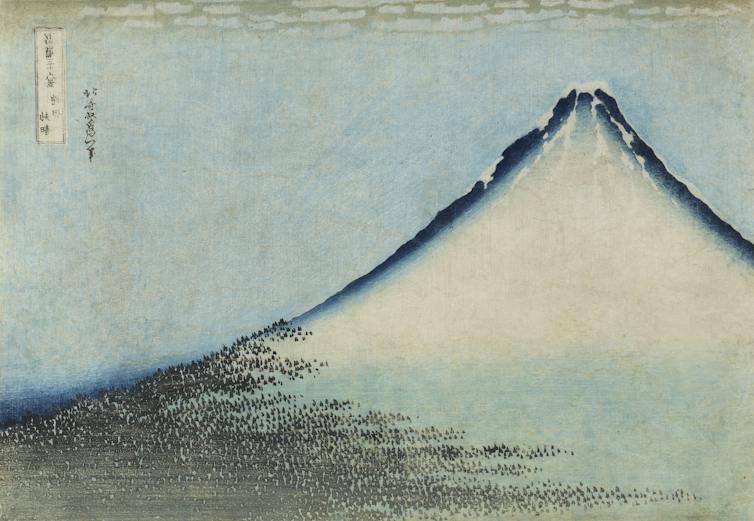
- The Light Blue Variant: A softer atmospheric take, featuring a ridge edged in heavy indigo, inviting the viewer’s eye deep into the geological anatomy of the peak.
- The Dark Variant: A more unsettled, dramatic composition featuring lightning-like cracks reminiscent of a fractured ceramic vessel.
Confronting the Icon: The Great Wave
Hanging on the opposite wall is arguably the most recognizable image in global art history: Under the Wave off Kanagawa, universally known as The Great Wave. Encountered within the context of the wider series, however, it ceases to be an isolated masterpiece and becomes merely one view among many.
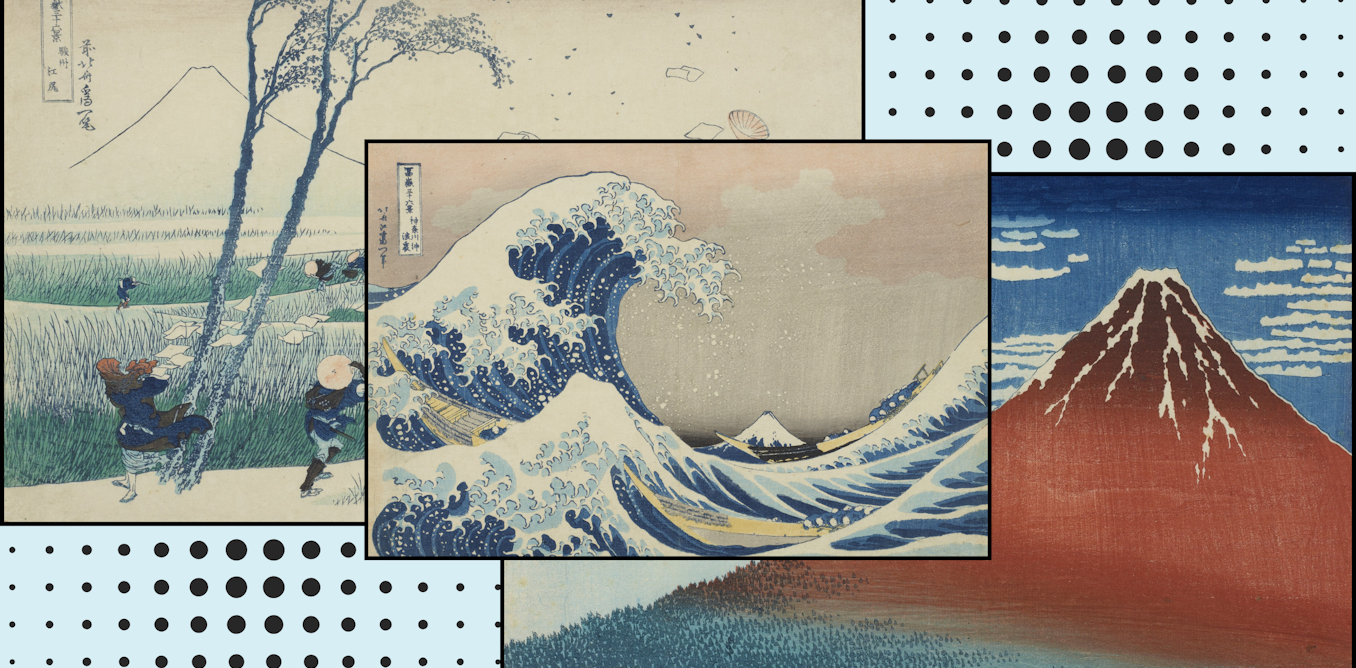
The foam of the wave reaches out like grasping, knuckled fingers, while white spray flecks scatter across the dark water like distant stars. Despite depicting violent motion, the print maintains an eerie, profound stillness. Nestled beneath the towering wave is Mount Fuji once more—rendered as a tiny, distant triangle compared to its expansive dominance in Red Fuji. It is the same sacred mountain, but radically reframed by the vast, indifferent power of the sea.
The Middle Rooms: Daily Life and Intersecting Geometries
As the exhibition progresses through subsequent galleries, visitors encounter the bustling fabric of Edo-period society. Ordinary people hurry over arched bridges, toil in agricultural fields, and journey along winding mountain roads. Hills wear patterned bandanas of farmland, while Prussian blue skies fade into soft, feathered edges.
Hokusai plays playfully with geometry and shape. In one instance, three humble haystacks echo the three small peaks of Fuji’s summit. The artist consistently positions the viewer in an interstitial space—looking down upon human activity while gazing up at the celestial expanse, yet never granting an omniscient vantage point that reveals everything.
In the third room, a specific print arrests the attention of many visitors: Mishima Pass in Kai Province. The image depicts travellers linking arms around the girth of an enormous, ancient tree. To the casual observer, it reads as an affectionate, communal embrace. Upon closer historical and contextual inspection, however, one learns that these strangers are likely engaged in a pragmatic act: measuring the tree’s massive circumference. This sudden realization highlights a fundamental cognitive bias—how rapidly human beings project their own emotional narratives onto strangers.
The Ascent: Pilgrims and the Climax of the Series
As the exhibition reaches its conclusion, the perspective shifts dramatically. Viewers no longer gaze at Mount Fuji from a geographic or psychological distance. Instead, the final prints depict pilgrims actively climbing into the very fabric of the mountain.
Rendered with a rhythmic repetition that evokes frames of an early stop-motion film, these figures merge into a collective movement. Near the summit, they crowd tightly into a rock shelter—a poignant, intimate window into a shared trial that no single individual could master alone. The exhibition thus completes its arc: moving from distant admiration of an iconic landmark to an immersive, human-scale participation in the journey itself.
Supporting Context & Metrics
| Exhibition Detail | Fact / Figure |
|---|---|
| Venue | Dulwich Picture Gallery, London, UK |
| Collection | The Iuchi Collection (on deposit at The National Museum of Western Art, Tokyo) |
| Timeframe | Created between 1830 and 1833 (Hokusai in his 70s) |
| Total Prints | All 46 prints (36 original views + 10 later additions) |
| Historical Milestone | The first, and potentially only, time the complete series is exhibited together in the UK |
| Closing Date | January 17, 2027 |
Psychological Implications and the Science of Awe
The encounter with Hokusai’s work offers fertile ground for psychological analysis, particularly regarding the concept of mentalising—the psychological term for our innate capacity to imagine the internal mental and emotional states of others. As demonstrated by the misinterpretation of the figures measuring the tree in Mishima Pass, humans constantly default to internal projections rather than objective inquiry.
Furthermore, Hokusai’s monumental depictions of nature evoke what psychologists define as the "awe response." Psychological studies, such as research examining human reactions to towering eucalyptus trees, indicate that experiences of awe diminish self-absorption, foster prosocial behavior, and heighten an individual’s sense of connection to a broader community. While a paper print cannot physically alter human behavior, exposure to vast spatial compositions and humbling natural scales encourages viewers to step outside their egocentric frameworks, rendering them more receptive to the perspectives of others.
Official Statements & Curation Perspectives
Curatorial choices within the exhibition have sparked nuanced discussions regarding museum design and audience engagement. While the gallery walls are painted in dusky, atmospheric blue tones designed to echo Hokusai’s signature Prussian blue pigments, some critics have noted that the strict separation of prints can occasionally feel overly rigid.
Art critics and contemplative visitors have observed that fixing each picture within isolated frames risks treating the series as a disconnected anthology of highlights rather than an organic, flowing continuum. Nevertheless, the deliberate manipulation of lighting establishes a quiet, meditative temple-like silence within the galleries, allowing viewers to commune directly with the quiet majesty of Hokusai’s vision.
Reflecting on the overarching impact of the exhibition, museum educators emphasize the revolutionary nature of Hokusai’s democratic approach to art. By producing affordable prints for the masses, Hokusai democratized landscape aesthetics, ensuring that the sublime beauty of nature and the dignity of daily labor were accessible not merely to shoguns and elites, but to the ordinary citizens of Edo.
Future Outlook
The exhibition Hokusai: Thirty-six Views of Mount Fuji from the Iuchi Collection remains on display at the Dulwich Picture Gallery in London through January 17, 2027. Given the extreme rarity of gathering this complete, fragile series—lent by the Iuchi Collection via the National Museum of Western Art in Tokyo—this event represents a once-in-a-generation milestone for British cultural institutions.
Looking forward, the exhibition is expected to profoundly influence how international museums approach the display of serialized graphic art, moving away from isolated masterpiece syndroming toward holistic, contextual curation. For contemporary audiences navigating an increasingly fractured and hyper-individualistic digital landscape, Hokusai’s timeless exploration of scale, community, and shifting perspectives offers an enduring antidote: a reminder that our personal viewpoint is merely one slice of a vast, interconnected human landscape.