Executive Overview
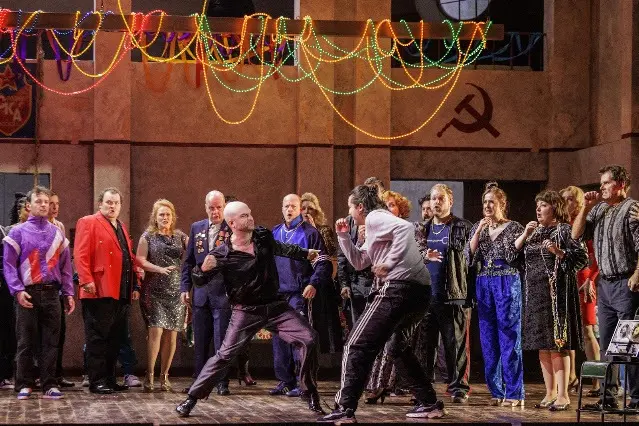
Opera North’s newly minted co-production of Tchaikovsky’s Eugene Onegin opened at the Leeds Grand Theatre on October 24, 2026, drawing immediate critical attention for its audacious directorial premise. Directed by Patrick Nolan—Artistic Director of Opera Queensland—and conducted by Garry Walker, the production boldly relocates Alexander Pushkin’s timeless narrative from the 1820s aristocracy to the turbulent sociopolitical landscape of late-20th-century Russia, stretching from the twilight of the Brezhnev era through Gorbachev’s perestroika and into the chaotic rise of the oligarchs in 1991.
Developed as a collaborative venture between Opera North, Irish National Opera, and Opera Queensland, the mounting features a striking creative team, including set designer Leslie Travers, costume designer Elizabeth Gadsby, lighting designer Malcolm Rippeth, choreographer Maxine Braham, and fight director Enric Ortuño. Musically and vocally, the production triumphs. Bolstered by a stellar cast led by John Brancy as Onegin, Verity Wingate as Tatyana, and Caspar Singh as Lensky, alongside a formidable orchestra under Walker’s baton, the evening delivers transcendent vocal and instrumental artistry.
However, Nolan’s conceptual framing proves deeply contentious. By discarding the rigid class stratifications and agrarian traditions of 19th-century Russia in favor of a decaying Soviet-era community hall, the staging occasionally undermines the internal logic of Tchaikovsky’s masterwork. While the individual performances elevate the production into a satisfying theatrical experience, the directorial framework forces the audience to reconcile soaring Romantic lyricism with a bleak, anachronistic aesthetic.

Detailed Chronology & Production Design
Act-by-Act Breakdown
Nolan’s structural approach reorganizes Tchaikovsky’s libretto into specific historical anchors within the late Soviet and post-Soviet eras:
- Act One (Set in 1980): Framed against the ideological backdrop of the run-up to the Moscow Olympics, the opening scene replaces traditional peasant dances with a stark, static routine involving colored boards wielded by the chorus. Set entirely within a dilapidated, utilitarian community hall—a single, unchanging set serving all three acts—the intimacy of the Larina estate is instantly compromised. The famous jam-making sequence is entirely omitted, replaced by extraneous stage business for Madame Larina and Filipyevna. The act culminates in an uncomfortable, jarring close where Onegin aggressively kisses a stunned Tatyana, stripping away any veneer of the Byronic hero.
- Act Two (Set in 1985): Following Mikhail Gorbachev’s sweeping political and economic reforms, the community hall transforms into the venue for Madame Larina’s name-day party. Eschewing traditional ballroom elegance, choreographer Maxine Braham devises an unstylish, hyper-energetic sequence of 1980s “dad dancing” and sharp choreography. The social dynamics shift wildly as Brancy’s Onegin flaunts appalling behavior toward Olga and Lensky, driving the narrative inevitably toward a low-key, gritty duel scene. Notably, the production bypasses the libretto’s detail of Onegin utilizing his valet as a second, altering the traditional mechanics of the duel.
- Act Three (Set in 1991): The final act captures the dying breath of the Soviet Union and the birth of the oligarchic elite. Opening with the majestic strains of the Polonaise, guests in sophisticated black-and-white evening attire gather incongruously within the same shabby community hall, while remaining dances are summarily cut. Here, the concept achieves its maximum dramatic impact. The simmering emotional friction between Brancy’s slick, menacing Onegin and Wingate’s poised, commanding Tatyana ignites a powerful, high-intensity finale.
Set and Costume Architecture
Leslie Travers’s set design deliberately rejects any romanticized or "Jane Austen-esque" prettification of the past. The single, unchanging, industrial hall emphasizes a lack of privacy, stripping away the enclosed domestic spaces vital to the characters’ psychological development.
Elizabeth Gadsby’s costume design charts a fascinating trajectory through the eras. While the early acts embrace the drab, utilitarian textures of late Soviet life, Act Three shifts dramatically into a sophisticated black-and-white palette. Brancy’s impeccably tailored evening suit grants him a chilling, predatory aura reminiscent of a post-Soviet mob enforcer, while Lensky and Zaretsky are outfitted with sharp period overcoats that anchor their fatalistic encounters.

Supporting Context & Musical Metrics
Vocal and Orchestral Triumphs
Despite the friction generated by the directorial concept, the musical execution under Garry Walker’s baton remains universally acclaimed. Conducting from the pit of the Leeds Grand Theatre—a venue whose modest scale perfectly suits Tchaikovsky’s original conception of Eugene Onegin as "lyric scenes"—Walker draws rich, deeply felt lyricism from the orchestra. The instrumentalists treat the score not merely as an accompaniment, but as a living, breathing emotional landscape that frequently compensates for the stage’s visual dissonances.
Principal Cast Evaluations
- John Brancy (Eugene Onegin): Portraying Onegin as a definitive anti-hero, Brancy sheds all traditional romanticism. Slight and shaven-headed, his characterization is infused with self-satisfaction and an inflated sense of local importance. Vocally, however, Brancy soars far above the drab staging. His smooth, burnished baritone cuts through the sonic textures with effortless authority, reaching its dramatic peak in the intense confrontations of Act Three.
- Verity Wingate (Tatyana Larina): Wingate carries the emotional core of the opera with remarkable psychological continuity, tracing Tatyana’s evolution from an introspective, distant youth to a commanding, aristocratic woman. In the celebrated Letter Scene, Wingate deploys a plangent yet brilliant vocal tone infused with immense dynamic strength. Her final confrontation with Brancy crackles with theatrical electricity, driven by razor-sharp artistic chemistry.
- Caspar Singh (Lensky): Singh presents a deeply serious, intense poet. While his lyric tenor occasionally feels stretched under the pressure of Act Two’s chaotic party staging, his performance recovers brilliantly in the lead-up to the duel. His nuanced, restrained aria and subsequent vocal interplay with Brancy stand out as highlights of tragic beauty.
- Jingwen Cai (Olga): Cai imbues Olga with a bubbly, engaging coquettishness. Her styling suggests a young woman yearning for escape beyond rural confines, making her flirtation with Onegin read as reckless boredom rather than malice. Cai navigates the role’s lower tessitura with confidence and charm.
- Joshua Bloom (Prince Gremin): Reimagined as a modern post-Soviet oligarch, Bloom serves as a silver-fox figure devoid of military wounds or aged gravitas. Nevertheless, he delivers Gremin’s reflective aria with a resonant, commanding bass-baritone that grounds the aristocracy of Act Three in vocal gold.
- Supporting Ensemble: Florian Panzieri delivers a strikingly youthful, energetic Monsieur Triquet, complete with Elvis-inspired stage movements. Hannah Mason (Madame Larina) and Claire Pascoe (Filipyevna) turn in committed performances, though their characterizations suffer somewhat from the production’s truncated domestic framing. Pascoe, however, shines brightly in her intimate Act One scene alongside Wingate.
Official Statements & Critical Reception
The reception of Opera North’s new production highlights a classic dichotomy in contemporary operatic staging: the friction between conceptual modernization and musical fidelity.
Patrick Nolan’s stated artistic intent behind the late-20th-century relocation was to infuse Tchaikovsky’s 19th-century masterpiece with a "contemporary energy" that mirrors the volatile shifts of societal power structures—specifically drawing parallels between the rigid hierarchies of imperial Russia and the bureaucratic stagnation of the late Soviet Union, followed by the lawless capitalism of the 1990s.

Critics and audiences alike have noted the ambition of this vision. However, prominent reviews—such as those from Planet Hugill—have raised pointed questions regarding dramaturgical cohesion:
"Some very fine individual performances particularly from the three principals make for a satisfying evening despite the production’s misguided decision to relocate the action to Russia in the 1980s and 1990s… The production seemed to be aiming to remove the prettification of the opera… Here, the opposite had happened, and for me the results were unsatisfactory."
Furthermore, comparisons have naturally arisen with Opera North’s concurrent revival of Verdi’s Rigoletto (directed by Femi Elufowoju jr.), which successfully utilized modern contextual frameworks while maintaining psychological resonance with the original text. In contrast, Eugene Onegin‘s persistent reliance on an unchanging, ugly industrial hall and the omission of vital narrative rituals (such as the jam-making and traditional peasant choreography) left many traditionalists questioning the necessity of the conceptual overlay.

Future Outlook
As Opera North’s production of Eugene Onegin continues its performance run at the Leeds Grand Theatre before transferring to partner venues under the Irish National Opera and Opera Queensland banners, it stands as a polarizing yet undeniably compelling entry in the work’s performance history.
The production serves as a masterclass in how elite vocal artistry and passionate orchestral direction can rescue a staging from its own conceptual overreach. While Patrick Nolan’s socio-political lens may not convince every purist—largely due to its sacrifice of Pushkin’s delicate class nuances and interior domesticity—the sheer vocal brilliance of John Brancy, Verity Wingate, and Caspar Singh ensures that the human heart of Tchaikovsky’s score remains vibrantly intact.
Future stagings of this co-production will undoubtedly prompt ongoing debates among opera administrators and directors regarding the limits of historical transposition. Yet, for audiences fortunate enough to witness the vocal pyrotechnics and dramatic commitment of its principal cast, this Eugene Onegin will be remembered as a high-stakes theatrical gamble that ultimately triumphed through the sheer force of musical excellence.