Executive Overview
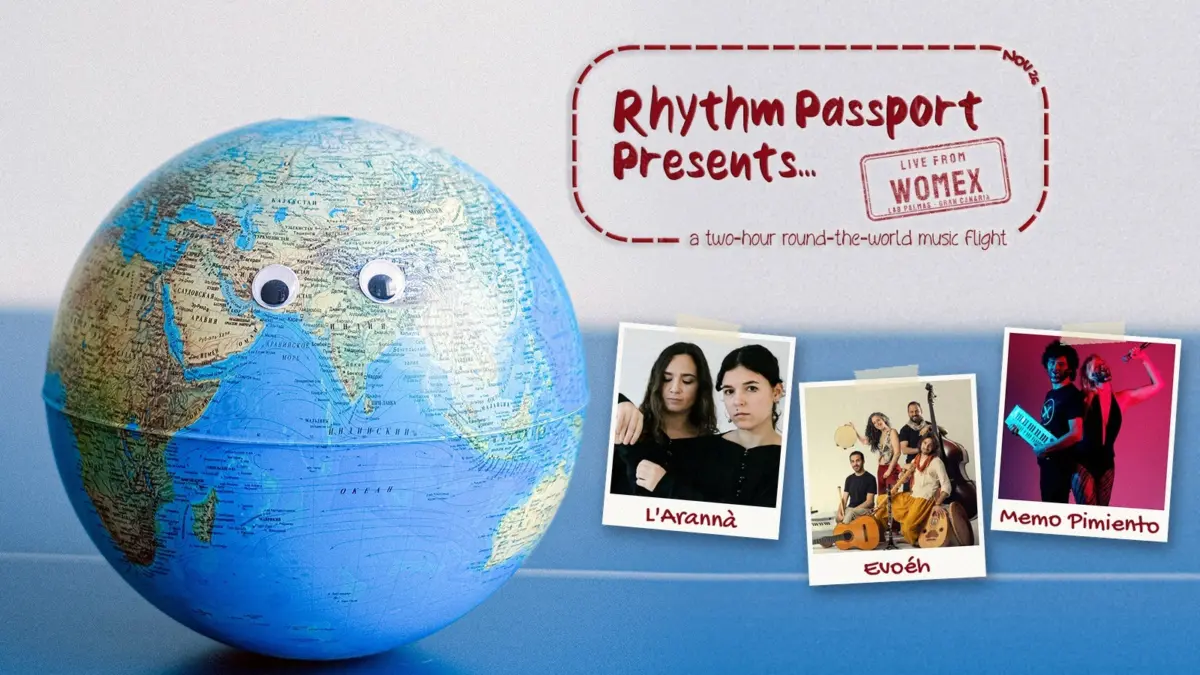
Global music discovery platform Rhythm Passport has officially dropped its latest auditory dispatch, capturing the pulsating, eclectic heart of WOMEX 26 (World Music Expo), which recently unfolded against the sun-drenched backdrop of Las Palmas de Gran Canaria. Returning from the Canary Islands with little more than a mild Mediterranean tan, a bulging tote bag of freshly acquired promotional releases, and an exclusive master recording of live radio sessions, the Rhythm Passport team has transformed their fieldwork into an immersive, multi-artist radio broadcast.
Recorded entirely live inside the purpose-built Radio WOMEX studio, this latest episode serves as a vital snapshot of contemporary global roots music, bridging the ancient and the avant-garde. The broadcast focuses on three distinct, highly innovative acts operating at the fringes of traditional folk and electronic production: Catalonia and the Balearic Islands’ L’Arannà, the cross-cultural Mediterranean-Iberian duo Evoéh, and the Mexico City-born, Brussels-based analog synthesizer visionary Memo Pimiento.
This feature article provides an exhaustive, behind-the-scenes breakdown of the broadcast, exploring the cultural significance of the artists featured, the technical methodologies behind their live studio performances, and the broader geopolitical and artistic conversations dominating WOMEX 26. By examining how these musicians weaponize heritage against homogenization, we uncover a vital blueprint for the future of world music curation.
Detailed Chronology: Inside the Radio WOMEX Studio Sessions
The curation of the Rhythm Passport post-WOMEX broadcast was designed as a sonic journey, moving chronologically through contrasting geographies, historical epochs, and modern production techniques. Below is a detailed tracking of the broadcast’s live sessions, artist interviews, and structural highlights.
1. Opening Dispatch: The Canarian Aftermath and Studio Genesis
The episode opens with the signature welcoming cadence of the Rhythm Passport hosts, immediately transporting the listener from the brisk winds of northern Europe to the sub-tropical warmth of Gran Canaria. The hosts unpack the exhausting, exhilarating reality of attending WOMEX—an annual crucible of networking, showcase performances, and late-night artistic exchanges.
Special recognition is extended to the broadcast engineers and producers at the Radio WOMEX studio, whose technical infrastructure enabled high-fidelity, zero-latency live tracking on the convention floor. Rather than relying on pre-recorded album cuts, the broadcast prioritizes the raw, unfiltered energy of the performance space, capturing breathing room, transient studio chatter, and spontaneous acoustic interplay.
2. L’Arannà: Resurrecting Ibiza’s Cant Redoblat with Synthesizers
The first primary guest session features Lara Magrinyà and Anna Sala, the creative forces behind L’Arannà. Stepping into the studio fresh off their showcase performance, the duo brought the striking conceptual framework of their current touring project, Turmarí.
- The Musical Foundation: At the core of Turmarí is cant redoblat, an ancient, highly ornamented style of vocal performance historically native to the Balearic islands of Ibiza and Formentera. Traditionally defined by its microtonal shifts and rhythmic intensity, this ancestral vocal art is treated by L’Arannà not as a museum piece, but as a living, breathing idiom.
- Instrumentation and Arrangement: In the studio, Magrinyà and Sala achieved a jarring yet intoxicating juxtaposition. They paired their searing, traditional vocal delivery with modern synthesizers, the organic rattle of traditional castanets, and the pastoral reedy breath of the flaüta (a traditional Balearic pipe).
- The Interview: During their sit-down with the Rhythm Passport team, the duo articulated the challenges and responsibilities of reinterpreting island folklore for contemporary European audiences. They noted that electronic instrumentation does not dilute the historical weight of cant redoblat; rather, it acts as a sonic amplifier, providing a drone-like, hypnotic architecture that makes the archaic vocal ornaments punch through modern sound systems.
3. Evoéh: Rooted Wanderers and Handmade Frequencies
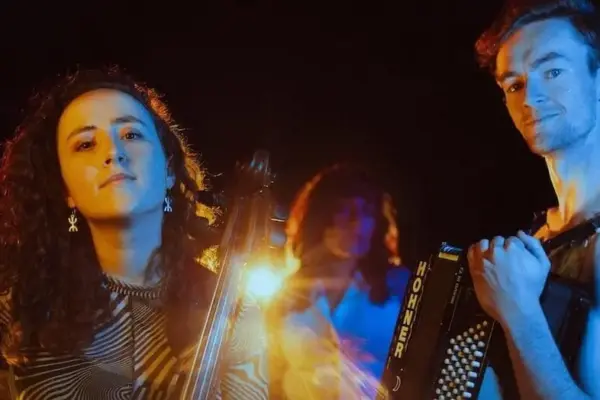
Transitioning from the Balearic islands to the broader Iberian Peninsula, the broadcast shifts focus to Evoéh. Represented in the studio by Ariana Barrabés (vocals and percussion) and Jesús Olivares (guitar, oud, and a custom-built African lyre), the duo offered a masterclass in cross-Mediterranean synthesis.
- Genre-Defying Composition: Evoéh’s sonic palette draws heavily from traditional Iberian and Sephardic folk idioms, infusing them with the harmonic sophistication of modern jazz and the fiery rhythmic attack of flamenco. Their music refuses to recognize rigid national borders.
- The Seed Metaphor (Músicas Semilla): The conversation centers largely on their latest studio album, Músicas Semilla. Olivares and Barrabés discussed the philosophical premise of the record: the idea that every seed was once a traveller. Just as botanical seeds drift across oceans, adapting to new soils while retaining their core DNA, the songs on the album wander fluidly across more than seven distinct languages.
- Live Performance: The studio performance highlighted Olivares’ craftsmanship. Alongside his traditional nylon-string guitar and the Middle Eastern oud, he demonstrated the unique acoustic properties of an African lyre he constructed entirely by hand. Backed by Barrabés’ nuanced, earthy percussion and crystalline vocal phrasing, the performance demonstrated how acoustic minimalism can carry immense emotional and historical resonance.
4. Memo Pimiento: Analog Cumbia and Intercultural Collaboration
Slowing down the tempo and shifting continents entirely, the third segment introduces Memo Pimiento. Born in Mexico City and currently based in the artistic melting pot of Brussels, Pimiento is a producer and performer who bends electronic music to his will through specialized hardware.
- The Aesthetics of Rebajada: Pimiento specializes in rebajada—a cumbia subgenre characterized by slowed-down playback speeds, deep subterranean bass frequencies, and psychedelic analog processing. Rather than using laptop-based digital audio workstations (DAWs) on stage, Pimiento builds his immersive soundscapes live using an array of vintage and modern analog synthesizers.
- The Studio Exchange: The interview explores his migrant journey—how the tropical polyrhythms of Latin America are filtered through the gray, industrial skies of Western Europe.
- The Cross-Genre Finale: In one of the broadcast’s most magical unscripted moments, guitarist Jesús Olivares (from Evoéh) returns to the studio to join Memo Pimiento. Together, they execute a stunning, one-off acoustic-meets-electronic version of Pimiento’s track “Sol y Piel,” proving that cumbia grooves and Mediterranean folk guitar fingerpicking share an unspoken rhythmic kinship.
5. Festival Highlights and The Way Forward
The broadcast draws to a close with a curated playlist of the hosts’ personal musical highlights harvested from the wider WOMEX 26 showcase stages. Capturing everything from thunderous horn sections to intimate solo sets, this closing segment serves as a panoramic audit of the current global music market. The episode signs off with a metaphorical "flight" clearance, bidding farewell to the Canarian archipelago while leaving listeners with an exhaustive mental checklist of artists to watch in the coming year.
Supporting Context & Metrics: The WOMEX Phenomenon and Global Music Economics
To fully understand the significance of Rhythm Passport’s live broadcast, one must contextualize WOMEX as both a cultural exchange and a multi-million-euro economic engine for the global music industry.
The Scale of WOMEX 26
WOMEX (Worldwide Music Expo) is globally recognized as the most important international networking trade fair for world music, roots, folk, ethnic, and traditional music. Every year, the event rotates to a different European host city, bringing together:
- Delegates: Over 2,600 music professionals representing more than 90 countries.
- Sectors: Record labels, booking agents, festival directors, journalists, cultural institutions, and streaming platform curators.
- Showcases: More than 60 live acts performing across multiple stages over five intensive days and nights.
[WOMEX 26: Las Palmas de Gran Canaria]
 ├── 2,600+ Global Delegates (90+ Countries)
 ├── 60+ International Showcase Acts
 └── Dedicated Media Nodes (e.g., Radio WOMEX Studio)
      └── Rhythm Passport Live Broadcast Generation
           ├── L’Arannà (Balearic Folk-Synth)
           ├── Evoéh (Iberian-Mediterranean Jazz/Flamenco)
           └── Memo Pimiento (Mexican-Belgian Analog Cumbia)
The Economic Realities of Niche Roots Music
While major label pop dominates streaming algorithms, niche roots and traditional fusion acts rely heavily on specialized platforms like WOMEX and independent media outlets like Rhythm Passport for career sustainability.
According to data compiled by independent music advocacy groups:
- Live Performance Revenue: Unlike commercial pop acts that generate massive percentages of revenue via streaming royalties, traditional and world music artists derive up to 70% to 80% of their annual income from live touring and festival bookings.
- The Geographic Bottleneck: Acts like L’Arannà or Evoéh often face massive logistical and financial hurdles when trying to break out of their regional markets (Catalonia/Balearic Islands and Iberia, respectively). Events like WOMEX act as vital B2B (business-to-business) marketplaces where a single 45-minute showcase can secure a 15-city international festival tour.
- The Role of Specialized Media: Independent digital broadcasters and podcasts function as cultural curators, filtering through thousands of applications to highlight artists who successfully negotiate the tension between cultural preservation and modern innovation.
Official Statements & Curatorial Insights
The intellectual core of the Rhythm Passport broadcast lies in the artists’ own reflections on their craft. Below are synthesized excerpts and thematic breakdowns of the statements made during the live studio interviews at Radio WOMEX:
On Tradition as a Dynamic, Living Force
When discussing the integration of cant redoblat with synthesizers, Lara Magrinyà and Anna Sala (L’Arannà) emphasized that traditional music dies the moment it is placed behind glass:
"People often assume that looking back at ancient island songs means you want to freeze time. For us, it is quite the opposite. The shepherds and fishermen of Ibiza and Formentera who sang these melodies centuries ago were using the tools and emotional languages available to their time. By bringing synthesizers and modern electronic drones into the equation, we aren’t violating tradition—we are honoring its adaptive, living spirit."
On Migration, Roots, and Botanical Metaphors
Ariana Barrabés and Jesús Olivares (Evoéh) elaborated on the conceptual architecture of Músicas Semilla, focusing on how music mirrors human and botanical migration:
"A seed doesn’t care about national borders or political maps. It falls, it travels on the wind or in the belly of a bird, and it takes root wherever the soil is welcoming. The music of the Mediterranean and Iberian Peninsula has always been a meeting point for diverse cultures—Romani, Sephardic, Arab, Christian, and African. When we sing in seven different languages, we are simply acknowledging that our cultural roots have always been multinational and deeply interconnected."
On Analog Production and Transnational Identity
Memo Pimiento addressed the intersection of his Mexican roots and his current European residency through the lens of hardware production:
"When you move from Mexico City to Brussels, your relationship with time and space changes entirely. Cumbia is inherently warm, vibrant, and urgent. But when you slow it down into rebajada on analog synthesizers in a European studio, you capture the melancholy of displacement. It becomes a bridge between two worlds: the tropical heat I left behind and the mechanical precision of the city I now call home."
Future Outlook: The Next Wave of Global Roots Curation
As the dust settles on Las Palmas de Gran Canaria and the international music community looks ahead to future editions of WOMEX, the implications of broadcasts like Rhythm Passport Presents point toward several key trends shaping the future of global music:
1. The Decentralization of World Music
For decades, "world music" was treated as a monolithic, patronizing catch-all term dominated by Western gatekeepers looking for exotic novelties. The current wave—typified by artists like L’Arannà, Evoéh, and Memo Pimiento—shatters this paradigm. Regional identities (Balearic, Iberian, Mexican-Belgian) are asserting themselves with fierce autonomy, refusing to water down their linguistic or stylistic peculiarities for international consumption. Instead, they invite global audiences to meet them on their own terms.
2. The Marriage of Analog Hardware and Ancestral Lore
The technical setups witnessed in the Radio WOMEX studio signal a growing rejection of sterile, hyper-digital production. Whether it is Jesús Olivares building his own African lyre, Memo Pimiento tweaking analog synth filters for slowed-down cumbia, or L’Arannà marrying modular synths with castanets, artists are proving that future-facing electronic music and deep historical roots are not mutually exclusive. In fact, the friction between organic, acoustic antiquity and synthesized futurism is producing some of the most compelling art of the decade.
3. The Indispensable Value of Independent Broadcasting
As major streaming algorithms increasingly homogenize listening habits through predictable recommendation loops, independent platforms like Rhythm Passport provide an essential public service. By archiving, contextualizing, and broadcasting live studio performances from trade fairs like WOMEX, they ensure that adventurous listeners retain access to the margins—where the most vital cultural transformations are quietly taking place.
To listen to the complete live broadcast from Radio WOMEX, explore previous episodes, and view the full track list, visit the official Rhythm Passport Podcasts Page. Cover photography by Anna Shvets.