Executive Overview
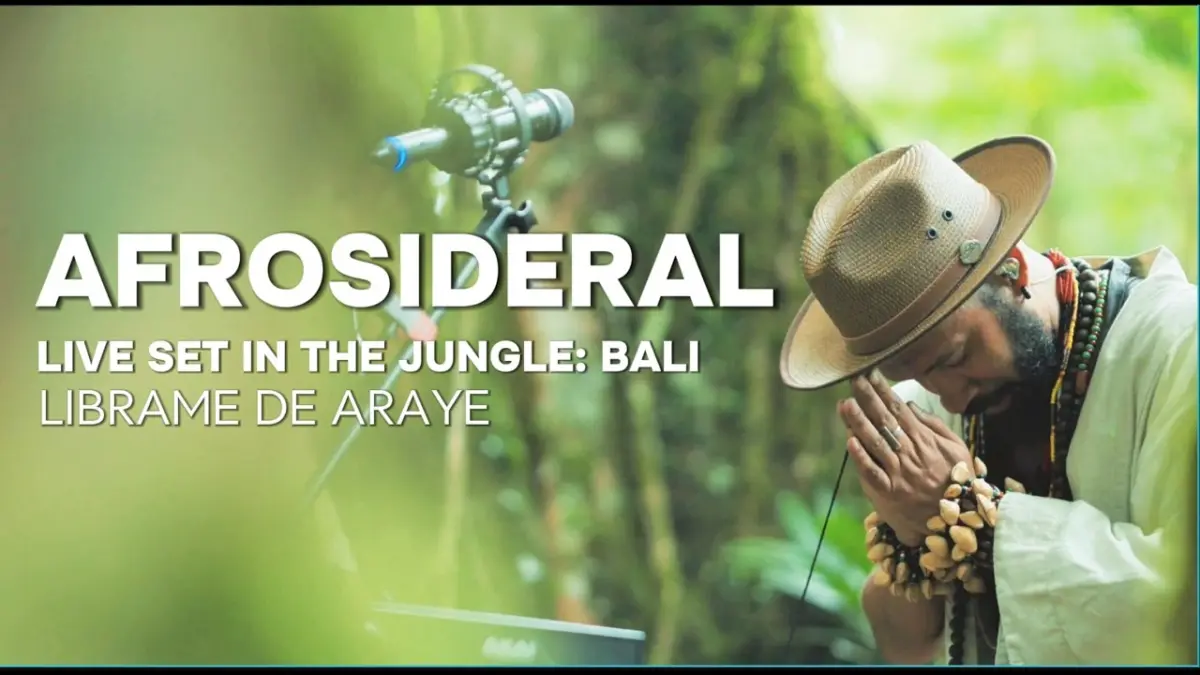
In an era where electronic music production often relies on sterile digital workstations and software-driven homogeneity, visionary producer and vocalist Kumar Sublevao-Beat—recording under the moniker Afrosideral—has chosen a path rooted in organic geography and ancestral resonance. Deep within the emerald canopy of the Balinese jungle, Afrosideral recorded a breathtaking Afrotropical Mystic live set. This immersive performance seamlessly weaves raw human voice and acoustic percussion with forward-thinking Afro-Cuban electronic music, placing the orishas—the revered deities of the Yoruba tradition—at the very heart of the sonic ecosystem.
At the center of this jungle session stands an arresting rendition of "Líbrame de Arayé." For this exclusive live interpretation, the track opens with an ethereal Balinese flute introduction, a deliberate touch added by Sublevao-Beat to allow "the sound, the space, and the energy of the moment" to clear a path before the core rhythm takes hold. Created specifically for live audiences and performed exclusively on stage, this extended version transforms the studio recording into a living, breathing ritual.
This article explores the deep spiritual foundations, geographical journeys, and artistic evolution of Afrosideral. By examining his critically acclaimed 2019 release El Olimpo de los Orishas, his roots in Havana’s pioneering late-1990s hip-hop underground, and his ongoing cultural exchange in international spaces like Bali’s Ubud, we uncover how traditional West African and Caribbean cosmology continues to find a vibrant, contemporary home on global electronic dance floors.
Detailed Chronology: From Havana’s Hip-Hop Underground to Global Electronic Frontiers
The Genesis in Havana (Late 1990s)
The story of Afrosideral cannot be told without understanding the artistic crucible of late-1990s Havana. As an MC navigating the nascent Cuban hip-hop scene, Kumar Sublevao-Beat developed a lyrical sharpness and rhythmic intuition that captured the socio-political realities of island life. During an era defined by economic hardship and sweeping cultural shifts following the collapse of the Soviet bloc, Cuba’s hip-hop movement served as an essential outlet for youth expression.
Kumar’s early talents did not go unnoticed. He achieved wider recognition as a member of a prominent hip-hop collective that was prominently featured in Habana Blues, the critically acclaimed 2005 musical drama directed by Benito Zambrano. The film exposed international audiences to the raw, underground vitality of contemporary Cuban musicians striving to balance artistic integrity with commercial realities. This formative period instilled in Kumar a deep respect for collaboration, storytelling, and the power of rhythm as a vehicle for narrative.
The European Transition and the Birth of Afrosideral
Seeking new artistic horizons, Kumar eventually relocated to Europe, establishing a base from which to experiment further with his sound. It was during this geographic and psychological transition that the Afrosideral project took shape. Moving away from traditional verse-chorus hip-hop structures, Kumar leaned heavily into his Afro-Cuban heritage, merging it with modern electronic production techniques.
Afrosideral became the vehicle for a spiritual and sonic exploration. Rather than viewing electronic music as cold or mechanical, Kumar approached synthesizers, drum machines, and dub production techniques as modern instruments capable of channeling ancient forces. The project positioned him at the vanguard of a global movement of artists reclaiming electronic spaces for indigenous, diaspora, and roots music traditions.
The Landmark Release: El Olimpo de los Orishas (September 2019)
The culmination of years of experimentation materialized in September 2019 with the release of El Olimpo de los Orishas (The Olympus of the Orishas). Issued via New York’s esteemed Wonderwheel Recordings—a label renowned for bridging global roots music with contemporary electronic beats—the album served as Afrosideral’s official coming-out party.
Self-produced by Kumar, the record is a masterclass in cross-cultural synthesis. He meticulously layered ancestral vocal chants and acoustic percussion instruments over heavy, hypnotic electronic rhythms infused with a distinct dub aesthetic. The album received widespread critical acclaim for its ability to honor sacred Yoruba traditions while remaining undeniably contemporary and club-ready.
Among its standout pieces is "Líbrame de Arayé," positioned as the second track on the album. The phrase translates directly to "free me from envy and ill will," with the word arayé originating from Lukumí, the specific dialect of the Yoruba language preserved and spoken in Cuba. Significantly, Kumar dedicated the track to Obatalá, the revered orisha who, according to Lukumí cosmology, is responsible for shaping the human body before birth. In this tradition, Obatalá’s sacred color is white, symbolizing absolute cleanliness, clarity, and purity.
The Balinese Interlude and Future Horizons (2026)
The global resonance of Afrosideral’s music eventually brought Kumar to the lush landscapes of Indonesia. The world-renowned Bali Spirit Festival in Ubud, celebrated for its holistic approach to music, yoga, and dance, recognized the deep spiritual alignment between Balinese culture and Afro-Cuban traditions. Following a successful debut, the festival booked Afrosideral for a highly anticipated second consecutive year in April 2026.
It was during this Asian sojourn that Kumar captured the Afrotropical Mystic live set deep in the Balinese jungle. By placing his voice and percussion against the backdrop of an ancient rainforest, he created a dialogue between two geographically distant yet spiritually attuned cultures, cementing his status as a truly global practitioner of sacred electronic music.
Supporting Context & Metrics: The Intersection of Tradition and Technology
The Linguistic and Spiritual Architecture of Lukumí
To fully grasp the weight of Afrosideral’s work, one must understand the preservation of Yoruba heritage in the Americas. When enslaved West Africans were forcibly brought to Cuba during the transatlantic slave trade, they preserved their cosmological systems by syncretizing them with Spanish Catholicism—a practice known as Santería or Regla de Ocha. However, within the initiated communities, the pure ancestral language, Lukumí, was maintained.
Tracks like "Líbrame de Arayé" are not merely songs; they are invocations. By utilizing Lukumí terminology, Kumar taps into a centuries-old linguistic resistance movement. When he dedicates the track to Obatalá, he is invoking the creator of human consciousness and physical form. In electronic music production, where vocal samples are often treated as texture, Kumar treats them as sacred vessels.
Production Anatomy: Dub, Electronics, and Ancestral Chants
The sonic blueprint of El Olimpo de los Orishas relies on a delicate balance between three distinct pillars:
- Ancestral Chants & Percussion: Recorded with organic reverence, capturing the micro-tonal shifts of human voices and the rich timber of traditional drums like the batá.
- Modern Electronic Production: Crisp drum programming, sub-bass frequencies, and atmospheric pads that provide a expansive canvas for the listener.
- Dub Aesthetics: Heavy use of spatial effects, tape delays, and reverb. This dub influence creates a meditative, hypnotic environment, echoing the spiritual trance states induced during traditional orisha ceremonies.
The Evolution of the Live Set Experience
As demonstrated in his Balinese jungle recording, Afrosideral’s live performances transcend standard DJ or live-PA formats. By introducing site-specific elements—such as the Balinese flute intro added to "Líbrame de Arayé"—Kumar actively acknowledges his physical surroundings. This improvisational flexibility ensures that the music remains a living, breathing entity rather than a fixed digital product.
Official Statements & Artistic Philosophy
While reflecting on the genesis of the jungle performance and the specific mechanics of "Líbrame de Arayé," Kumar Sublevao-Beat has offered profound insights into his creative ethos:
"The sound, the space, and the energy of the moment must open the way before the track begins."
This philosophy underpins his decision to alter the entry point of "Líbrame de Arayé" exclusively for live audiences. By introducing the Balinese flute, he creates a localized bridge, inviting the spirits of the rainforest into a conversation with the Afro-Cuban orishas.
Discussing the thematic core of the track, Kumar emphasizes the protective and purifying nature of the composition:
"Líbrame de Arayé means ‘free me from envy and ill will.’ It is a prayer for clarity, a dedication to Obatalá, whose white light cleanses the human vessel before it enters the world."
Furthermore, representatives from Wonderwheel Recordings have frequently highlighted Afrosideral’s unique ability to honor history while driving the global bass and electronic scenes forward. By treating electronic music as a medium for spiritual transmission, Kumar challenges the commercialized boundaries of modern club culture, reminding listeners that rhythm is humanity’s oldest technology for connection.
Future Outlook: The Global Trajectory of Afrotropical Mystic Soundscapes
As the global music community increasingly looks beyond Western Eurocentric production models for inspiration, artists like Afrosideral are proving that deep cultural roots are the ultimate source of artistic longevity. The success of El Olimpo de los Orishas and the viral fascination surrounding his Balinese jungle sessions indicate a growing appetite for music that possesses both intellectual depth and visceral dance-floor appeal.
Looking ahead to his return to the Bali Spirit Festival in April 2026 and beyond, Kumar Sublevao-Beat shows no signs of slowing his cross-continental explorations. His ability to merge the sacred chants of Havana with the natural soundscapes of Southeast Asia and the sleek mechanics of European electronic production positions him as a vital architect of twenty-first-century global music.
For listeners seeking to dive deeper into this sonic universe, the studio version of "Líbrame de Arayé" remains available for streaming on platforms like Bandcamp, while physical and digital copies of El Olimpo de los Orishas continue to inspire collectors worldwide. As Afrosideral continues to tour and evolve, he carries forward an ancient flame—proving that whether performed in a Havana alleyway, a European club, or deep within the Balinese jungle, the orishas will always find a way to make their presence felt.