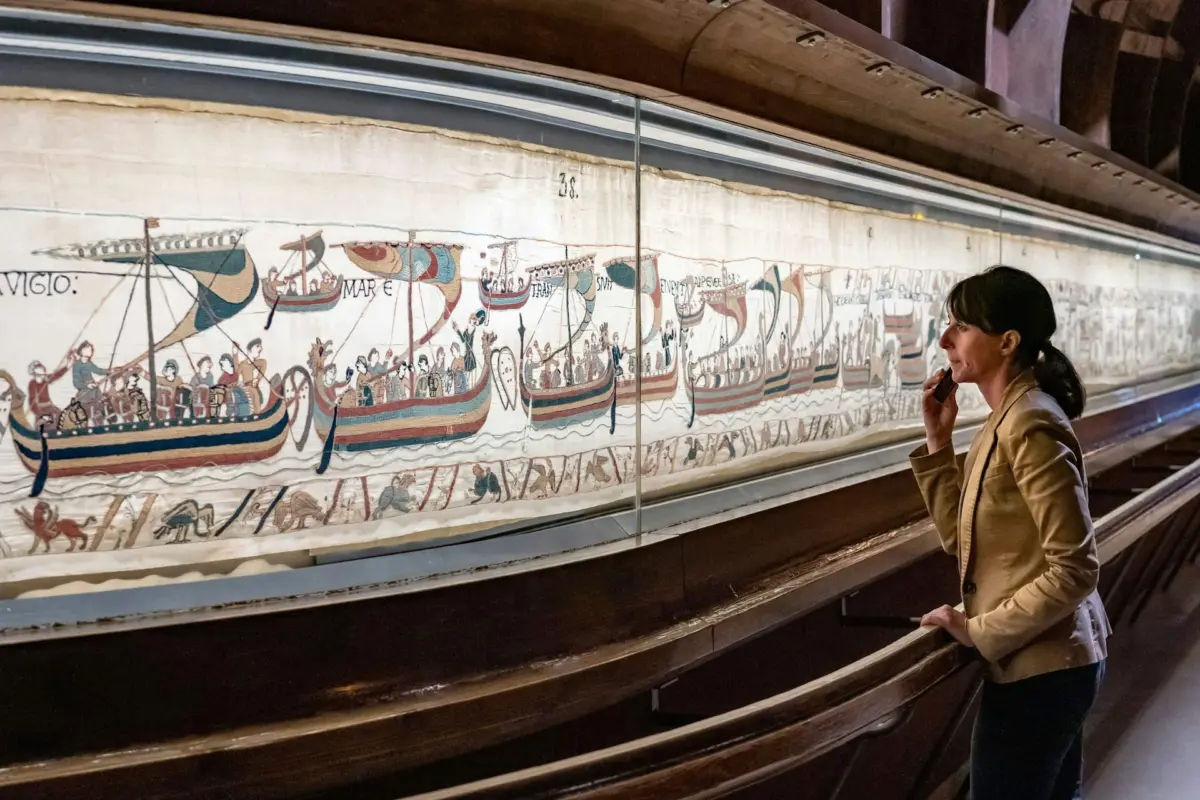
Executive Overview
As the cultural world prepares for the landmark British Museum exhibition—scheduled to run from September 2026 through July 2027—scholars, conservators, and the public alike are casting a renewed gaze upon one of medieval Europe’s most breathtaking artifacts: the Bayeux Tapestry. Measuring an astonishing 68 meters in length, this iconic embroidery has, for centuries, been studied primarily through the lenses of political history, military strategy, and textile mechanics.
However, recent academic breakthroughs by textile archaeologists and professional embroiderers are shifting the paradigm of how we interpret this 11th-century masterpiece. Moving beyond questions of who commissioned it, where it was stitched, or what hidden messages lie within its borders, contemporary research delves into how medieval audiences physically, cognitively, and sensorially engaged with the hanging. Far from being a static, silent wall-hanging viewed in sterile museum conditions, the Bayeux Tapestry was originally designed as a dynamic, kinetic, and multisensory experience. In the drafts, flickering candlelight, and communal halls of the early medieval world, the tapestry breathed, moved, and spoke to its viewers, functioning as an immersive piece of architectural theater.
Detailed Chronology
Understanding the trajectory of the Bayeux Tapestry requires charting its journey from an early medieval political statement to a modern global icon of cultural heritage:
- 1066–1077 CE (The Creation Epoch): Following the Norman Conquest of England, the tapestry is crafted (likely in southern England, such as Kent or Winchester, though commissioned by Norman patrons like Bishop Odo of Bayeux). Artisans use laid-and-couching embroidery techniques with woolen yarns on a linen foundation.
- 1476 CE (First Written Record): The tapestry makes its first definitive appearance in the written historical record, cited in an inventory of the treasury of Bayeux Cathedral, where it was traditionally displayed annually around the feast of relics.
- 1792–1794 CE (French Revolutionary Turmoil): During the French Revolution, the tapestry narrowly escapes destruction. It is requisitioned to cover a military wagon, saved at the last moment by a local lawyer who recognized its historical value and hid it for safekeeping.
- 1814–1870s (Romantic Rediscovery & Conservation): Antiquarians begin intensively studying, illustrating, and documenting the embroidery. In the mid-19th century, professional needlewomen create accurate full-scale reproductions, cementing its status as an academic and national treasure.
- 1944–1945 CE (World War II Protection): As Allied forces prepare to land in Normandy, the tapestry is secretly evacuated from the Musée de Peinture to the basement of the Louvre in Paris, and later to the Château de Sourches, surviving the conflict unscathed.
- 1982–1983 CE (Scientific Examination): The tapestry undergoes rigorous physical analysis led by French conservators, yielding unprecedented data on its linen ground fabric, wool dyes, and stitching structure.
- September 2026 – July 2027 (The British Museum Exhibition): In a historic cultural exchange, the Bayeux Tapestry is slated for display at the British Museum, prompting a wave of fresh academic research regarding its tactile, sensory, and visual reception.
Supporting Context & Metrics
To fully appreciate the scale and intricacy of the Bayeux Tapestry, one must look closely at its physical metrics and the socio-cultural context of its creation during the early medieval period (450–1100 CE).
The Material Reality
The artifact is not actually a tapestry in the strict technical sense—which implies a woven textile made on a loom. Instead, it is an embroidery, stitched by hand using crewel-style wool yarns on a plain-weave linen ground fabric.
- Total Surviving Length: Approximately 68 meters (223 feet).
- Height: Roughly 50 centimeters (20 inches).
- Color Palette: Dominated by terracotta, blue-green, dark green, yellow, and greyish blue wools, which historically derived from natural dyestuffs such as woad, madder, and weld.
- Stitch Types: Principally outline stitch and laid-and-couching work, which allowed embroiderers to fill broad color fields efficiently while conserving precious woolen thread.
The Oral Tradition and the "Scop"
In early medieval Anglo-Saxon and Anglo-Norman society, the scop (an oral storyteller, poet, and singer) held a vital role. The scop recounted tales of heroes, legendary battles, and ancestral triumphs, shaping a shared cognitive memory within the community. However, the scop’s performance was ephemeral; once the final words were spoken, the sonic landscape dissolved into silence until the next recitation.
The Bayeux Tapestry bridged the gap between oral poetry and visual art. Unlike the scop, who dictated a unified emotional response to an assembled audience, the tapestry provided a permanent, unchanging visual canvas. Yet, because it lacked a singular, spoken narrative voice, it invited decentralized, highly personal interpretations from every onlooker who walked along its length.
Official Statements and Academic Insights
Scholars specializing in textile archaeology and early medieval material culture have increasingly emphasized the sensory dimensions of the embroidery.
"When the tapestry was hung within a medieval castle keep, it was far from a static museum piece," notes a leading textile archaeologist and contributor to the British Museum’s exhibition catalogue. "When hung, it would have moved, caught by a draught or a person passing by. This movement would have made the stitched pictures come ‘alive’, turning the static narrative into something akin to a film."
This kinetic quality fundamentally alters our understanding of medieval visual culture. The fibrous texture of the wool threads contrasted sharply with the smooth, cream-colored linen ground. As natural light shifted across the undulating surface of the hanging throughout the day, shadows danced over the stitches.
- Dynamic Imagery: Horses appeared to gallop as the fabric rippled; ships’ sails billowed in imaginary winds; and warriors’ hair seemed tossed by gales.
- Sensory Integration: When displayed during feasts and mealtimes, the tapestry interacted directly with its environment. The ambient sounds of clattering pottery, ringing metal vessels, roaring hearth fires, human laughter, and overlapping conversations merged with the depicted scenes of cooking, slaughtering, and feasting.
- Acoustic Dampening: The dense, heavy wool and linen fabric would have absorbed sound, dampening external noises and creating a semi-enclosed, intimate acoustic bubble for those gathered within the hall.
Thus, the Bayeux Tapestry functioned as a form of medieval "theatre in the round." It was an immersive multisensory installation that demanded physical and emotional participation from its audience, acting as a catalyst for animated debate, personal reflection, and communal bonding.
Future Outlook
As the international academic community looks toward the landmark 2026–2027 British Museum exhibition, the trajectory of Bayeux Tapestry research is entering an exciting new phase. The convergence of high-resolution digital imaging, microscopic fiber analysis, and sensory archaeology promises to unlock even deeper layers of meaning.
Future research will likely focus heavily on cognitive material culture—exploring how medieval viewers processed visual narratives through the simultaneous activation of touch, sight, and sound. Rather than viewing historical artifacts as isolated visual texts, modern historians are increasingly recognizing that objects like the Bayeux Tapestry were active agents in shaping medieval psychology, politics, and social cohesion.
Furthermore, as cultural institutions develop more immersive display techniques, contemporary museum-goers may soon experience a facsimile of that original medieval reception: viewing the undulating stitches under dynamic lighting conditions that mimic the flickering hearths of an 11th-century Norman hall. Through these innovative approaches, the Bayeux Tapestry continues to transcend its physical threads, proving that a nearly thousand-year-old embroidery still has vital stories to tell about what it means to be human, to remember, and to bear witness to history.