Executive Overview
For decades, the holy grail of dynamic control has remained firmly anchored to the legendary Fairchild 670. Coveted for its ultra-rare status, iconic valve-driven architecture, and signature "gluey" saturation—cemented into modern music history by The Beatles at Abbey Road—the original unit has long been out of reach for all but the world’s most elite commercial tracking and mastering facilities. While original vintage models regularly command upwards of $40,000 on the secondary market, and modern recreations push the $30,000 threshold, the financial barrier to entry has kept the true Vari-Mu experience locked away in legendary studios.
Enter Heritage Audio. Having already established its prowess with the full-fat Herchild 670 and the compact Grandchild 670/500, the company has returned with its most compelling proposition yet: the Herchild 670N. Priced at an aggressive $3,000, this latest iteration aims to deliver the legendary warmth, musical compression characteristics, and dynamic response of a vintage Fairchild at roughly one-third of the cost of its predecessor.
By streamlining its internal componentry—utilizing fewer valves and transformers while cleverly expanding its feature set to include per-channel make-up gain—Heritage Audio has engineered a compelling piece of analog hardware. This review dives deep into the engineering, real-world studio performance, and market positioning of the Herchild 670N to determine whether this downsized titan deserves a permanent home in contemporary mixing and mastering signal chains.

Detailed Chronology
The Evolution of the Fairchild Heritage
To understand the significance of the Herchild 670N, one must trace the lineage of the technology that inspired it. The original Fairchild 670, designed in the 1950s, was an engineering marvel built around a Vari-Mu (variable-mu) circuit. Unlike solid-state or optical compressors, Vari-Mu design executes compression directly inside the vacuum tubes themselves. As the input signal peaks over the designated threshold, the compression ratio increases progressively. This dynamic behavior, combined with a relatively leisurely attack time, ensures that transient details are never brutally squashed, while the hard-working valves impart a rich, pleasing array of even harmonics.
[1950s: The Original Fairchild 670]
       │ (Ultra-rare, legendary Beatles studio staple)
       ▼
[2021: Heritage Audio Herchild 670]
       │ ($10,000 dual-channel flagship, 22 NOS valves)
       ▼
[2023: Grandchild 670/500]
       │ ($2,000 500-series format, stereo-capable)
       ▼
[Present: Herchild 670N]
       └─ ($3,000 downsized 5U rack unit with expanded controls)
In 2021, Heritage Audio made waves by introducing the Herchild 670—a dual-channel emulation priced at $10,000 that relied on 22 new-old-stock (NOS) valves and bespoke transformers to capture the authentic vibe of the 1950s original. Housed in a mammoth 6U chassis with illuminated VU meters and oversized bakelite-style knobs, it was a deliberate physical and sonic homage to a bygone era of recording.
Recognizing the demand for a more accessible footprint and price point, Heritage released the Grandchild 670/500 in 2023. Squeezing the essence of the design into a 500-series format for around $2,000, the unit proved that sublime stereo Vari-Mu processing could be achieved with fewer tubes. This successful miniaturization laid the groundwork for a missing link in the product family: a dedicated rackmount unit that bridges the gap between the premium full-size 670 and modular systems. The result is the Herchild 670N—a 5U powerhouse packed with advanced routing options, modern side-chain intelligence, and a price tag that recalibrates expectations for high-end hardware.

Supporting Context & Metrics
Architectural Breakdown and Physical Footprint
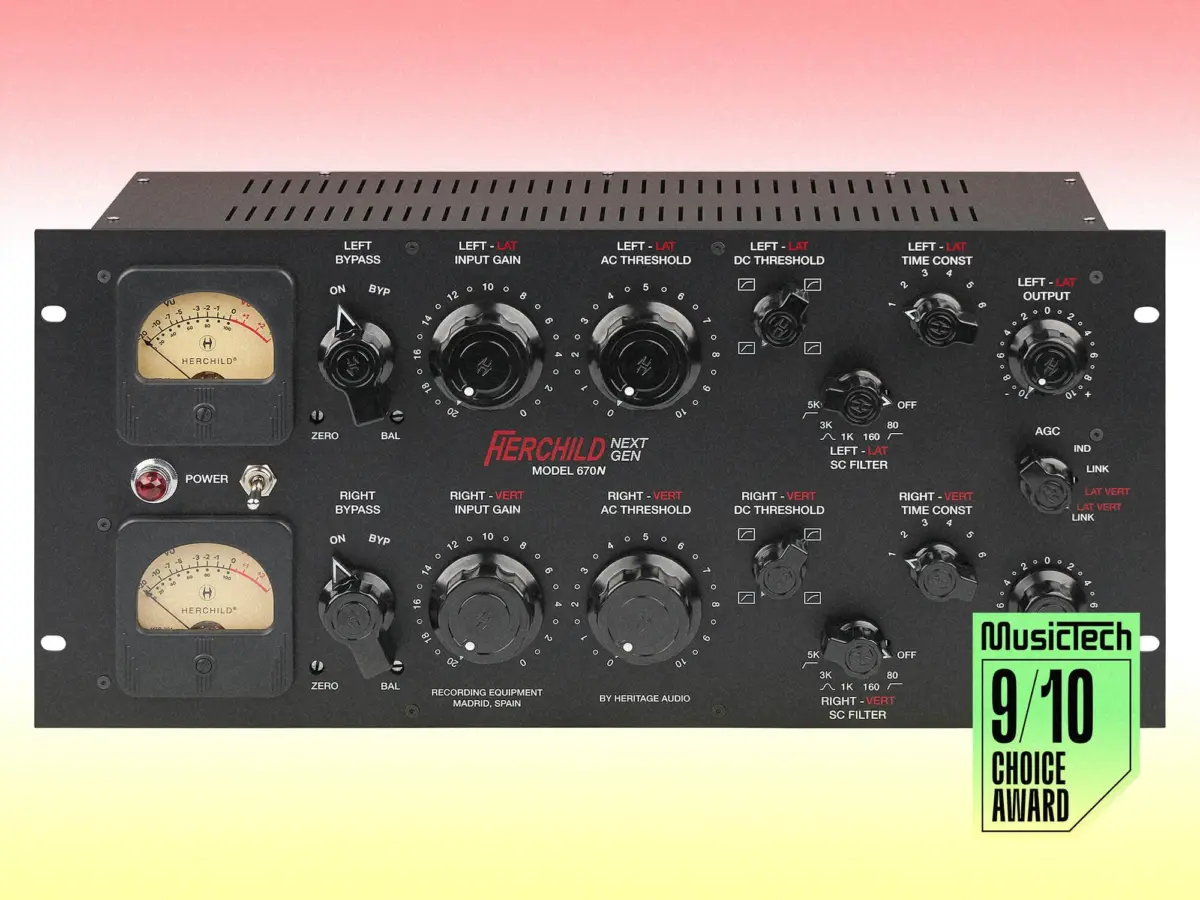
Despite being pitched as a more streamlined option, the Herchild 670N demands physical respect in the studio. Housed in a sturdy 5U rack enclosure, it is slightly smaller than its 6U older sibling, yet it still commands considerable space in an outboard rack. The rear panel remains refreshingly uncluttered, featuring balanced XLR inputs and outputs alongside a dedicated connector for an external power supply to minimize mains hum and electromagnetic interference.
On the front panel, the layout marries vintage aesthetics with modern utility:
- Meters & Bypass: Illuminated dual VU meters monitor gain reduction, flanked by a true hardware bypass switch.
- Input Gain & AC Threshold: Two large, soft-detent dials utilize an intuitive "turn up for more" operational logic. Input Gain drives the input stage harder against the tubes, while AC Threshold increases the depth of gain reduction.
- DC Threshold: A critical control for manipulating the compression response curve, allowing users to shift smoothly from a gentle soft-knee (ideal for delicate vocals and mastering) to a hard-knee punchiness (perfect for crushing drum room microphones).
- SC Filter: A remarkably sophisticated side-chain filter. Beyond standard low-frequency damping to prevent mix-bus pumping from heavy kick drums, it features upper-frequency settings (1kHz, 3kHz, and 5kHz) designed to tame hi-mid harshness, sibilance, and brittle high frequencies found in budget condenser microphones or aggressive overheads.
- AGC Operating Modes: Accessed via a rotary switch, the unit supports four distinct modes: IND (dual mono for independent processing), LINK (traditional stereo linking), and dedicated LAT/VERT modes (Mid/Sides encoding/decoding).
- Per-Channel Output Gain: A welcome addition that provides independent output control per channel, optimizing gain staging in dual mono or widening the stereo field during Mid/Sides mastering tasks.
Official Statements & Engineer Insights
Real-World Studio Performance: Mastering and Mixing
To evaluate its true capability, the Herchild 670N was subjected to rigorous testing across both mastering sessions and individual track mixing duties.

Mastering Applications
In a mastering scenario, Vari-Mu compressors traditionally excel early in the signal chain, acting as an invisible glue that unifies disparate elements while adding harmonic sustain. Using the Herchild 670N on a folk-rock mix via its LAT/VERT (Mid/Sides) mode yields remarkable results.
By applying a gentle time-constraint profile to shave off several decibels of aggressive digital peaks, the hardware effortlessly smooths out the coldness often associated with in-the-box (ITB) productions. Compressing the side channels slightly harder than the central element anchors the lead vocal in the phantom center while widening background vocals and spatial effects. Bumping the output gain of the side channels up by a single decibel creates a three-dimensional, expansive soundstage.
It is worth noting that the unit’s custom transformers introduce a subtle, pleasing low-end warmth and weight. While this adds incredible body to weak sources, mastering engineers should anticipate a minor low-frequency boost, occasionally requiring a modest pre-EQ dip to maintain optimal headroom.

Tracking and Mixing Applications
When deployed on individual mix elements—such as lead vocals—driving the 670N harder yields up to 5dB of transparent gain reduction without ever sounding choked or compressed into submission. Breath noises are naturally drawn closer to the listener, and vocal phrase tails remain consistent and articulate.
Furthermore, utilizing the unit in IND (Dual-Mono) mode allows an engineer to process two completely distinct sources simultaneously—such as treating a primary lead vocal on Channel A while slamming a gritty bass guitar line into the valves on Channel B. The resulting sonic upgrade to an entire mix bus is a quality that software plugins still struggle to replicate authentically.
Future Outlook
Market Positioning and Final Verdict
The market for high-end, dual-channel Vari-Mu hardware is fiercely competitive. Industry stalwarts like the Manley Variable Mu command prices exceeding $5,000, while alternative units such as Gainlab’s The Dictator and Tegeler Audio Manufaktur’s Vari Tube offer smaller 2U and 3U footprints at competitive price points. However, these rivals frequently compromise on advanced stereo-linking flexibility and native Mid/Sides (LAT/VERT) processing capabilities.

By packing a robust selection of vintage-style valve circuitry, expansive side-chain filtering, and mid-side mastering architecture into a $3,000 package, Heritage Audio has effectively redefined the entry point for professional-grade analog compression.
For producers, mix engineers, and mastering studios seeking the elusive "Fairchild sound" without liquidating their studio budget, the Herchild 670N emerges as a clear front-runner. It serves as an inspiring studio centerpiece that encourages tactile, hands-on mixing—proving that the allure of vacuum-tube magic is more relevant, and more accessible, than ever before.