Executive Overview
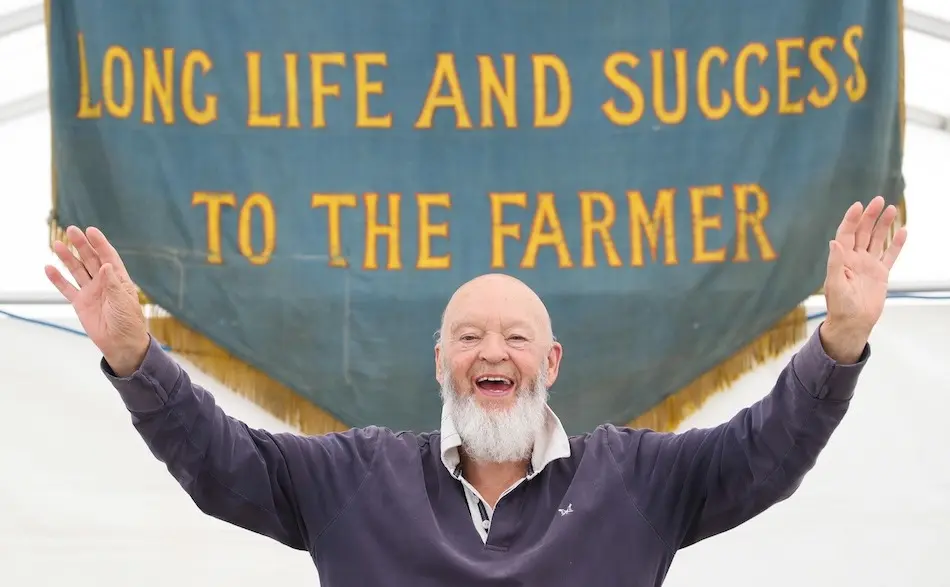
To generations of music lovers, countercultural icons, and dairy enthusiasts alike, the name Michael Eavis is synonymous with the rolling hills of Somerset and the greatest greenfield festival in the world. As the calendar turns to October 17, 2025, Sir Michael—dairy farmer, visionary impresario, philanthropist, and Methodist—celebrates his 90th birthday.
Sitting down for an exclusive interview at his home in Pilton, captured through the lens of photographer Rik Mav, Eavis reflects on a lifetime that defied the humble expectations of a Somerset agricultural upbringing. Far from slowing down, the nonagenarian remains remarkably sharp, active, and deeply engaged in the ongoing narrative of Worthy Farm. Whether discussing the logistics of the upcoming festival fallow year, the widespread commercial availability of Worthy Farm cheddar in major supermarkets, or his enduring commitment to social housing and local philanthropy, Eavis embodies the restless energy that built an empire out of mud, music, and counterculture.
This milestone birthday arrives not just as a personal triumph for a man who spent decades battling local authorities, magistrates, and the police, but as a moment of profound reflection for a global institution. Glastonbury Festival is no longer merely a weekend gathering of hippies and rock fans; it is a cultural touchstone, a political megaphone, and a economic juggernaut that continues to pump millions into charitable causes while anchoring itself firmly in its rural, working-class roots. As Eavis prepares to celebrate his landmark birthday surrounded by family, locals, and his band—with a rumored rendition of Frank Sinatra’s My Way on the setlist—we examine the extraordinary life, trials, and enduring legacy of the man who did it all his way.
Detailed Chronology: From Pilton Dairy to Global Phenomenon
The story of Glastonbury Festival cannot be separated from the geography and history of Worthy Farm. Long before fields echoed with the electric chords of Neil Young or the roar of hundreds of thousands of revellers, Michael Eavis’s life was tethered to the rhythm of agricultural labor and West Country Methodist traditions.
The Early Years and the Spark of 1970
Born in 1935, Eavis’s early decades were defined by the realities of farming life in Somerset. However, the trajectory of his life—and the cultural landscape of the United Kingdom—shifted irrevocably in September 1970. Inspired by an open-air blues festival he attended at nearby Bath University, Eavis paid £1,500 to witness Led Zeppelin perform at the Bath Festival of Blues and Progressive Music. Struck by the communal atmosphere and artistic freedom, he immediately called the festival organizers, secured the contact for group booking agents, and decided to host his own event at Worthy Farm.
The inaugural event, then known as the Pilton Pop, Folk & Blues Festival, took place on September 19, 1970. Charged with an admission fee of just £1—which famously included free milk from the farm—roughly 1,500 attendees gathered to watch T. Rex (who stepped in when headliner Marc Bolan’s band pulled out, though history often misattributes the exact lineup details) perform on a makeshift wooden stage. It was a modest, chaotic, and idealistic beginning. Yet, even in its infancy, the festival captured a zeitgeist that privileged communal living, environmental awareness, and anti-establishment politics.
Navigating the Crucible of Conflict
The decades that followed were far from a smooth ascent. Throughout the 1970s, 1980s, and 1990s, Eavis found himself locked in a persistent, high-stakes battle with local authorities, the Pilton village residents, regional magistrates, and law enforcement.
"I think the main thing is that, in those days, I was always at war with the council and the village and the local magistrates and the police," Eavis recalls, reflecting on the turbulent foundational years. The friction was existential. Tales of injunctions, licensing hearings, and hostile local sentiment are legendary in British festival lore. The hostility reached such a fever pitch that the chairman of the local magistrates delivered a stark, uncompromising warning to Eavis: "If you do this again, you’ve had it."
Yet, rather than folding under pressure, Eavis leaned into the friction. He understood that the struggle wasn’t merely an administrative hurdle; it was the crucible that forged the festival’s gritty, resilient identity. "The fight was really what made it work, there’s no doubt about that. It was certainly worth it!" he notes. Through persistent negotiation, community engagement, and an eventual realization by local stakeholders of the economic and cultural benefits the festival brought to Somerset, the adversarial relationship slowly thawed into a fragile coexistence, and eventually, a deep-seated civic pride.
Supporting Context & Metrics: Milk, Cheddar, and Social Housing
While the festival occupies a massive footprint in the public consciousness—generating headlines across the globe every June—Eavis’s life remains anchored to the dual pillars of agriculture and community welfare. The intersection of his dairy farming business and the global festival brand has yielded unexpected commercial successes that highlight the breadth of his influence.
Worthy Farm Cheddar: From Pasture to Supermarket Shelves
At 90, Eavis still maintains a profound pride in the agricultural output of Worthy Farm. The dairy herd, which forms the literal and figurative foundation of the farm’s operations, continues to thrive. In a modern twist that would have seemed entirely implausible during the countercultural haze of the 1970s, the milk produced on the farm is sent directly to Wyke Farms to craft the official Worthy Farm Cheddar.
The product’s journey from Somerset pastures to national retail shelves is a point of recurring wonder for Eavis. Recalling a trip to Scotland via train, he shares a charming anecdote about spotting the cheese in the wild: "When we got off in Glasgow, there was a Co-op shop just over the road. So I decided to pop across just to see if they had the cheese… They did! It was all over the shelves! Isn’t that wonderful?" Today, the cheddar is available in hundreds of shops across Britain, serving as an everyday commercial bridge between the mythical festival site and the consumer public.
Philanthropy and the Pilton Housing Initiative
Beyond music and cheese, Eavis’s most enduring legacy within his local community may well be his commitment to social housing. Recognizing the crippling housing crisis affecting rural communities—where skyrocketing property prices often price local families out of the villages they grew up in—Eavis spearheaded a visionary social housing project in Pilton.
To date, 52 social houses have been built in the village to ensure that local people can afford to remain rooted in their community. The project has garnered national praise, earning validation from high-profile figures such as former England footballer and broadcaster Gary Lineker, who visited Pilton to open the homes and produced a widely circulated documentary piece highlighting their profound social impact.
For Eavis, this initiative represents a deeply personal fulfillment of values instilled by his upbringing. "I think my mother would be proud of me for the houses too," Eavis reflects. "They look lovely on a sunny day. I drive that way out of the village, you know, and I see the sun shining out on them and think, ‘How did all this happen?’"
Official Statements & Reflections: The State of the Festival
As Glastonbury enters a designated "fallow year"—a mandatory environmental break designed to allow the dairy farm land to recover and regenerate—Eavis is far from idle. True to form, his calendar is filled with creative collaborations, site visits, and forward-planning.
Creative Collaborations and the Fallow Year
Despite the absence of a festival gate in 2025, the infrastructure of imagination never sleeps at Worthy Farm. Over the past week, Eavis held meetings with key creative masterminds behind the festival’s most spellbinding immersive environments, including Joe Rush and the kinetic engineering team behind Arcadia.
"We’re keeping busy," Eavis notes with characteristic enthusiasm. "I’ve seen both Joe Rush and Arcadia in the last week, which gave me great pleasure as I still really enjoy working with such creative people." This ongoing dialogue ensures that when the gates finally reopen, the festival will continue to push the boundaries of large-scale public art and immersive theatre.
Political Activism and the Methodism Connection
When asked about the secret to the festival’s longevity and its uncompromising political edge, Eavis points directly to his foundational worldview. Glastonbury has consistently served as a platform for global activism, partnering with organizations like Greenpeace, WaterAid, and Oxfam, while giving voice to anti-war movements, environmental campaigns, and human rights advocacy.
Asked if his Methodist upbringing is the key to this moral compass, Eavis answers without hesitation: "I’m sure it is." This ethical framework has ensured that the festival is never merely an exercise in commercial entertainment, but a moral gathering place where music, conscience, and community intersect.
Future Outlook: A Legacy Set in Stone
As Sir Michael Eavis looks toward his tenth decade of life, the question of legacy naturally arises. Over more than half a century, he has transformed a 1,500-person gathering in a Somerset dairy field into the premier cultural institution on the planet. Millions of pounds have been channeled into charitable endeavors, local families have been secured permanent housing in Pilton, and generations of music fans have shared moments of transcendent communal joy under the Somerset skies.
Even with the festival’s current capacity, Eavis acknowledges the staggering demand: "At this point, it feels like you could put a million tickets on sale and they’d still sell out. They probably would!" Yet, despite the corporate scale and global prestige, the soul of the festival remains stubbornly local, rooted in the dirt, the grass, and the persistent vision of a dairy farmer who refused to back down.
When asked to name his favorite edition of the festival since its inception in 1970, Eavis offers a response that encapsulates his forward-looking philosophy: "I always think that the most recent one is the best one. I really do." For 2025, his musical highlight remains Neil Young’s spellbinding Saturday night headline performance—a testament to an enduring love affair with great songwriting and raw, unvarnished performance art.
The Birthday Celebration
True to form, Eavis’s 90th birthday celebration will not be a stiff, black-tie gala in London, but a community affair held right in Pilton, surrounded by family, old friends, and local residents. True to his showman spirit, he plans to take the microphone and perform three songs with his band—keeping the specific setlist a closely guarded secret, though industry wagers heavily favor a defiant, triumphant airing of Frank Sinatra’s My Way.
Looking back at a life defined by stubborn resilience, agricultural labor, artistic radicalism, and community care, Eavis can look out across the sunlit social housing of Pilton, across the green expanses of Worthy Farm, and across a global cultural landscape shaped entirely in his image, and ask the question that hums quietly beneath it all:
“How did all this happen?”
For the millions who have walked its fields, danced in its mud, and found community in its chaos, the answer is simple: Michael Eavis did it his way.